

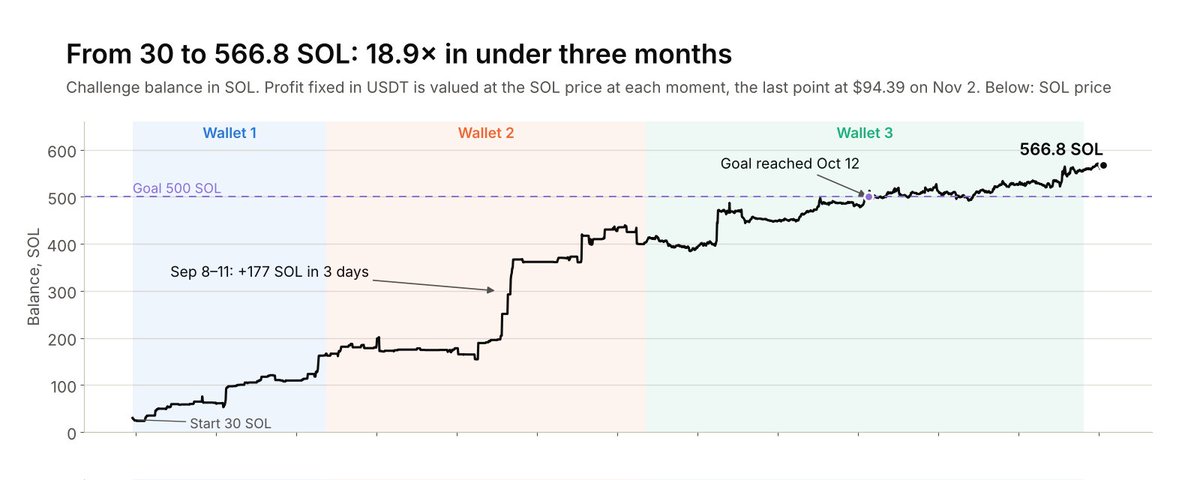
Meteora DLMM LP | 30 → 567 SOL in 83 days On-chain breakdowns of real strategies Fee scalping & risk management systems
Joined February 2019
- Tweets4.8K
- Following358
- Followers1.5K
- Likes2.7K



What's next? 100 → 1,000 SOL Challenge
While the market is bleeding, I've been thinking about my next moves.
I barely spent any time LPing in November. There were plenty of other things I needed to take care of, and I've also been actively developing new tools.
Starting in December, once I move to another country, I'm planning to get back into LPing more actively and potentially launch a new challenge:
100 → 1,000 SOL 🚀
I'm also planning to launch a separate, fully automated LP challenge a bit later. It'll be interesting to see how an automated strategy performs on its own.
Of course, I could be wrong, but I have a feeling we might be approaching a good time for memecoin activity to pick up again.
I'm not expecting anything like the summer season across multiple chains, at least not right away.
But I do think we'll see some signs of recovery over the next few months.
For now, I'm building, preparing, and waiting for the right opportunities.
🤖 Made with AI

I went through three months of LP trades
RWA accounted for:
• 30% of total LP profit
• 5% of all positions
• 9% of total liquidity deployed
tokenized stocks, pre-IPO and other assets. but not all of them made money
what caught my attention more than the profit itself: three assets generated 87% of the RWA result
solana:oPAiAikWTaFj9RYoRFD35ccfwhnMcB3ThgBZRHSkjTZ: +55.4 SOL
solana:Xs2yquAgsHByNzx68WJC55WHjHBvG9JsMB7CWjTLyPy: +34.5 SOL
solana:BABANGA4JE7Kkam4nTrALAwAVgsNJUuFJnnkF7S16BZp: +19.6 SOL
these positions weren’t held for weeks either
the median hold time was 23 seconds
it’s the same active fee farming as on memecoins
and there’s a very specific problem: many pools are empty. 39% of positions earned almost nothing
in October, trading activity in the selected pools practically disappeared
I’m interested in the moments when volume flows into RWA, while liquidity still allows you to capture a meaningful share of the fees
full stats in the article below
🤖 Made with AI


69% of my most profitable positions were re-entries
usually just 3 seconds after closing
here’s how narrow one-sided Spot works:
all SOL (or USDC) goes into the active bin and a few bins below
price moves up → the range gets left behind, I’m 100% in SOL and only lose network fees
→ I close and reopen higher, usually within 3 seconds
price stalls → sellers fill my bins, and fees cover the price loss
price breaks down → I exit immediately and sell the token
numbers across 541 positions:
- re-entries: +210.3 SOL
- first entries into a pool: just +26.5 SOL
- 3–5 bins: +177.8 SOL
- 1 bin: −9.6 SOL, the only unprofitable width
the edge isn’t in the first entry. it’s in staying close to the price while there’s still volume
full analysis in the article below


$MIHAO: 5 DAYS, 68 POSITIONS, +41.4 SOL
Between Nov 10 and Nov 15 I farmed MIHAO across 4 Meteora DLMM pools:
• Net: +41.4 SOL
• Fees earned: +58.8 SOL
• Price impact: −17.4 SOL
• 3,767 SOL of volume through my positions
• 38 positions that actually traded: 27 green, 11 red
By pool:
• bin 25 → +25.6 SOL (13 of 15 green)
• bin 100 → +7.0 SOL
• bin 20 → +6.8 SOL (one position still open, +14.2)
• bin 80 → +2.0 SOL
What worked
Mostly one-sided Spot: SOL only, from the current price down to about −20%. Some positions lasted minutes, during the heaviest volume spikes. Others I held for days: one stayed open for 3.6 days and earned 10.9 SOL in fees, another has been running for 1.5 days and is up +14.2 SOL. The dips kept refilling the range and turning into fees.
Once I flipped and rode the pump with a token-side Bid-Ask: 218k solana:4CxjZyMNoF1p6eXHXHv1TWpS2X47CuUmLwtGe18spump sold into strength over ~9 hours. +22 SOL from one position, the best trade of the run.
What didn't
After that ride I got too bullish. I parked 150k+ MIHAO in a range above the price and held it for over 2 days. It sat out of range, earned nothing, and lost to the price: −13.7 SOL. That one decision cost a third of what the fees made.
The lesson is the same as in the article: the strategy pays when you farm volume, not when you bet on direction.
Why I'm watching MIHAO
I think this token is a sentiment gauge for the whole meme market right now.
If it keeps climbing, I expect memes to wake up. If it starts bleeding, it will deepen the negative mood that's already there.
Either way, I'll keep farming it, one-sided.


MetaTrader 🐂🀄️ retweeted

I LP blue chips. My positions stay open for weeks. Sometimes I forget they exist 😅
Meanwhile this guy runs positions that last under a minute and re-opens 3 seconds later. 1,910 of them in 83 days, 30 → 566 SOL
And he doesn't click a single button: his own software opens, claims fees every ~13 seconds, closes and re-opens
I read all his articles.
Rare to see someone share the losses this openly, so thanks for that 🙏
Then ran his wallets through SolMapper, a side project of mine
What hit me most: it's not about picking the right token. It's speed, a clear exit, and a bot that doesn't hesitate when the pump or the dump starts
Doing this by hand looks like a great way to donate your SOL 🙃
Only one of my LP strategies made money whether SOL was falling, flat or pumping: wide one-sided Spot.
+48 / +48 / +44 SOL across all three.
But it was the top strategy in only one of them. I split 1,910 positions from my 30→500 SOL challenge by how SOL had moved in the 7 days before each entry:
SOL falling → narrow Spot led: +62.2 SOL, PF 5.8
SOL up 0–7% → narrow Spot led: +180.4 SOL, PF 13.8, 78% win rate
SOL up 7%+ → wide Spot led: +43.5 SOL, while narrow went negative (PF 0.91)
Narrow is the engine. Wide is the one that never broke
HOW AI CAN HELP YOU WITH LP
closed positions showed +189 SOL, the balance only grew +137.4
this is not a counting error
52 SOL disappeared between closing the LP and swapping tokens back to SOL: slippage and price change
the position is already "closed in profit" but part of the money never reached the balance
no standard tracker shows this leak so clearly
I didn't find it by hand, I found it by asking the on chain data through Claude Code + Helius:
how much actually came into the wallet, how much went out and why that differs from position pnl
with the same setup I broke down 1,910 positions from the 30 → 566 SOL challenge , without writing a single line of code
any wallet, mine or someone else's, in a couple of minutes
on the surface it's just a report: win rate, profit factor, widths, drawdowns
the alpha is in the questions you ask after:
which range width gave the best profit factor?
what do the worst trades have in common?
why do holds over 10 minutes and pools with 5%+ fees end up in the red?
from these questions came my working rules: narrow ranges beat wide ones, a bin step with a 7–9 profit factor and what you don't see in a green pnl
so before you copy a wallet or size up your own setup, the question is not "what's the pnl"
it's "how much of that pnl did the wallet actually keep"
I've heard you can put the same setup on your current positions through the LP Agent API + Claude
but I haven't personally tested the difference or what exactly you can use the LP Agent API for
if you're interested in this topic, how and where you can actually use AI in LP
just leave any reply, that's how I'll know you want more of it
you don't need to be a developer
you need to know which questions to ask


MetaTrader 🐂🀄️ retweeted
Been farming solana:4CxjZyMNoF1p6eXHXHv1TWpS2X47CuUmLwtGe18spump since yesterday.
Tried a few different strategies: two-sided Spot, short-duration positions, and one-sided Bid-Ask above the price.
One thing is clear: longer-duration positions work much better on this token.
My best results came from an upward Bid-Ask on the 25 / 0.25% pool.
Most of the volume has already shifted to the 20 / 0.2% pool, so I'm waiting for a pullback to look for another entry.
I expect they'll keep pumping it leading up to Breakpoint.
This market desperately needs some positivity, even if it's just a local rally. 🫡
🤖 Made with AI
The single strategy that generated 56% of all profit in my 30 → 566 SOL challenge
a median hold time of just 25 seconds
While Two Sided Spot was my favorite, Narrow One Sided Spot (1–11 bins funded quote only) was the absolute growth engine: 541 positions across 103 pools.
Raw On Chain Data:
- Net PnL: +236.7 SOL (439.2 SOL in fees)
- Win rate: 68.2%, 1.02% avg return per trade (1.49% in SOL pools, 2.6x higher than wide ranges)
- Execution speed: 25s median hold
- Pool split: 386 trades in memecoin SOL pools (median size ~20 SOL) and 155 in major USDC pools (ORE, AAVE, AVAX up to 329 SOL size)
The Core Mechanics:
Deposit quote only (SOL or USDC) into the active bin and 3–5 bins directly below the market price
- Price pumps: the range gets left behind instantly, closing 100% in quote asset. Downside risk is exactly $0. 315 positions were left behind and still made +111.5 SOL in fees.
- Price pauses/dips: sellers fill your bins, paying massive swap fees. During consolidation, fees drastically outpace impermanent loss.
Key Edge / Data Anomalies:
1. The 1-bin trap: 119 single bin trades were net negative. The real sweet spot is 3–5 bins: +177.8 SOL with a ridiculous 10.47 profit factor.
2. The 30s–3m window: 220 trades in this duration generated +159.4 SOL. Under 15s price runs away too fast; holding past 3m invites severe dump risk.
3. Token inventory on close: closing with 25–75% token yielded +116.2 SOL (~5% per trade). Closing with >75% token (dump slicing through) lost -59.7 SOL across 52 trades.
4. Fee tiers: 1% fee pools printed +143 SOL. 2% and 5%+ pools barely broke even.
The Execution Playbook:
1. Trade only live runners with aggressive volume (in quiet October, fee capture collapsed to 0.7% and the strategy went flat).
2. Set 3–5 bins strictly below price.
3. If price breaks out upward, close and re-open higher immediately (re-opens generated +210.3 SOL vs +26.5 SOL on first entries).
4. Take profit during the pause (±2% price consolidation yielded +192.5 SOL).
5. If price breaks downward through your bins, close immediately and market sell the token.
MetaTrader 🐂🀄️ retweeted
TWO-SIDED SPOT: 279 POSITIONS, +91 SOL, 29% OF ALL FEES
My favourite DLMM strategy. I pulled every position from on-chain data.
vs one-sided Spot:
▶ 3.6× more fees per trade
▶ 2× higher net return per SOL deployed
▶ 71.3% win rate, 2.3 min average hold
The catch: holding tokens makes losses bigger. Just 13% of trades (20%+ dumps) ate two thirds of everything the strategy earned.
In the full breakdown:
▶ how I enter (and why 96% of positions start the same way)
▶ ratio, range and the dip cushion
▶ what auto-reinvest really does
▶ the SOL filter that tells me when NOT to use it
Full article👇