

Energy & Climate - science, technology, policy, economics & law. Innovation & optimism, not habit & fear. Adjunct Prof of Energy, @JHU
Maryland, USA
Joined April 2009
- Tweets2.3K
- Following225
- Followers1.3K
- Likes1.6K
6. Only about one-quarter of U.S. oil production occurs on federal/public lands, most of it offshore. However, onshore oil production on federal lands has tripled in the last decade.

5. The U.S. is a net exporter of oil. In 2005 & 2006, the U.S. net importer (60% of the volume of petroleum products provided to consumers) while in 2022 it was a net exporter (6% of the volume of petroleum products provided to consumers).

3. The U.S. is the largest oil producer in the world, well ahead of Saudi Arabia and Russia. Again, note the increase after 2008 because of fracking.

It is amazing how little most people know about the basics of oil in the United States. A few fundamentals for the interested. 1. Oil production in the U.S. is at record levels (still slightly below pre-pandemic levels)

A big part of the situation in Texas is a dramatic fall in gas production (because of freezing in and around wells) causing gas-fired power plants to reduce or stop generating power. These two graphs from this week's @EIAgov's Natural Gas Weekly Update illuminate the situation.


A 2011 winter storm resulted in electric power outages for 3.2 million Texans. Recommendations to avoid a repeat were largely ignored. The fundamental failure is not about energy sources, energy mix, or technology, it is a failure to prepare. ferc.gov/sites/default/files…

Yes. More generally, it is the greater use of lower quality (lower energy density) sub-bituminous and lignite coal compared to higher quality (higher energy density) anthracite and bituminous coal. The rise of sub-bituminous coal from the Powder River Basin is very notable.

Yes. Important to recognize that some data includes/exclude certain related jobs - esp. related to transportation and at powerplants are often overlooked. And, of course, to compare coal employment numbers to wind and solar jobs - and even non-energy employers like UPS or Walmart
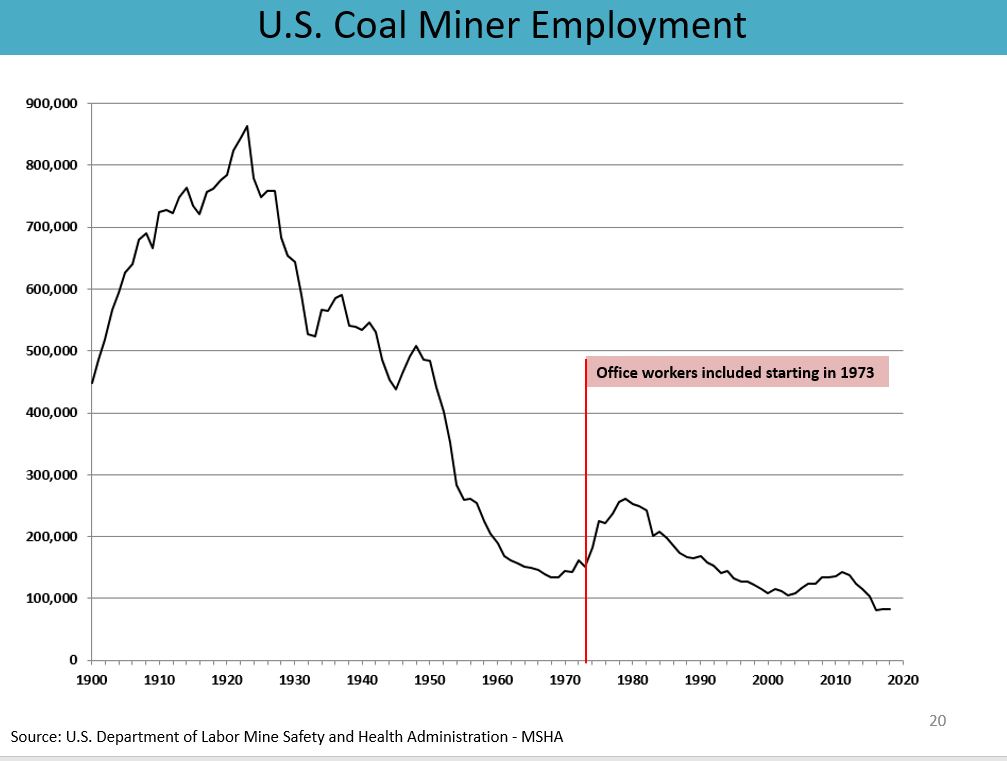

A little nuance. While this is true for primary energy from coal, the tonnage of coal produced is just back to the 1965 level of consumption. This is because the primary energy obtained per ton of coal has dropped by about 21% since 1965.

Another 13% drop in the cost of lithium-ion #batteries in 2020 shows that economics is lining up to support the transition from petroleum-based internal combustion engines to #ElectricVehicles. There are other factors (e.g. changing stations) but change is unavoidable.
