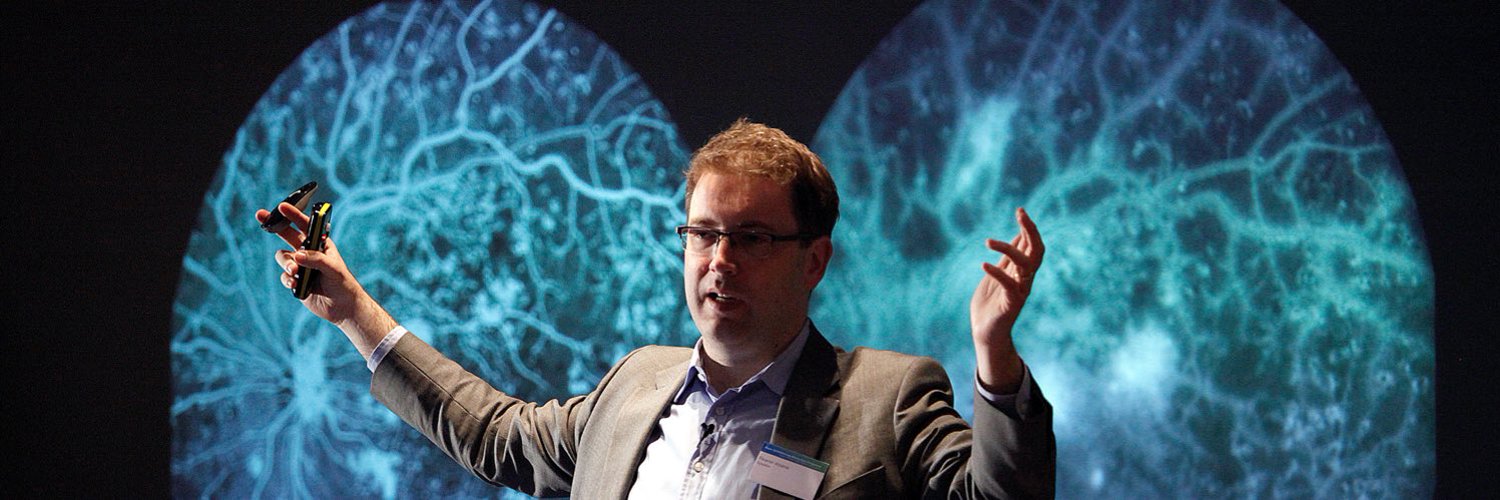

UKRI Future Leaders Fellow, Institute of Ophthalmology, UCL @UCLEye and Moorfields Eye Hospital NHS Foundation Trust @Moorfields; Director @INSIGHTEyeHub 🇮🇪
Joined March 2011
- Tweets5K
- Following1K
- Followers5.1K
- Likes31.2K







Pinned Tweet
Check out #MyYearInBooks @goodreads to discover the 64 books I read in 2024!
goodreads.com/user/year_in_b…
Pearse Keane retweeted

Since we launched SovAI 6 months ago, we have invested in over a dozen British AI companies, designed and launched a unique procurement scheme to make Government a better customer - with over 100 companies now in that process - and have supported entrepreneurs voices in Govt on everything from non-competes to essential data access.
It’s great to have an additional 25% funding to expand our areas of focus to include industrial applications of AI, and buy more services from British start-ups in particular in cyber security.
Here’s to an even bigger next 6 months - so much more to do.

We’re excited to announce an additional £120m for Sovereign AI to back the future of AI in Britain.
An extra £60m to invest in the UK’s most promising AI companies, expanding into Physical and Industrial AI.
And £60m more for R&D procurement, backing innovation in areas such as AI security and AI for healthcare.
We want to help founders start and scale in Britain, and turn innovation into impact.

ALT Sovereign AI logo £120m new funding £60m more to invest in the UK's most promising AI companies £60m more for our R&D Procurement Scheme
Pearse Keane retweeted

Is a medical image like a social security number?
Retinal autonomous AI has been at the forefront of medical AI: regulation, reimbursement, ethics, and adoption. Now, retinal images are again at the forefront of concerns, about privacy and confidentiality of medical data. Multiple US States have enacted laws specifically calling out restrictions on retinal images. And the considerations used for considering retinal images, as personally identifiable information, apply as well to all medical images. This may well be a harbinger of more to come, which may make it difficult to impossible to do medical research or build AI.
Whether right or wrong, it is important to understand where these concerns are coming from.
We studied how retinal images have been depicted in art historically. Our paper just came out, and the results show that almost all (>98%) descriptions of retinal imaging are negative, and describe surveillance and dread. Very few are positive or medical.
sciencedirect.com/science/ar…
@pearsekeane
Pearse Keane retweeted

Gemini 4 Argon is a step change in model performance.
In recent weeks, it has had a transformative impact on the Science projects in our team at @GoogleDeepMind and our external collaborators, and helped make a number of remarkable advances across scientific disciplines. 🧵👇
Pearse Keane retweeted

🌍𝗠𝗲𝗱𝗶𝗰𝗮𝗹 𝗔𝗜 𝘀𝗵𝗼𝘂𝗹𝗱 𝗯𝗲 𝗲𝘃𝗮𝗹𝘂𝗮𝘁𝗲𝗱 𝗶𝗻 𝘁𝗵𝗲 𝗹𝗮𝗻𝗴𝘂𝗮𝗴𝗲𝘀, 𝗰𝗼𝗺𝗺𝘂𝗻𝗶𝘁𝗶𝗲𝘀 𝗮𝗻𝗱 𝗵𝗲𝗮𝗹𝘁𝗵 𝘀𝘆𝘀𝘁𝗲𝗺𝘀 𝘄𝗵𝗲𝗿𝗲 𝗶𝘁 𝘄𝗶𝗹𝗹 𝗮𝗰𝘁𝘂𝗮𝗹𝗹𝘆 𝗯𝗲 𝘂𝘀𝗲𝗱.
Delighted to announce the launch of #MAGIC (𝗠𝗲𝗱𝗶𝗰𝗮𝗹 𝗔𝗜 𝗚𝗹𝗼𝗯𝗮𝗹 𝗜𝗻𝗶𝘁𝗶𝗮𝘁𝗶𝘃𝗲 𝗮𝗻𝗱 𝗖𝗼𝗹𝗹𝗮𝗯𝗼𝗿𝗮𝘁𝗶𝗼𝗻) introduced in our new @NaturePortfolio @NatureMedicine correspondence.
📜MAGIC paper: nature.com/articles/s41591-0…
🔗MAGIC website: magic-ai.health/
MAGIC brings together clinicians, AI researchers, policymakers, industry stakeholders and local experts to address a critical question: does strong benchmark performance translate into safe, useful support across diverse healthcare settings?
Our initial priorities are:
✅ A global health LLM evaluation benchmark addressing multilingual coverage, regional disease burden and sociocultural adaptability.
✅ A global deployment reporting standard clarifying intended use, target users, healthcare settings, and performance and safety across populations.
Thank you to our colleagues #worldwide for helping launch the network. 𝗢𝘂𝗿 𝗴𝗼𝗮𝗹 𝗶𝘀 𝘁𝗼 𝘂𝗻𝗱𝗲𝗿𝘀𝘁𝗮𝗻𝗱 𝘄𝗵𝗲𝗿𝗲 𝗺𝗲𝗱𝗶𝗰𝗮𝗹 𝗔𝗜 𝘄𝗼𝗿𝗸𝘀, 𝗳𝗼𝗿 𝘄𝗵𝗼𝗺, 𝗮𝗻𝗱 𝘂𝗻𝗱𝗲𝗿 𝘄𝗵𝗮𝘁 𝗰𝗼𝗻𝗱𝗶𝘁𝗶𝗼𝗻𝘀.
#MAGIC #MedicalAI #AI #LLM #GlobalHealth #ResponsibleAI #HealthEquity #DukeNUS @dukenus

Pearse Keane retweeted

NEW Viewpoint: The clinician–artificial intelligence scientist: a proposed career pathway in medicine.
Read it here: thelancet.com/journals/landi…

Pearse Keane retweeted
AI is a big W for 40-somethings. Old enough to have learned how to do things the right way, young enough to learn some new tricks.
Pearse Keane retweeted

The retinal image can detect risk of atrial fibrillation years before it shows up @PLOSDigiHealth
Another example of opportunistic AI detection in ~90,000 people from 2 cohorts
journals.plos.org/digitalhea…
eyewire.news/news/moorfields…


Pearse Keane retweeted
When it comes to assessing AI for patients, critical factors like trust and safety have been largely ignored. From a systematic study of 330 reports
nature.com/articles/s44360-0…

Pearse Keane retweeted
Our new paper on consumer AI for healthcare : it's not just about model quality and benchmarks
Assessment of @OpenAI @AnthropicAI @Amazon @AntGroup patient-facing health AI systems
w/ @pearsekeane, Yilan Wu, Alvin Liu
nature.com/articles/s44360-0…

Pearse Keane retweeted

Delighted that THE INFINITY MACHINE, my biography of Demis Hassabis, has made the long list for the Financial Times book prize.

Another one to add to my Amazon list 👇

No plan survives the first five minutes five minutes of contact with reality. How do we deal with what comes next? My new book MINUTE SIX. A survival guide for an increasingly volatile, uncertain & complex world amzn.eu/d/09A238Sh

2
5
1,424
Pearse Keane retweeted

We’re excited to announce DiG-bench, a new benchmark for discovery!
Over the last few weeks we’ve been testing frontier AI models on our novel discovery games and seeing how they score. Each game is a text-based environment, so they probe discovery capabilities in the natural domain of language models, rather than requiring additional, potentially confounding, visual understanding.
TL;DR frontier models have improved a lot over the last few months. But they are still stumped by some surprisingly simple problems, even in their native text domain.
With
@cocosci_lab (@Princeton) @MITCoCoSci (@MIT) @SchmidhuberAI (@KAUST_News) @misovalko (@Inria) @tri_dao (@PrincetonCS) @RMBattleday @zebkDotCom @FraserGreenlee @akaijsa @ClareMaguire @TimMuller1 @kubicek_ales @physicscat0x7d @SukritSumant @thoughtchannel_
(1/5)

Short public service announcement 😀

Planning to watch tonight’s solar eclipse? 🌒
@PearseKeane from @Moorfields Eye Hospital has shared an important warning - never look directly at the Sun with the naked eye.
It can cause serious and potentially permanent damage to your eyesight.
6
425
Pearse Keane retweeted

👋 it’s summer time in New Palo Alto :)
open.substack.com/pub/artica…
Pearse Keane retweeted

Announcing Discovery Loop!
I am very excited to announce that, along with my longtime friends and collaborators @Sanjay_Ghemawat, @OriolVinyalsML and @quocleix, we are founding Discovery Loop (@DiscoLoopAI), a Public Benefit Corporation whose mission is to automate machine learning, science, and engineering to accelerate discoveries and progress. The four of us have worked together for 14 to 30 years, and have helped build some of the world’s most used products, infrastructure and AI models, and we’re excited to turn our attention to this ambitious endeavor.
♾
Learn more at: discoveryloop.com


Very cool work @chrisck 🙌

High-stakes decisions with language models
We introduce 'decision-analytic steering' in this study: arxiv.org/pdf/2608.01361
In real-world decisions, different types of errors rarely have equal consequences. So, a system making recommendations under uncertainty must do more than predict what is likely to be true. It must also reflect the relative costs and benefits of acting or failing to act.
As an example, in emergency medical triage, missing a patient who needs immediate care is often far more costly than sending someone to the emergency department who ultimately did not need to go. It's critically important to consider that asymmetry.
We set out to investigate opportunities for decision-analytic steering by generating ROC curves for families of model. These sample curves showing the true positive and false positive rate for two models on a set of emergency medicine triage cases.

6
782
Pearse Keane retweeted

Only about a quarter of human diseases have an approved therapy. By some estimates it's a few percent. Most of those treatments slow a disease rather than stop it.
Closing that gap is what the AI-cures-everything story promises. Build a system smart enough and the cures hidden in what we already know will fall out. I have worked at the intersection of machine learning and biology for three decades, and I believe #AI will eventually transform human health. The capabilities arriving now are extraordinary. But the promise rests on an assumption that is simply false: that we already understand human biology well enough for a clever enough reasoner to find the answers in it. We don't.
More than 90% of drugs entering clinical trials fail, a number that has barely moved in decades. In the large majority of those failures the molecule was engineered just fine. The mechanism it targeted was wrong. We are doing a pretty good job at manufacturing keys, but they are generally for the wrong locks. And because nobody wants to fail in the clinic, the industry has retreated to the locks it already trusts: 38 targets now have more than 50 programs against each of them, while the number of novel targets advanced per year fell from roughly 100 in 2015 to about 30 in 2024.
AI will not reason its way past this. Biology wasn't engineered. It is the product of billions of years of messy, stochastic evolution, and the variation that produced is too vast and too idiosyncratic to work out in the abstract. You have to measure it. Aimed at a biology this thinly sampled, AI will mostly help us generate failures faster.
I founded @insitro because getting to the right locks requires a different kind of system. We generate multimodal human and cellular data at scale, use machine learning to find causal drivers of disease, and test those hypotheses experimentally. Virtual Human™ is built for causal discovery; TherML™ turns what it finds into the right therapeutic intervention. It is working: first-in-class programs internally and with partners, three #ALS targets that Virtual Human™ identified and @bmsnews nominated, and additional collaborations with @EliLillyandCo and @GileadSciences .
Today we are launching Deep Phenotype: Scaled Biology, Deep Causality. Issue one is "Drug Discovery Has No Magic Wands," the first half of a two-part essay on the magical thinking currently running through our field and what I think it will actually take. After that you will hear from insitro's own scientists and engineers, people who work across computation and experiment because the problem requires both.
Getting this right is hard, and we do not have all of it worked out. I hope you will follow along and think it through with us.
DeepPhenotype.Substack.com

Pearse Keane retweeted

Last week, @sci_works & @wellcometrust hosted a group of fifty scientists, policymakers, & funders to discuss whether we have the right mix of scientific organisations in Britain, & if not, what can be done 🏗️
We polled attendees to gauge the mood. Here are the results 🧵...

