

C.E.O at Corporate Staffing Services| HR Consultant| Certified Trainer| Email [email protected]
Nairobi, Kenya
Joined July 2014
- Tweets3K
- Following265
- Followers3.4K
- Likes701







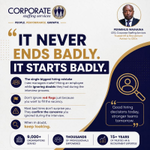


Why losing your job at 42 is different from losing it at 25.
Losing your job at 25 is stressful. But losing it at 42? That's a different kind of stress altogether.
Here is why.
1. Your financial responsibilities are much bigger.
At 25, you might be paying rent, supporting yourself and figuring out life. At 42, you could have school fees, a mortgage, rent, car loans, ageing parents and a family depending on your monthly salary.
Your salary may stop, but the bills don't.
2. You have less room to experiment.
At 25, you can take a lower-paying job, move back home, change careers or try something completely different. At 42, taking a 40% pay cut is not just a career decision. It affects your entire household.
3. The job market can be less forgiving.
You may have 15 or 20 years of experience, but that doesn't automatically make finding another job easier. Senior positions are fewer, competition is stiff, and some employers may question your salary expectations or consider you overqualified.
4. Starting again can feel like going backwards.
Imagine spending 18 years building your career, earning promotions, managing teams and establishing yourself professionally, only to find yourself applying for jobs alongside people who are much younger.
It can be a difficult pill to swallow, especially when you know what you bring to the table.
5. You carry the pressure quietly.
At 42, people look up to you. Your children expect stability. Your family depends on you. You may not even feel comfortable telling friends that you are unemployed.
So you smile, attend to your responsibilities and privately worry about where the next salary will come from.
6. Your professional identity is deeply tied to your career.
After years of being a manager, director or head of department, losing your job can affect more than your income. You lose your routine, sense of purpose, professional standing and sometimes even your confidence.
7. You have less time to rebuild your retirement plans.
At 25, you have decades to recover financially. At 42, you are probably thinking about university fees, retirement savings, investments and whether you will ever be financially comfortable.
Every year without income feels more expensive.
But here is the thing.
Losing your job at 42 does not mean your career is over. Your experience, relationships and professional knowledge still count.
However, it is a reminder that you cannot afford to take your career for granted.
For those in their 40s, what scares you most about losing your job at this stage of life: the financial responsibilities, the job market or having to start again?

The experienced professional nobody wants to hire.
You're 45. You have 20 years of experience.
You've managed teams, handled budgets, led departments and delivered results.
You know your industry. You have the qualifications. You have a track record.
But you've been job hunting for six months.
You apply for senior positions. Some employers don't respond. Others invite you for interviews, only to tell you they want someone "more flexible", "more adaptable" or with "a different energy".
You start wondering what is wrong.
The reality is that the job market can be particularly difficult for experienced professionals.
Some employers want 15 years of experience but have a salary budget of 5 years of experience.
Others want a senior manager who can fix problems, lead teams and deliver results, but don't necessarily want to pay for that level of expertise.
Then there is the issue nobody wants to discuss openly: age.
Some employers worry that you are too expensive. Others wonder whether you can work with younger teams, learn new technology or adapt to new ways of working.
And the longer you stay unemployed, the harder things get.
School fees are still due. Rent and mortgage payments don't stop. Your family still depends on you.
You may even find yourself applying for jobs below your previous level because you need an income.
But experienced professionals also need to look in the mirror.
The market has changed. Technology has changed. Business expectations have changed.
Your 20 years of experience matter, but you must show that your skills are still relevant. You cannot rely on what you achieved 10 years ago.
You must keep learning, adapting and demonstrating the value you bring today.
Employers also need to ask themselves a question.
Are we looking for the best person for the job, or are we simply looking for someone younger and cheaper?
Because years of experience can bring judgement, business understanding and the ability to handle situations that cannot be learnt from a textbook.
And that has value.
For professionals in their 40s and 50s, have you noticed that finding a job becomes harder even as your experience grows? What has your experience been?

Why Your Best Employees Struggle as Managers — And What It's Costing Your Organization
You promoted them because they were great at their job.
_But did you prepare them to manage people?_
Too often, a top performer becomes a manager and then:
▪️ Struggles to delegate
▪️ Micromanages the team
▪️ Avoids difficult conversations
▪️ Keeps escalating routine decisions
The result? Lost productivity, frustrated staff and good people leaving.
Join us to find out why this happens and how your organization can fix it.
🗓 Wed, 30th Sept 2026
⏰ 11:00 AM – 1:00 PM (EAT)
📍 Online via Zoom
🎤 Godfrey Wakoli*, Training & Development Manager, Corporate Staffing Services
👥 For CEOs, Business Owners, HR Leaders & Senior Managers
👉 Register here: us02web.zoom.us/meeting/regi…
Limited spaces. Feel free to share with a colleague who manages people. 🙏

181

The Higher You Rise, the More Political Your Job Becomes
Early in your career, being good at your job can take you far.
You know your work. You meet deadlines. You solve problems. You deliver results.
Then you become a Supervisor.
Manager.
Head of Department.
Or CEO.
And suddenly, competence alone is no longer enough.
The higher you rise, the more political your job becomes.

1
139
If you were earning KSh 200K before COVID…
What are you earning today?
KSh 250K?
KSh 500K?
KSh 1M?
Or are you still around KSh 200K?
As an executive recruiter, I’ve noticed something uncomfortable in Kenya’s job market:
For many experienced professionals, salaries have barely moved.
But here’s the interesting part… 🧵

1
273
So if you’re earning KSh 200K+ and feel stuck, don’t just ask:
“How can I get a salary increment?”
Ask a much harder question:
“What would make another employer willing to pay me twice what I earn today?”
Then work backwards.
What skills?
What results?
What exposure?
What responsibilities?
What type of employer?
1
24
Because another 5 years of experience can leave you…
5 years older.
With 5 more years on your CV.
More responsibilities.
More pressure.
More experience.
And almost the same salary.
Don’t let experience accumulate without your market value increasing with it.
Your career should not just get longer.
It should get more valuable.
20

Perminus Wainaina retweeted

A millionaire told me “The Empty Boat Theory”
And I never looked at people the same away again:


