

Tracking the AI buildout by the numbers: chips, power, hyperscaler capex, physical AI & BTC. Charts daily. Commentary, not advice.
Pittsburgh, PA
Joined May 2021
- Tweets229K
- Following4.3K
- Followers3.4K
- Likes357K



Pinned Tweet
Everyone's watching the AI apps. I'm watching the concrete.
The real AI story is fabs, memory, power lines, and data centers going up faster than the grid can handle. Most people only notice when it hits earnings.
So every day I break it down by the numbers. One chart. A source in every post. No hype, no hopium. And I'll tell you when I'm wrong.
Here's the deal: drop the one AI bottleneck you think the market is sleeping on 👇
I'll chart the best answers this week and tag you.
Follow if you want to see the buildout before it's in the headlines.
33
Fifty-two percent of fund managers now expect a hyperscaler capex cut in the next six months. That's Bank of America's November survey. The companies haven't flinched.
So who do you believe?
Source: BofA Global Fund Manager Survey, Nov 2026
Commentary, not advice.
28
411 days.
That's how long Bitcoin has gone since its $126.2K peak (Oct 6, 2025). This morning it printed a fresh cycle low near $55.3K, then snapped back above $60K.
Line it up against the last three bears (peak to bottom):
• 2013–15: −87% in 406 days
• 2017–18: −83% in 364 days
• 2021–22: −77% in 378 days
• Now: −56% at today's low, day 411 and counting
So this is the shallowest drawdown of any cycle, and already the longest clock. Every prior bottom landed between day 364 and day 406. We just ran past all of them.
My read: the four-year-cycle playbook can't be right on both depth and timing this time. Either the floor is still lower, or ETFs and treasury buyers have stretched the cycle into something slower and shallower.
Cost of finding out overnight: $2.67B liquidated across crypto in 24h (Coinglass), overwhelmingly longs.
Which pattern breaks first, the depth or the timing? Drop your answer and I'll chart the replies.
Commentary, not advice.
25
Bitcoin and gold falling together this year tells you the real trade: rates, not debasement.
Gold hit $3,830.74 on Nov 16, down 31.5% from its $5,594.82 January record (Reuters), with the dollar near its highest since April 2025 and markets pricing a December hike. Both "hedges" lose when real yields rise, because neither pays you to wait.
The second-order effect: if the Fed blinks in December, the two worst assets of 2026 could have the most fuel. If it hikes, there's no hiding spot.
Which one bounces first, BTC or gold?

Bitcoin (-33%) and Gold (-19%) are the two worst performing major assets so far in 2026. This is something we haven't seen before in any calendar year.
bilello.blog/newsletter

15

Nvidia printed a record quarter and lost ~$901B in a week.
My take: the market isn't pricing AI demand anymore. It's pricing trust.
What breaks first?
0%Nvidia bounces hard
0%More downside first
0%Rotation to power & grid
0%Memory takes the crown
0 votes • 17 hours
The AI buildout is paid for.
Oracle says its $300B OpenAI contract is fully funded. Korea's DRAM exports hit $23.4B in 20 days, +574% y/y. The Senate passed permitting reform.
Prices fell. Forecasts rose.
What breaks the bear case first?
1/5 Oracle just confirmed its $300B OpenAI contract is fully funded, vendor financing included. The biggest AI buildout deal in history is not a hope, it is paid for.
38
1/5 Oracle just confirmed its $300B OpenAI contract is fully funded, vendor financing included. The biggest AI buildout deal in history is not a hope, it is paid for.
4/5 And the science keeps compounding. Isomorphic Labs just raised a $5B Series C, six months after a $2.1B round, to push AI drug discovery further.
1
11
$20B raised. "Fully funded."
Oracle answered the AI buildout's biggest question at 4:01 PM ET Friday, one minute after the close: its OpenAI contract is fully funded. It calls itself the first hyperscaler fully funded for this investment cycle.
What it said:
• Final raise done: about $20B, roughly half stock, half debt (Reuters)
• Vendor financing from Investor Day is in place
• Abilene campus nearly complete
• Shackelford, the next gigawatt-scale site, fully permitted
• Nvidia Vera Rubin rack handover on track for the coming weeks
• Positive free cash flow expected in 2H FY2028, >$30B targeted in FY2029, self-funding growth from then
Why it matters on a day chips fell 10%: this month's bear case on the buildout hasn't been demand. It's been who pays. ORCL closed at $101.19 before the statement, down 8.5% on the day and 21% since Nov 11. It rose as much as 3.3% after hours.
Funded isn't built. The test now is delivery: racks handed over, gigawatts energized, and the cash-flow turn arriving on schedule.
If financing stops being the worry, is power the next bottleneck the market prices?

30
My week, graded: 3 right, 2 wrong, 1 split.
Misses first.
I said Nvidia's quarterly step-up was shrinking. It wasn't. Q3 revenue added $19.6B ($96.2B → $115.8B), its biggest quarterly add yet, and the $130B Q4 guide adds another ~$14.2B. Wrong on the numbers.
The morning after the print, I wrote that demand, supply and power were all moving the same way. The fundamentals were. The stocks weren't: S&P −8.6% on the week, Nasdaq about −10%, and the SOX −10.73% on Friday alone. I read the reports right and the tape wrong.
What held up:
• Financing over the guide. Before the print I said Nvidia's financing commentary mattered more than the $108B guide. It beat and guided $130B, and the stock still lost 23% on the week. On the call, Kress said Nvidia will be "disciplined and selective" with neoclouds.
• BTC as high-beta risk, not a hedge. ~$59.0K Friday, −4.7% alongside a −5.28% Nasdaq, after a $582M spot ETF outflow on Nov 19.
• Hike risk. My week-ahead asked how much support for hikes was already in the room. Today Gov. Cook said she dissented in October for tighter policy, and Dec 8–9 hike talk is live.
The split: Anthropic. Demand held through Nvidia week. It priced at $83, above its $70–78 range, and closed day one +17% at $97.17. Then it slid to near $87, ~22% below its $111.50 open.
Lesson: a beat doesn't fix a governance and financing problem. This week the market priced the boardroom and the balance sheet, not the income statement. Next week I'm weighting credit and governance signals ahead of revenue lines.
What did you get wrong this week?

1
38
Prices fell. Forecasts rose.
Analysts raised tech earnings estimates ~17% in about 3 months (Truist), and S&P 500 tech now trades below the S&P 500 on forward P/E for the first time since 2017, down from 32x at the Oct 2025 peak.
Second-order: the buildout's valuation got cut in half while its profit forecasts climbed.
Which shows up first: Q4 capex guides or cash flow?
80
Wall Street just lent ~$32B against Nvidia chips, and charged more for it than for lending to SpaceX itself.
Project Saturn priced: an Apollo/Goldman vehicle buys Vera Rubin racks and leases them to SpaceX for 5 years. The $25.2B senior tranche yields 8.26% (345bp over Treasuries). SpaceX's own 2031 bonds trade near 7.2%.
That's odd on paper. Moody's rates the GPU notes A3, one notch above SpaceX, thanks to hell-or-high-water lease terms.
The second-order part is the payoff schedule. Principal is planned to be repaid in under 4 years on a 5-year lease. Lenders are pricing the collateral to lose value fast. Per the FT, they even pushed for a covenant to keep the chips on Earth so they could be repossessed (unclear if it made the final docs).
It got done on a day AI stocks sold off hard. Credit is still funding the buildout. It's just charging a depreciation premium.
If GPU-backed debt becomes the template, what's the real useful life of a Rubin rack: 4 years or 6?

41
The intraday peak was Jun 20, 2024: $140.76. The quarter Nvidia had just reported then: $26.0B revenue. Last quarter: $115.8B, ~4.5x. With the stock back under that peak, the entire drawdown is multiple compression. The bear case now needs FY28 numbers to be wrong.


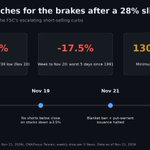
BREAKING: The S&P 500 and Dow Jones Industrial Average officially enter correction territory, now down -10% from their record highs.


37
Big Tech capex can set a record next year and still look like a slowdown.
Big 4 capex was $201.9B in Q3, +108% y/y. The $1.04T 2027 consensus is only ~29% above that quarter's annualized pace.
Record dollars, growth rate down by more than two-thirds. Is the market already front-running the deceleration?
18
Anthropic opened at $111.50 today, about a $2.01T market cap. The number I'd watch isn't the share price. It's revenue per $1 of compute.
From its IPO fact sheet:
• Q1'25: 0.40x
• Q2'26: 2.08x
• Q3'26: 1.72x
Q3 revenue was $17.0B against $9.9B of compute and infrastructure costs. The ratio fell because Anthropic took delivery of $5.0B of compute under short-term commitments, which it says costs significantly more than its multi-year contracts.
The second-order read: a lab paying up for short-term capacity means demand outran the compute it had locked in. That's good for whoever rents out short-term GPUs, and it squeezes the lab's margin until the cheaper multi-year capacity shows up.
At $2T, the market is betting the ratio gets back above 2x. Does it happen in Q4, or is pricier short-term compute the new normal?
29