

Exploring the people, ideas, and stories behind physics research.
- Tweets7.5K
- Following513
- Followers76.5K
- Likes2K





ALT A close-up illustration of a flake of iron chalcogenide connected to bright yellow electrodes against a dark yellow background.

ALT Abstract image featuring a colorful array of dots in warm hues of red, orange, and yellow, with overlapping shapes in shades of blue.

ALT A rendering of three glowing 3D volumetric forms. From left to right, the shapes transition from cone-shaped to bell-shaped and from green to blue.

ALT A rendering of rays of pastel-colored light traveling through two rectangular prisms.

ALT Two examples of rhombus-shaped 4-site atomic clusters on Lieb lattices on a blue background.

ALT A graph of trapped atoms’ optical depth over 200 milliseconds. Red data points showing atoms loaded using the RPGC-molasses rise and level off near 20 during conventional cooling. When gray-molasses cooling begins at 50 milliseconds, blue points climb steeply and level off near 120. A small inset graph shows the effect peaking near zero when two lasers are tuned for this cooling method.

ALT A grid of yellow squares with the letters JTU written in blue and green. An inset black image on the bottom shows JTU again written in white.

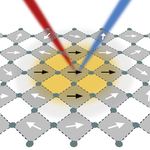
ALT A grid of gray and white diamonds, with the gray diamonds featuring white arrows in the center that point in various directions. In the center of the grid is a red and a blue laser beam that meet and form a V shape. Around these lasers, the squares in the grid are tinted yellow and the arrows in the center of the gray diamond are colored black and all point to the right.

ALT An illustration of red wavy beams of laser light on the left, a green atom surrounded by a single electron in the center, and an analog clock on the right against a yellow background.

ALT An illustration of an open book. The text on the page on the left says “The Born Rule” and lists ingredients in bulletpoints: noncontextuality, normalization, and additivity. The word additivity is circled in red and below is red text that reads no substitutions.

ALT Artist’s illustration of the IceCube Lab sitting atop Antarctic ice at night. A cross section of the ice is visible in the foreground, making the strands of small, black sensors buried in the ice visible. A bright light source shines down from the sky in the top right corner.

ALT A 3D illustration of an optical setup on a white surface. A red laser beam passes through a lens and two transparent plates, turns orange after a copper-colored block, and continues past a black cube and a glass prism. A curved mirror reflects the orange beam onto a thin, light-blue jet surrounded by small blue spheres representing xenon atoms. A wavy blue line, representing an emitted electron, curves from the jet down to a round black detector.

ALT Illustration of a hybrid quantum computer. On the left, a wavy cyan line representing a boson and a yellow sphere representing a fermion meet at a central point and scatter apart, with arrows marking their path. On the upper right is a large circuit diagram representing the large numbers of qubits and gates. Below it, a much smaller circuit links one thick cyan boson line and one yellow fermion line with a few gates, representing the cavity modes.

ALT A star-shaped atomic pattern inside a chromium sulfur bromide crystal.

ALT Eight black and white high-speed images showing a soft conical valve oscillating, buckling, folding shut, and turning inside out as fluid pressure increases.

ALT An electron-microscope image of a nanosized cube (red) wrapped in a gold layer against a dark background.

ALT Seven streams of freefalling liquid, shown horizontally. A purple band, representing ultraviolet light, extends across six of the streams. Those streams narrow as they extend from the light, showing their transformation into soft solid filaments.

ALT An illustration of water molecules — represented by red and white spheres — constrained between two parallel surfaces — represented by gray spheres — that are a few nanometers apart. In the center is a row of four white spheres with white arrows between them pointing right, representing charge transport.
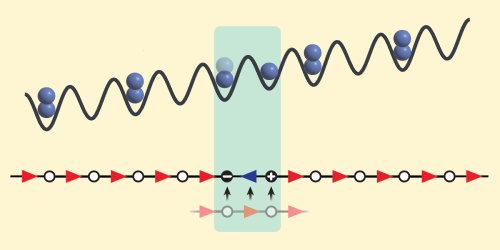
ALT Diagram of a 1D optical lattice with sinusoidal potential energy wells. Blue spheres represent rubidium atoms. They occupy the wells, showing a transition from doubly occupied sites to adjacent single-occupancy sites to mimic false-vacuum decay and particle-pair creation.

ALT Two scientific figures side-by-side. Left: Labeled “Electron gas,” the figure shows charged particles moving along straight paths when no magnetic field is present, and moving along arched trajectories when a magnetic field is applied. Right: Labeled “Molecular gas,” shows neutral particles traveling in straight lines between inter-particle collisions, where an applied magnetic field alters scattering angles and collision probabilities rather than bending individual trajectories.