





I came across this on my way to a HS football game the other night ... well-deserved! @Super70sSports

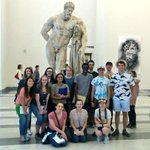
CNU students "Hangin' with Hercules" in the Naples Archeological Museum! @CNUStudyAbroad – at Campania, Italy

Italian 101: VESUVIO ("Mt. Vesuvius"). Pliny the Younger: "People lamented their fate; some prayed for death. Many sought the aid of the gods, but still more imagined there were no gods left, and that the universe was plunged into eternal darkness for evermore." @NAIntlPrograms – at Pompei, Campania


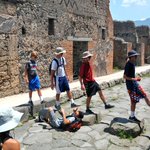
Italian 101: STRADA ("road"). In Pompeii, the roads doubled as sewers, hence the high curbs & stepping stones, which still allowed carts & wagons to pass. In one pic, you can see Trey doing his impersonation of someone who fell into the muck & mire of the street. @NAIntlPrograms – at Pompei, Campania


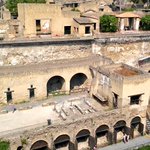
Italian 101: ERCOLANO ("Herculaneum"). When Vesuvius erupted in August of 79AD, it completely buried the Roman city of Herculaneum in volcanic material. Before 1980, we thought everyone had managed to escape: then the boathouses were discovered ... @NAIntlPrograms – at Ercolano, Campania


Italian 101: COLONNA ("column"). Today we visited the Greek colony of Poseidona (founded c. 600BC), which was later subjugated by the Romans (273BC) and renamed Paestum. The site is dominated by 3 stunning Greek temples (the 2 dedicated to Hera are shown here). @NAIntlPrograms – at Campania, Italy


Italian 101: CASTELLO ("castle"). This 11th century Norman stronghold sits atop the birthplace of Mt. Etna, which burst forth from the sea about 500,000 years ago. As you can tell, however, the assault on the castle by our students didn't go so well. @NAIntlPrograms


Italian 101: ALBERGO ("hotel"). Deeply discounted rooms available since 2002, courtesy of Mt. Etna. @NAIntlPrograms


Italian 101: PRANZO ("lunch"). Pizza for lunch today at Angelina's in Giardini-Naxos, site of the 1st Greek colony in Sicily (734BC). Yes, that is a french-fry pizza in the middle of the table ... no, it didn't last long. @NAIntlPrograms – at Giardini Naxos, Sicily


Italian 101: ORECCHIO ("ear"). This ear-shaped cavern is part of the ancient quarry-system in Syracuse. It is named "The Ear of Dionysius," after a Syracusan tyrant who (supposedly) eavesdropped on the quarry-workers by listening through a small hole at the top. @NAIntlPrograms – at Syracuse, Sicily


Italian 101: FRUTTA ("fruit"). Market in Syracuse. To purchase fruit that looks this good, our students navigated a different system of weights, new currency, & intimidating crowds ... all while being chatted up by vendors hawking their wares in a strange language @NAIntlPrograms – at Syracuse, Sicily


Italian 101: PESCE ("fish"). Daily market in Syracuse. Images speak for themselves. More to follow. 'Nuff said ... enjoy! Oh, and try not to be *too* jealous. @NAIntlPrograms – at Syracuse, Sicily


Italian 101: MOSAICO ("mosaic"). These mosaics are just a few that adorn the uniquely-sumptuous 4th century AD Roman villa at Piazza Armerina. These particular mosaics reveal the villa owner's business. Can you figure out what it was? Our students did! @NAIntlPrograms – at Syracuse, Sicily


Italian 101: GELATO ("happiness"). OK, we all know that this is a wildly inaccurate translation, but it perfectly captures the feeling at our favorite Sicilian gelateria, Ragno D'Oro in Agrigento. @NAIntlPrograms – at Syracuse, Sicily


Italian 101: COSTRUZIONE ("construction"). Ropes were slipped through U-shaped channels carved into both ends of a stone, which was then lifted into place by a wooden crane. These stones are from the Temple of Zeus at Agrigento (destroyed by Carthage in 406BC). @NAIntlPrograms


Italian 101: TEMPIO ("temple"). This (unfinished) 5th century BC temple in Segesta was the first of many to be visited by our Odyssey Explorers. From the pictures below, can you figure out how we know it is unfinished? Our students did! @NAIntlPrograms – at Calatafimi-Segesta, Sicily


Italian 101: CAVA ("quarry"). Stones cut from the quarry at Cave di Cusa were used to build the temples at Selinunte. The quarry was abandoned permanently in 409BC when the Carthaginians launched a sneak-attack resulting in the destruction of Selinunte. @NAIntlPrograms


Italian 101: ISOLA ("island"). It was clear enough to see the Egadi Islands off the coast of Erice. Here, in 241BC the Roman navy crushed the Carthaginians, effectively ending the 1st Punic War & setting the stage for a showdown with Hannibal a few decades later. @NAIntlPrograms – at Erice, Sicily
