

Organizational Design & Culture | I talk about behaviour and decision-making at work and in financial markets
Joined December 2009
- Tweets6K
- Following513
- Followers717
- Likes439



PK retweeted

Set a reminder for my upcoming Space! teapaw.org/i/spaces/1RJjpbZNjbBKw
Don’t allow your “experience” and “expertise” deprive you a new learning opportunity.
Those who stopped learning find themselves equipped for a world that no longer exists.
PK retweeted
Let’s be honest. 👀
Have you ever sat through a performance review where your manager told you to improve, but couldn’t give you one clear example of what you were doing wrong?
Or where you heard about your shortcomings for the FIRST time during the review?
How exactly are employees supposed to improve when feedback comes as a surprise?
This Friday on 9to5withAwele, we’re discussing:
Performance Review: Genuine Feedback or Corporate Ritual?
I want to hear your experiences.
Have you ever had a performance review that actually helped you grow? Or was it just another corporate formality?
Let’s talk. 👇🏽
🗓️ Friday, October 23
⏰ 8 PM WAT
📍 X Space: @AweleDavies

PK retweeted
CALLING HR & PEOPLE PROFESSIONALS!
Are you passionate about workplace conversations and career growth?
I’m looking for guest speakers to join my X Space this Friday:
Topic: “Performance Review, Genuine Feedback or Just Corporate Ritual”
📅 Friday, 23rd October, 2026
⏰ 8PM WAT
If you have insights, experience or a strong opinion on this matter, send me a DM.
Come share your perspective. 🎙️

Organisations are now looking for people who can think independently, work with autonomy and use AI effectively.
Don’t be surprised if job interviews start asking candidates to review flawed AI-generated advice, identify the risks and defend their own professional judgement.
Many job descriptions are like well-written fiction.
The reality of many roles is either different or simpler than what was stated on the advert.
That’s why I think many ‘performance issues’ are actually clarity issues. If the role and expectations aren’t clear and accurate from the start, how can performance ever be measured correctly?
Recruiters are using AI. Job seekers are using AI too. Yet both sides are complaining!
We’ve created a system where machines are talking to machines, and the human side of recruitment is gradually disappearing.
Hiring is about real people having real conversations about their real potential.
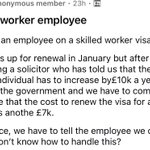
This was shared in an HR group I’m part of, and I think this is how many Skilled Workers lose their sponsorship.
Once employers receive advice from a solicitor, they’re often not willing to consider anything else.
When was the employee first sponsored? Those sponsored before 4 April 2024 may qualify for lower salary thresholds when renewing. Was this considered? What occupational going rate applies to the role? Does the employee really need a £10k increase? What makes up the £7k cost? Are some of these costs for the employee to bear? Is the employee close to ILR?
I wish I knew what the solicitor considered before giving this advice.

A demanding workplace expects a lot from employees. A toxic workplace makes employees pay an unreasonable personal price to meet those expectations.
High expectations aren’t toxic. But unrealistic targets, lack of resources, excessive workloads and unfair treatment when things go wrong can make a workplace toxic.
And sometimes the problem isn’t even the manager. It’s how the organisation is structured and how work is organised.
If employees are constantly burning out, leaving or afraid to speak up, can we really call that a high-performing organisation?
Performance matters, but we also need to look at what it takes to achieve it.

Many CVs are strong on ATS relevance but weak on differentiation. This is why almost every CV sounds the same nowadays.
Two people can have the same job title and responsibilities, but their experiences could be very different in terms of scale, complexity, decisions and outcomes.
Your CV should reflect these differences, not just list responsibilities. Show the problems you’ve handled, the environments you’ve worked in and what you achieved.
PK retweeted
A demanding workplace is not necessarily a toxic workplace. But some employers have mastered the art of confusing the two.
Let’s talk about it.
A demanding workplace will challenge you. It will set high expectations, hold you accountable, push you to improve, and sometimes require you to go beyond your comfort zone.
A toxic workplace, on the other hand, will make you question your worth, sacrifice your mental well-being, and feel guilty for having boundaries.
Here’s the difference:
A demanding workplace says, “This work needs to be better. Let’s figure out how to improve it.”
A toxic workplace says, “You are incompetent. I don’t know why we hired you.”
A demanding workplace sets clear expectations and holds you accountable.
A toxic workplace keeps changing the goalpost and blames you for not meeting expectations nobody communicated.
A demanding workplace gives constructive feedback.
A toxic workplace humiliates you in the name of correction.
A demanding workplace respects your time but may occasionally require extra effort.
A toxic workplace treats your personal time as company property.
A demanding workplace challenges you to grow.
A toxic workplace drains you and calls it character development.
The truth is, a workplace can be challenging without being abusive. And a workplace can have high standards without destroying the people expected to meet them.
Employees should not use the word toxic to describe every difficult assignment, uncomfortable feedback, or demanding boss.
But employers should also stop using high performance as a cover for poor leadership, unreasonable expectations, disrespect, and burnout.
You can demand excellence without disrespecting people.
You can enforce accountability without intimidation.
And you can build a high-performing team without making everyone miserable.
Over to you: What is one behaviour employers often defend as “being demanding” that you consider a clear sign of a toxic workplace?
Let’s talk about it in the comments. 👇
#WorkplaceCulture #ToxicWorkplace #Leadership #EmployeeExperience #9to5withAwele

You probably know who has access to your company’s confidential information. But do you know what information your employees are sharing with AI tools?
Founders and CEOs need to start paying attention to how AI is being used in their organisations.
If an employee continues working and receive pay after probation ends without confirmation or extension, Nigerian courts may treat this as implied confirmation.

Many long-term performance issues in workplace could have been addressed earlier if employers took probation seriously.
Do you know anyone whose employment was terminated or probation extended because of poor performance?
Many organisations already have policies and procedures covering this, but how many actually follow them?
Many employees breach their employment contracts and obligations because they’re not familiar with them, while many employers act outside employment law and even their own internal policies because those employed to uphold these policies and laws haven’t even read the documents they’re supposed to follow.
Once there’s clarity on both sides, we’ll either see better workplaces or a sharp rise in workplace disputes at the National Industrial Court.