

we are building , human-led systems where technology amplifies capability, not replaces it. try out our workspace @ https://teapaw.org/t.co/HFN2GymiVF
Joined May 2026
- Tweets34
- Following2
- Followers4
- Likes18




Problem99 retweeted

I wanted 0 effort security. So I built it.
It’s called Kodeblue. install with 1 command, it learns by itself, improves daily, and protects 24/7.
Even protects vulnerable servers from PHP2SHELL, NODE2SHELL.
Need more ? its open source. Contribute.
Try it and thank me later.
Problem99 retweeted
837 attacks, 65 different attackers, 29 incidents that bypassed Cloudflare WAF and were blocked by Kodeblue. (an open source project)
This is only ONE of my servers in the past 10 hours.
cost ? 0.68$. what a joke.
here is the breakdown:
- 369 tries to find a phpMyAdmin panel
- 193 recon pings checking what’s running
- 135 PHP exploit attempts (PHPUnit, PHP-CGI, ThinkPHP)
- 48 tries to use the box as an open proxy
- 25 probes for dashboards, admin panels and shells
- 21 WordPress takeover attempts
- 18 bots fishing for .env files
- 15 router and camera exploits
- 3 malware check-ins asking for an update
0 got in. all got blocked. and knowledge shared between all my servers

We told an AI agent to attack a live server. KodeBlue was the only thing watching. No WAF.
It caught the first request, blocked the attacker in 20 seconds, and wrote the incident report in 5 minutes. Nobody got woken up.
Open source, out Sunday, Oct 25.
problem99.io/kodeblue
Kodeblue goes open source this weekend.
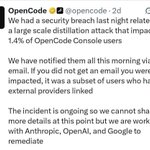
This week, OpenCode disclosed a breach overnight: a large-scale distillation attack that hit 1.4% of their Console users. They’re still working through it, so we won’t speculate on the details.
What it did was put a number on something we’d been saying for a while. Attackers run agents around the clock. Most servers still wait for someone to read an alert in the morning.
kodeblue is an open-source AI blue-team agent that lives on each of your Linux servers:
→ Learns what normal looks like for that exact machine
→ Notices change in seconds and filters out the noise
→ Investigates like an analyst, contains when your policy allows
→ Read-only by default, asks before it acts, every action has an undo
→ Apache 2.0, bring your own model, one binary per server
→ Cents a day in model costs, not a SOC contract
It’s free and open source, so anyone can run it. It’s built on the same engine as the Kodeboard harness, specialized for security, and we’ve been running it on our own services for a while before putting it in front of anyone else.
Get notified when it ships: problem99.io/kodeblue

Get notified here : problem99.io/kodeblue

15
Taskies didn’t work on the first try. Or the second.
Our first idea for agents that kept re-exploring the project was a mind map. It found the important parts, mapped their connections and handed that to the agent. It felt sensible until we tried it on bigger projects. The map grew, the connections grew, and our shortcut became a pile of information the agent had to wade through.
What was missing was somewhere to keep what we’d learned: why a rule exists, why an approach didn’t work. So agents started writing shared definitions as they worked. Then different agents began editing global info from their own corner, and things got scrambled. Definitions needed versions and continuity, and that became the memory system.
Then the orchestrator kept trying to do everything itself. We fixed it with instructions. Sort of. Sometimes it delegated, sometimes it went straight back to working alone. So we stopped relying on it to invite everyone in. Now the Taskie lays out the subtasks and Subies pick up what suits them.
Last piece: one model per Subie. But a tiny visual tweak and a tangled interface don’t require the same reasoning or cost. So each Subie got two model tiers.
Then the pieces started coming together.
And then we measured it 👇

We’re excited about Taskies and Subies, and we’re not going to pretend otherwise.
We’re building Kodeboard for hybrid work, where people and AI build things together. So we wanted agents that share what they know and work around a project the way a team does. A kind of collective intelligence, built because we needed work to move faster.
The impact numbers look good. The more interesting part is the trial and error it took to get there, so here’s that story.
problem99.io/news/how-we-fel…
The team added a stat to the new blog post about taskies without me knowing...
but they are not wrong.
2
2
36
Meet Taskies, the little characters bringing collective intelligence to Kodeboard.
Every task gets its own Taskie. It comes into existence, gets to work, and calls in Subies - subagents - when it needs a hand.
Before it disappears, it leaves behind definitions: what it built, how things work, and what the next Taskie should know.
The next Taskie starts with that knowledge and adds to it. Each task leaves the project a little wiser.
Their animations tell the story, too: working, asking for your attention, or waiting for review. You can follow along as they work.
Born to help.
Curious by nature.
Gone with a pop.
Here’s a first look. 👇
Try it out @ problem99.io/kodeboard

38
“We can build that with AI.”
“Great. Who’s maintaining it?”
Version one is the start. Give the work an owner and track it through review in Kodeboard.
problem99.io/kodeboard

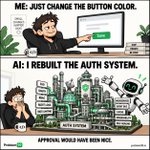
A tiny request. A surprise architecture migration.
What’s the biggest detour an agent has taken on a “quick fix”?
problem99.io/kodeboard

Big congrats to @MiniMax_AI on shipping MiniMax H3!
We’re not a media platform, we’re the workspace devs build in and we integrated the M3 multimodal foundation model on Kodeboard for our users and but releases like this are exactly why we’re excited about what’s coming next
in AI tooling.
H3 is an open, multimodal model that unifies text, image, video, and audio into one workflow, with real control over characters, motion, scenes, and sound. That’s a serious jump for anyone building AI-native products.
1
1
42