






Excited to see this paper in print soon! Thanks to many for their comments on this! Special thanks to John Asker for excellent editing at JPE!
1
147
Resolving uncertainty later leads generators on the exit margin to be more likely to exit! Our point is subtle: this is about delaying uncertainty resolution holding
enforcement probability constant. Yet increasing coal exit might not be the current administration’s objective!
1
166
The executive order responds to stricter MATS standards that the previous administration announced in 2024. The current executive order highlights that changing administrations also contribute to policy uncertainty.
1
49
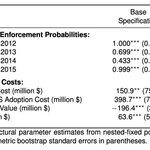
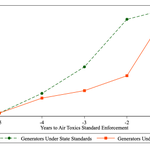
Along the way to these results, our paper uses generators’ decisions and state mercury policies to estimate generators’ perceived probabilities of MATS enforcement. In 2014, the year the Supreme Court agreed to hear arguments, the perceived enforcement probability fell to 43%!
1
54
Our study shows that, in some cases, policymakers may want to prolong uncertainty until after firms need to make decisions to help achieve policy goals. This contrasts with the “real options” result that higher levels of uncertainty cause delays in irreversible decisions.
1
55
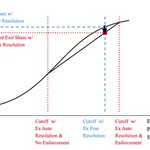
If coal had been more profitable and exit unlikely, we’d be on the left of the figure and earlier uncertainty resolution would have increased exit. This is more like adoption of a new, costly technology (residential solar). There, resolving uncertainty earlier increases adoption.
1
60
Why? Cheap natural gas reduced coal’s profits, leading many coal generators to be close to exiting. Figure 4 of the paper shows that, when such a generator can respond to the court decision, its expected exit probability is lower than if it can’t use this information to decide.

ALT Cumulative distribution function of the probability of exit across expected profit shocks. A blue dashed line on the right indicates the profit shock cutoff with ex-post uncertainty resolution leads to high levels of exit. On either side there are red dashed lines that indicate the two profit shock cutoffs with or without certain enforcement. The figure shows that, in expectation across these two potential exit rates, expected exit is lower if uncertainty is resolved earlier.
1
74
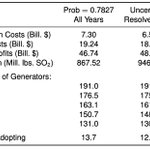
How does this affect generator exit? The delay between announcement and uncertainty resolution caused more generators to exit. Resolving uncertainty 4 years earlier would have lowered generator profits by $1.4 billion but also reduced pollution damages by up to $1.8 billion.
1
69
MATS affected coal generators. The original challenges to MATS took 4 years, and generators exited in the interim. With a quicker court decision, they could have taken action in response to the outcome. Instead, they made choices given the expected outcome.
1
78
Many executive branch policies are challenged in the courts and these challenges can take years to resolve. Yet firms may need to take irreversible actions before the courts have ruled. How might these actions change if policy uncertainty was resolved more quickly?
1
91
The rule was announced in 2012 with enforcement in 2016 but was challenged up to the Supreme Court. The rule was eventually enforced in 2016.
1
96
“Policy Uncertainty in the Market for Coal Electricity: The Case of Air Toxics Standards” looks at the original uncertainty surrounding MATS enforcement. ashleylanger.com/files/polic…
1
149
Recently the President ordered that coal generators don’t need to comply with the Mercury and Air Toxics Standard (MATS). My forthcoming JPE paper with @GGowrisankaran and Wendan Zhang on uncertainty surrounding MATS. Time for a thread! whitehouse.gov/presidential-…

Ashley Langer retweeted

This posting is coming late in the process, but we’d appreciate your help circulating it broadly. The Department of Geography and Environment has a fantastic and growing team of faculty and students engaged in environmental economics and policy research and teaching.

📣 We're hiring!
We're looking for an Assistant Professor (Education) in Environmental Economics and Policy.
⌛ 16 February 2025 (23.59 UK time).
🔴 zurl.co/M8Nwy

Ashley Langer retweeted

A couple of years ago a couple of friends and I made a "partial equilibrium" public good guide for new econ students who might want to become a Research Assistant. We no longer have the ability to maintain and update it to account for new information, so ... [1/n]
Ashley Langer retweeted

Pre-doc job announcement! @HarvardSalata is hiring fellows to work with Anna Russo, Wolfram Schlenker, @ctaylor463, and myself on environmental economics! Application review will begin on 10/31 and continue on a rolling basis. Please apply and share! sjobs.brassring.com/TGnewUI/…

some personal news: I have a pre-doc job to advertise, but for it to make sense I need to first share that in 2025-26 I will start a new job as an assistant professor at Harvard @Kennedy_School. I will dearly miss my friends @sffed, but am excited for new adventures in Boston!
Ashley Langer retweeted

Job market candidates: a quick thread on how the econ market works, incl. at business schools. 1) It is not unusual to get many 100s of applications. Nobody reads them all first-pass. Most places take a quick glance at letter/cv/intro, and keep the top x%.
Potential predocs! If you’re interested in IO and energy (or development/trade/health), please apply!

Come work with us! We (@TradeDiversion @GGowrisankaran, Pietro Tebaldi, and I) are hiring pre-docs to start in summer 2025.
@econ_ra @predoc_org
Ashley Langer retweeted

Don’t miss our LinkedIn Live with @MathematicaNow on 9/26 @ 1pm ET! Our panelists will be diving into how to build a career in #Economics, #PublicPolicy, and #DataScience. Register here: eventbrite.com/e/lunch-learn…
