

I talk about teaching innovation and excellence in higherEd | 3M National Teaching Fellow ! Director of Teaching Innovation
- Tweets1.5K
- Following106
- Followers253
- Likes25







ALT AI: Elevating the Landscape of Canadian Agriculture Nancy will speak about how AI has the potential to elevate the landscape of Canadian agriculture. This session delves into the implications AI has on current practices and the transformative opportunities it offers to agricultural technology.


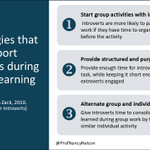
ALT 3 Strategies that Support Introverts during Active Learning (adapted from Zack, 2010. Networking for Introverts) 1. Start group activities with individual thinking - Introverts are more likely to participate in group work if they have time to organize their thoughts before the activity 2. Provide structured and purposeful activities - Provide enough time for introverts to dig into the task, while keeping it short enough to keep extroverts engaged 3. Alternate group and individual activities - Give introverts time to consolidate what they’ve learned during group work by following it with an similar individual activity

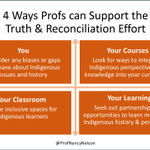
ALT 4 Ways Profs can Support the Truth & Reconciliation Effort You - Consider any biases or gaps you have about Indigenous issues and history Your Courses - Look for ways to integrate Indigenous perspectives and knowledge into your curriculum Your Classroom - Create inclusive spaces for Indigenous learners Your Learning - Seek out partnerships and opportunities to learn more about Indigenous history & perspectives

ALT Image showing an eagle representing the First Nations, a narwhal representing the Inuit, and a beaded flower representing the Métis. Education will create knowledge and from knowledge will come understanding. From understanding will come respect – both self-respect for Indigenous people and mutual respect for all. (Justice Murry Sinclair, Chair of the Truth and Reconciliation Commission)

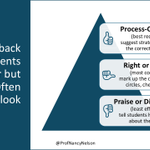
ALT Feedback Students Prefer Profs Often Overlook Process-Oriented - (best received) … suggest strategies to get the correct solution Right or Wrong - (most common) … mark up the content with circles, checks or Xs Praise or Disapproval - (least effective) … tell students how you feel about their work

ALT 3 Ways Profs can Minimize Student Boredom Establish Relevance • make sure students see the connection between what they're learning and the 'real world' Vary Teaching Methods • integrate different types of interactive and engaging approaches to reduce monotony and routine Model Expected Processes • give students in-class opportunities to see, practice, and get feedback on the types of questions they'll be asked on tests

ALT What Makes a Class Boring? (Sharp et al, 2016. Academic boredom among students in higher education) - ineffective teaching & learning strategies - personal attributes & style of professor - perceived irrelevance of the subject matter - lack of coherency and structure - minimal or no opportunity to interact - disruptive behaviour from other students - uncomfortable physical environment

ALT "Boredom and learning are mutually exclusive … students are never bored when they are learning and they are never learning when they are bored." (Kanevsky & Keighley, 2003)

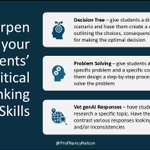
ALT Sharpen your Students' Critical Thinking Skills Decision Tree — give students a discipline-specific scenario and have them create a decision tree outlining the choices, consequences, and criteria for making the optimal decision Problem Solving — give students a discipline-specific problem and a specific constraint. Have them design a step-by-step process or strategy to solve the problem Vet genAl Responses — have students use genAl to research a specific topic. Have them compare & contrast various responses looking for inaccuracies and/or inconsistencies

ALT Critical Thinking Skills are Essential "Critical thinking is the ability to think clearly and rationally about what to do or what to believe. It includes the ability to engage in reflective and independent thinking." (Lau, 2011. An Introduction to Critical Thinking and Creativity) - see logical connections between ideas - identify, construct & evaluate arguments - detect inconsistencies in reasoning - systematically solve problems

ALT Shifting from Traditional to Authentic Assessments Learn - Develop a clear understanding of authentic assessment in your discipline (this is something genAl can quickly curate for you!) Try - Design and implement one authentic assessment task that aligns with 1-2 learning outcomes essential in your course Evaluate - Measure and reflect on how effective the task was (improved grades, positive student feedback, useful observations?)

ALT 3 Questions to Prime Student Thinking 1. What are the pros and cons of {topic/issue/method}? 2. What are two ways you could solve this {challenge/issue/problem}? 3. How does this {problem/question} relate to what we learned last class? (Schwartz & Bransford, 1998)

ALT 3 More Ways to be a Successful Educator (adapted from Rosenshine, 2012) - Ask lots of questions and check responses of all students: This provided required practice new concepts and helps learners connect new material to prior learning. - Ensure a high in-class success rate: Make sure that most of the students have grasped the concept before moving on to new or more difficult concepts. - Provide scaffolding for difficult tasks: Start with lots of assistance and gradually reduce that support as learners get more comfortable with the concepts