

Audience and Narrative Intelligence.
London, LA, Singapore, Sydney
Joined March 2013
- Tweets12.1K
- Following4.8K
- Followers9.6K
- Likes3.8K




Pulsar retweeted

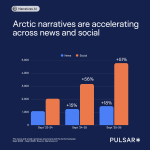
As the @arcticcircleorg Assembly kicks off in Reykjavik, we're looking at how the world thinks about the Arctic in our latest narrative Intelligence study, The Arctic Reframed.
The study covers three years of Pulsar Narratives AI data, billions of news articles and social posts, 13,731 narratives detected between 2023 and 2026 📈 📉
The biggest point for me is that the Arctic is not driving his own narrative, the story is written elsewhere.
Here's the headlines:
- Sovereignty, security and the economy now account for 6 in 10 Arctic narratives in both news (61%) and social media (59%). Three years ago it was 42% in news and 26% on social.
- Climate science and wildlife narratives fell from 44% to 17% of Arctic news coverage. The economy (shipping, energy, minerals) is now the biggest single theme, at 28%.
- Discourse is now driven by waves of geopolitical attention: in its busiest week, public attention to the Arctic in 2026 runs at 3.5 times a typical week, up from 1.9×. Every spike that could be traced to an event was geopolitical or a cold snap; none was a climate milestone.
- Indigenous and community voices make up only 0–5% of the Arctic narratives every year, in both news and social.
Full study in the comments ❄️🧊🏔️🐻❄️
#ArcticCircleAssembly #Arctic #CentralArcticOcean #ArcticGovernance #ClimateAction

Pulsar retweeted

Creators 🤝 Boosting Generous Actions

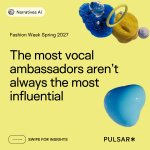
💙🤳 Creators with fewer than 1,000 followers drove some of the strongest @GivingTuesday engagement in 2025 - while larger accounts often underperformed.
But what does that contradiction mean? Our latest piece uses influencer intelligence to show how trust, identity, and participation outperform scale in cause-led campaigns.
⭐ Read more: pulsarplatform.com/blog/2026… #GivingTuesday

Pulsar retweeted
@Waitrose and @Marksandspencer are the UK’s two most premium supermarkets – but which attracts the more positive narratives amongst the public?
Our data suggests they're neck-and-neck, jockeying for position in a way that would seem quite out of place in the genteel aisles of either brand.
🧶 Product Quality
M&S is clearly ahead when it comes to positive narratives around product quality. This derives in part from the brand equity they draw from their clothing collections. Public conversation consistently reaffirms the idea that M&S knitwear, suits and underwear remain outliers for quality on the modern British high street – an association that feeds into a brand boost for their food & drink offerings.

Pulsar retweeted
There is a clear narrative gap in the way people talk about Pepsi and Coca-Cola.
When we map each brand’s narrative positivity, Pepsi is comfortably ahead: 74.2% vs Coca-Cola’s 49.3%. And what is a key driver of this gap? Marketing.
That is to say, audiences are responding to very different campaigns and cultural impact. @pepsi is perceived as culturally attuned and responsive—a youthful vibe that resonates with people who value relevance and experimentation. Culture-first groups such as pop culture & sports fans, in particular, gravitate toward the brand.
Whereas The @CocaCola's marketing narratives are pulled between the enduring appeal of holiday tradition and growing skepticism toward generative-AI activations and authenticity. Coke’s conversation clusters skew more politicized and crypto-adjacent, which shapes how campaigns get interpreted, amplified, and where they hit limits.


Pulsar retweeted
The question isn't whether AI will transform how we test ideas—it's how quickly we'll adapt to a world where experimentation becomes as easy as asking a question.
Pulsar retweeted
It's been just over a week since we launched Narratives AI, and the response has been truly incredible. Honestly, a few things caught me completely by surprise.
First, the sheer buzz around the launch! It seems the idea of easily detecting and measuring narratives really resonated. Second, the feedback from our early users has been fantastic – a blend of "wow, this is easy" and "can it do *this* next?" (More on those future features soon!). Third, the engagement levels are through the roof. Our top user spent over 3 hours actively exploring hundreds of narratives. That kind of session time for a brand-new product is unheard of! And fourth, the incredibly insightful questions we're getting about the data science – excellent questions about clustering and long context windows for LLM analysis.
Given all this engagement, we're tackling the best questions one by one. So, let's start with the most frequent:
"How does Narrative Intelligence differ from Social Listening, and what insights can Narratives AI provide that Social Listening can't?"
Here's my take: we don't see Narratives AI and Social Listening as rivals. Narrative Intelligence actually *precedes* Social Listening in the insight process. Think of it as mapping the entire data universe, developing research hypotheses, and *then* using Social Listening for targeted deep dives. You start broad, then get specific.
To illustrate these fundamental differences, we've created a short explainer video. I'd love for you to take a look and share your thoughts.
And stay tuned – we'll be back soon with answers to the *second* most-asked question!
Pulsar retweeted
Can you guess the top trending cause online during #GivingTuesday 2024? 🤓
33%Animal Welfare
67%Children & Elderly
0%Health & Health care
0%Science & Education
3 votes • Final results Pulsar retweeted
New data reveals a seismic shift in perceptions of the American Dream. 🇺🇸 💸 🗽
Search for "American Dream" in Narratives AI and the #1 narrative you'll see is "The American Dream is a Fading illusion". This is from crunching 39bn of social media posts and news media articles generated over the last 2 years.
A quant study from McCann also confirms the same: 73% of surveyed Americans are now viewing it as an illusion rather than an achievable reality.
Our latest research collaboration with McCann Worldgroup uncovers a stark transformation in how Americans perceive opportunity and success in 2024:
• 82% believe the system is fundamentally rigged
• 67% say hard work no longer guarantees upward mobility
• 91% of millennials feel less economically secure than their parents
• Only 12% believe they have a fair chance at building wealth
This isn't just about economics – it's a profound crisis of faith in our social contract. The data shows a direct correlation between rising inequality and declining belief in meritocracy.
What's particularly concerning is how this sentiment crosses traditional demographic and political lines. Whether in urban centers or rural communities, among college graduates or skilled workers, the narrative remains consistent: the American Dream has become a symbol of systemic failure rather than opportunity.
The implications for businesses, policymakers, and society are significant. When people stop believing in the possibility of advancement, it fundamentally alters their relationship with institutions, their career choices, and their vision for the future.
These findings were presented yesterday at SXSW in Austin, link in the comments to access the exec summary (do comment "American Dream" if you want to see the full study and we'll follow up).
What's your take on this shift? Have you observed this changing sentiment in your network or community?
I'll be sharing more detailed analysis from this research in the coming weeks. Follow along if you're interested in understanding how these changing perceptions are reshaping our economic and social landscape.

Pulsar retweeted
Do you know what your supporters were talking about on #GivingTuesday last year?
@PulsarPlatform dove deep to find topics that resonated across social media—you're gonna want to take a look at the results.
🤳 m.mtrbio.com/qhzzvwehbs

ALT A young woman enjoys a quiet moment at a coffee shop, checking her phone while seated.

ALT A smartphone displaying various social media icons held in a hand, showcasing modern communication apps.
Pulsar retweeted
Davos' @wef influence seems to be shrinking:
- News coverage is down 60% YoY (volumes, @PulsarPlatform )
- Social chatter is down 51% YoY (volumes, @PulsarPlatform)
Last week we noticed that Davos/WEF wasn't a trending topic in the countries where you'd expect (or need) it to be, such as US, UK, Canada, France, Italy, Spain, Russia, India.
Today we looked at pure volumes of news and social content on WEF and the decline has been pretty steep between 2024 and 2025.
Why? We asked a China representative (sorry @deepseek_ai) just to get some sass (all very balanced to be fair), and yea it didn't disappoint:
1. **Criticism of Elitism**: Davos is often seen as a gathering of the global elite, which can lead to criticism that it is out of touch with the broader population.
2. **Rise of Alternative Platforms**: There are now numerous other forums and summits where global issues are discussed, such as the G20, the United Nations General Assembly, and regional gatherings like the Asia-Pacific Economic Cooperation (APEC).
3. **Global Power Shifts**: The global balance of power is shifting, with emerging economies gaining more influence. These countries may not see Davos as the most important or relevant forum for their interests and may prefer to engage in other venues where they have more say.
4. **Digital Transformation**: In an instant digital world where you can shave 3% of the Nasdaq with a product release, does it matter that much what we say face to face, in the mountains, once a year? (Btw Deepseek only mentioned Digital Transformation and didn't self plug 😜 )
5. **Effectiveness and Outcomes**: There is a growing skepticism about the effectiveness of Davos in driving real change. Critics argue that the forum produces more talk than action, and without tangible outcomes, its influence may wane.
6. **Global Challenges**: The complexity and scale of global challenges, such as climate change, inequality, and geopolitical tensions, may be beyond the scope of what a forum like Davos can address, leading to questions about its relevance.
7. **Pandemic Impact**: The COVID-19 pandemic forced the WEF to cancel its in-person meeting in 2021 and hold a virtual event instead. This disruption may have long-term effects on the forum's influence and how it is perceived by the global community.
Or as @Zoë Williams put it on the Guardian last week, even the elites are bored of talking to the elites


Pulsar retweeted
12 hours to go for the biggest release in our Narratives AI private beta. 🔮
Drop your email here for access narrativesai.net
Pulsar retweeted

“We don’t argue with environmentalists anymore, they’ve come around to the idea that the new technology of nuclear energy is less carbon intensive than anything else. But the tech has been there for a while now so this shows that sometimes it takes generations to recover from a bad story” #nuclear #podcast #energy #cleanenergy #nuclearenergy
Pulsar retweeted
The "media franchise" is often misunderstood as a finance-first, audience-last, vehicle for entertainment. Diana Williams @silkyd67 argues the exact opposite: if we care about audiences, the franchise offers the best way to immerse yourself in any story world #audiences #podcast #podcastclips #podcasts
Pulsar retweeted
Gen AI chatbots like @OpenAI's ChatGPT, @AnthropicAI's Claude and @Google's Gemini might serve very similar use cases but are perceived by the audience in very different ways.
They do have one big thing in common though: they're all dropping ratings in Functionality and Credibility pic.x.com/pj9ywrm3s6 #ai #reputation

Pulsar retweeted
"We need to start seeing cultural intelligence/marketing as mainstream marketing. It's the vibrant and complex cultures that are driving trends, driving consumer preference, and creating meaning. That’s why cultural intelligence is so pivotal for brands who want to be relevant and profitable." Dr. Anastasia Kārkliņa Gabriel, Author of "Cultural Intelligence for Marketeers", on the adoption of cultural intelligence in the marketing world.
Pulsar retweeted
"We need to start seeing cultural intelligence/marketing as mainstream marketing. It's the vibrant and complex cultures that are driving trends, driving consumer preference, and creating meaning. That’s why cultural intelligence is so pivotal for brands who want to be relevant and profitable." Loved recording this episode with Dr. Anastasia Kārkliņa Gabriel because it tackles the very core of what we do.
Culture drives identity and identity drives behaviour. You miss the nuance of the identity and you miss the alignment with the behaviour AND your marketing is out of synch.
And yes sometimes this has to do with purpose and inclusivity but if you want to connect with any audience today, relevance via cultural fluency is really the only game in town.

Who’s the Audience of Cultural Intelligence? How has it evolved over the past few years? Where is it going next? 📚
We speak with Dr. Anastasia Kārkliņa Gabriel, author of ‘Cultural Intelligence for Marketers: Building an Inclusive Marketing Strategy’ about:
🌍 The need for brands to produce inclusive messaging that resonates with diverse audiences
📖 Examples of leveraging cultural movements from Lyft, Coca-Cola and Hinge
🤝 How championing cultural intelligence can benefit both businesses and society
Spotify open.spotify.com/episode/2Qo…
Apple podcasts.apple.com/gb/podcas…
Pulsar retweeted
Possibly the biggest upside of Gen AI: "it's encouraging us to think, what is it that separates us from this computer generated facsimile of us, what is it that makes us human". @stokel on the latest ep of Audiences 🎧
Pulsar retweeted

From de-influencing to no-buy, how audiences are embracing low consumption trends buff.ly/3zZyJsb #brands
Is conspicuous consumption on its way out? As people adapt to rising economic and climate anxieties, a new set of ideas, attitudes and behaviors is emerging