

https://xitter.cf/t.co/YOWPXGkXm7, a privacy focused QTC wallet https://xitter.cf/t.co/9qpBCSclUi, a Quantus explorer Built by https://xitter.cf/t.co/siHpQ9W21Y team
Quantus
Joined October 2026
- Tweets127
- Following11
- Followers35
- Likes40


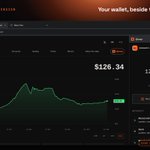


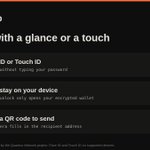



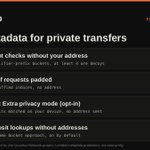
Holding your own keys also means knowing what happens to your coins. Qkeep tracks every transfer until it is final on chain, so you never have to guess whether a send really went through.

Want your address kept off our server? Turn on Extra privacy mode in Qkeep under Settings (opt-in), and Encrypted Accounts get checked on your device instead.

Keys you hold are only as safe as the signatures behind them. Post-quantum signing on-device is how self-custody lasts. Qkeep does that. xitter.cf/QuantusNetwork/status/…

Self-custody only works as long as the cryptography does.
@JoeMattia on sovereignty, self-custody, and getting back to our roots.
Post-quantum is becoming a baseline. For QTC holders it starts with signing: ML-DSA keys that stay on your own device, like in Qkeep. xitter.cf/YuviLightman/status/21…

Tap any transfer in Qkeep and check it yourself: full amount, tap-to-copy addresses, and a TXID that opens straight in the block explorer.

Anyone can run verify.mjs from the public GitHub releases repo to check that Qkeep serves exactly the published files. Have you ever verified a wallet's code before using it?
Quantum timelines keep shrinking, so keys that sign with post-quantum math today beat any rushed migration later.
xitter.cf/n13/status/21120458524…

Lattices were studied as an attack tool before they became a defense. Worth remembering when picking what guards your keys. xitter.cf/YuviLightman/status/21…
Eli is directionally correct that lattice-crypto has more algebraic structure than hash-crypto and that this structure could theoretically be used to break it, altho i think the newness of lattices is a bit overstated.
Lattice crypto originally started as offensive cryptanalysis, not a defensive structure.
In cryptography, you generally want all-or-nothing systems. If I try to guess your password and I’m even one character off, I should get no clue about how close I was or which characters were correct.
In practice, this is difficult. For example, if I respond slightly slower depending on how many characters are correct, then you can use timing to gradually extract the complete password. This is where timing attacks come from.
Lattices are like vector fields but instead of taking any linear combination of the basis vectors (with real coefficients) you only accept integer coefficients. So you have some building blocks and you can combine them but not shrink or stretch them. It’s similar to how crystals have evenly spaced atoms in multiple dimensions.
The basic idea in lattice attacks is that you find a bunch of clues or partial solutions and make each one a basis vector. Then you try to find (“Learn”) a combination of them whose sum is small (Short Integer Solution, SIS), which simultaneously combines the partial solutions to make a complete solution.
This method can be used to attack elliptic curve signatures when the nonces used are biased, not uniformly distributed.
Lattice signatures and zk-proofs use similar ideas but defensively, to find problems that resist lattice attacks. Learning-With-Errors (LWE) essentially takes that short integer solution and adds noise to it so that an attacker cannot use straightforward linear algebra to solve it. Then you can prove you know the solution without revealing it by solving a related problem.
Hash-crypto works quite differently. It basically uses one-way functions (hashes) as a building block and you prove you know a secret by selectively revealing the inputs to a publicly-committed output.
Since hash-crypto doesn’t have any algebraic equations in its structure, people say it has less attack surface, which is true. The tradeoff is that you have much larger signatures and it doesn’t have nice threshold schemes or key exchange algorithms or encryption, which all rely on that missing algebraic structure.
Both hash-crypto and lattice-crypto rely on the security of hash functions, tho, so the reduction in attack surface is a clear win for hash-crypto.
It would be great if we just had full security-proofs for some crypto-system so we wouldn’t have to rely on heuristics like this, but that’s just where we are in our scientific knowledge as a species. Maybe AI will help us solve P =? NP and that will lead to provably secure systems.
Quantum-safe from day one means keys and signatures have to be post-quantum too. Qkeep signs with ML-DSA on the device. xitter.cf/therollupco/status/211…

Joe Mattia says Quantus was built quantum-safe from day one, backed by about $2.5M from angels only and no VCs, so the rest of crypto has a benchmark to measure against.
@QuantusNetwork @JoeMattia

Standards that make post-quantum readiness verifiable matter most for keys and signatures. xitter.cf/QuantusNetwork/status/…
Proud to be part of the Quantum Alliance.
@YuviLightman is one of its founding contributors, helping build standards that make post-quantum readiness verifiable.
More ways to mine QTC means a wider, more distributed network. Mining is how the chain grows, so easier setup helps everyone. xitter.cf/MiningRabid/status/211…


Quantus joining a quantum alliance fits the point: post-quantum security matters most when holders keep their own keys. xitter.cf/Kausar81901420/status/…

GN CT 🌙
BTC is holding near $81.5k. Liquidations cooled to about $315M, a third of the midweek flush. Google search interest is at a multi-year low. Leave the wick.
🌙
The page is the Quantum Alliance. Nine firms, including Hacken, Midnight Foundation, Quantus and Postquant Labs, formed it to write shared quantum-resistant standards and migration notes for networks like Bitcoin and Ethereum. A working group is not a patch. It is a calendar for who moves first. Sit with the public keys that stay exposed, not the announcement.
The fork is Monday. The quantum note is longer. Sleep on the one that does not expire this week.
DYOR. NFA.
Rest. The chain keeps running. 💤
#GN #Crypto #Web3 #Bitcoin #Quantum

Quantum-safe signatures matter more than TPS once keys can be broken. QTC holders already sign with ML-DSA, and Qkeep does it on-device. xitter.cf/JunoCrypto3/status/211…

We spend endless hours debating TPS, gas fees, and onboarding the next billion users, but almost nobody talks about what happens when our underlying cryptography becomes completely obsolete.
I have been following post-quantum research for a while, and the biggest bottleneck has always been ecosystem fragmentation.
Having one chain attempt an isolated cryptographic migration while wallets and bridges remain on legacy standards achieves nothing.
The launch of the Quantum Alliance by @quipnetwork alongside Keystone, The Vault, Hacken, Abelian, Midnight Foundation, Quantus Network, INTMAX, and American Fortress solves this exact coordination problem.
It unites hardware wallet providers, security auditors, and layer protocols under one unified framework.
True resilience is not an individual feature. It is a shared baseline across every layer of the network.

Private sends from Encrypted Accounts now build the zero-knowledge proof on your own device.
QTC holders, do you keep most of your coins in one wallet or split them across a few?
Don't just trust the web wallet you open. With Qkeep you can run verify.mjs from the public qkeep-releases repo on GitHub and check that the served files match the published ones.
Qkeep is a free, non-custodial QTC wallet for web, Chrome and Android: qkeep.app

More wallet choices for Quantus is good for holders. Whatever you use, keep your own keys and verify what signs your transactions. xitter.cf/leeky_k_crypt/status/2…

JUST IN: QUANTUS IS NOW LIVE ON METEOR WALLET
The integration adds to NEAR's growing list of wallet integrations.
$NEAR

