
Introducing Qodo 3.0: the quality and governance layer for the software factory.
Engineering teams are building agentic software factories. Output is up, but code review hasn't kept up.
And a factory with no quality control is just a faster way to ship defects.
Qodo 3.0 governs your software factory from the first line an agent writes through review and into production.
Instead of individual PRs, group your code into work packages as connected changes across repos. Reviewed, ranked, and measured together, with a clear map of impact.
When does fine-tuning a model make sense?
Gil Elbaz (@gil_elbaz_) discusses latency, scale, and domain knowledge as reasons to train, alongside the expertise that requires. Listen to The Agentic Review podcast with @nnennahacks and @itamar_mar.
Watch Gil Elbaz on The Agentic Review podcast:
qodo.ai/podcasts/why-ai-cont…
31.7% of engineering leaders in our 2026 survey say quality depends on exhaustive manual work.
Which controls rely on someone remembering to intervene?
Record why a retry was disabled or who owns a data contract, and keep that reasoning current.

ALT Bar chart redrawn from Qodo’s 2026 report, Figure 7. Engineering leaders report fully guardrailed human and AI review, 47.3%; quality maintained through exhaustive manual work, 31.7%; AI review tools missing context-specific or architectural violations, 18.7%; little or no meaningful protection, 1.3%.
Compare leaders' reported review environments in our 2026 State of AI Code Quality report, pp. 12–13.
Download: qodo.ai/state-of-ai-code-qua…
What breaks when AI agents reach production?
Tomorrow in NYC, we're bringing builders and OSS maintainers together to talk reliability, code review, agent loops and observability.
Agentic AI in the Wild
Oct 22 · 5–8 PM EDT
Corgi Cafe, 121 E 27th St

ALT Event flyer for Agentic AI in the Wild: Open Source Agents in Production, Thursday, October 22 at 5 PM in New York City. Speakers: Dana Fine, Ryan Hamilton, Baruch Sadogursky, Jai Bhagat, Jay Messina and Miriam Lebowitz, plus a surprise speaker. Community partners and supporting organizations appear below.
The event's full. Join the waitlist here:
luma.com/l7dhbis5
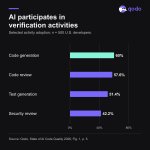
In our 2026 survey, developers use AI for code generation (60%), review (57.6%), and tests (51.4%).
Code and generated tests can share a misunderstood requirement. Give verification an agreed acceptance criterion it can check.
Explore how assumptions can carry across AI-assisted development stages in our 2026 State of AI Code Quality report, pp. 5–6.
Download: qodo.ai/state-of-ai-code-qua…
Qodo retweeted
I don't read code anymore.
The abstraction layer for humans has changed. AI agents are frontline coders now.
I define tasks and constraints, and I work with my team lead agent, but my role is that of a product engineer, a general of my robot army: designing logistics, providing provisions (context) and offering judgement for key decisions.
I use multiple models to help me, from different model families:
- A team lead agent that can either implement work, or assign it to other agents
- Automated reviewers to check for biases
- Multi-model cross family review for key changes
Intentionally, I create smaller iteration loops within the overall code review loop:
- Cheap + fast checks and verification from the implementing coding agent can send the change back for additional work
- Standardized reproduction of findings
- Re-review of final commits post fixes by lead models
- Evidence backed merge decisions
You need a code review loop that unblocks you as a human, keeping your judgement for the most important decisions, and unblocks your AI factory to move at agent speed.
Agents code. Humans lead.
Full breakdown featuring @coralbricksdev, @QodoAI, examples from my OSS project @avoidaiwriting , insights from @AnushElangovan, @kimblgn & much more below👇
Nuance is one of the hardest frontiers in agentic engineering.
Making it available to agents is work practitioners will need to do: explain it, codify it, and embed it into the software factories we’re building.
In her latest article, @nnennahacks explores how to codify that nuance, and why practitioners who learn to do it well will become increasingly valuable.
Read “How to Codify Nuance in Agentic Engineering”.
Read “How to Codify Nuance in Agentic Engineering” by @nnennahacks:
qodo.ai/blog/how-to-codify-n…
Liz Fong-Jones of @honeycombio on voice-driven coding: review the transcript before it becomes an agent's instructions.
Listen to The Agentic Review podcast with @nnennahacks and @itamar_mar.


