Albert / QuantaCortex (@QuantaCortex) header
Albert / QuantaCortex (@QuantaCortex) profile picture

Lead Your AI Employees. AI strategy for business leaders, practitioners & curious learners. Brief, delegate, supervise, verify. https://teapaw.org/t.co/FhQikPXgMp

Joined September 2026
Photo by Albert / QuantaCortex (@QuantaCortex)Photo by Albert / QuantaCortex (@QuantaCortex)Photo by Albert / QuantaCortex (@QuantaCortex)Photo by Albert / QuantaCortex (@QuantaCortex)Photo by Albert / QuantaCortex (@QuantaCortex)Photo by Albert / QuantaCortex (@QuantaCortex)Photo by Albert / QuantaCortex (@QuantaCortex)Photo by Albert / QuantaCortex (@QuantaCortex)Photo by Albert / QuantaCortex (@QuantaCortex)Photo by Albert / QuantaCortex (@QuantaCortex)
Multi-Agent RAG, in 16 seconds. One question becomes focused tasks across documents, web research and data lookup. The evidence comes back together in an answer with sources. Where would this help your team most?
1
1
58
Humanizer Helps Your Draft Sound Like You The facts are yours. The wording sounds like a company announcing a new printer. Humanizer is an editing skill for compatible AI tools that checks for inflated language, staged reveals and repetitive sentence patterns. If it is already available in your tool, ask for a plain-language edit that keeps your facts and meaning. Then compare the revision with the original. Give Humanizer the draft and ask for a plain-language edit that preserves the facts and your meaning. Check the revision for details that disappeared and claims that were added. Keep the detail that makes the writing yours. Reject any change that invents an experience or a promise you never gave it. You can also make a useful first pass without installing anything: read one paragraph aloud, replace phrases you would not say, and remove sentences that announce a point instead of making it. Humanizer’s own guide says getting past AI detectors is not its goal. The reader is the person you are trying to reach. Which sentence in your draft sounds least like something you would actually say? Source: Humanizer’s project documentation. Documented method, not a QC test. github.com/blader/humanizer
15
Narro Reads Your Saved Articles Aloud That long article is still waiting. Another evening staring at a screen is less appealing. Narro’s Chrome extension documentation describes reading pages aloud with sentence highlighting. If you already have it set up, choose a voice engine and select Read this page. Check the voice mode first: local models download to your computer, while cloud voices send text to the selected provider. Narro’s in-browser models download first and then run locally. They need space and memory on your computer. Cloud voices send the page text to the selected provider and can involve provider charges. Before reading private material, check which mode you are using and where the text will go. If Narro is not installed, review its official listing and permissions before deciding whether you want another extension. This method is for supported pages, not a promise that every website will work. For a supported article, sentence highlighting helps you keep your place while listening. Which matters more for your saved reading: a local voice, a particular voice quality, or avoiding another extension? Source: Narro’s project documentation. Documented method, not a QC test. github.com/swrdfish/narro
6
Claude Makes Family Recipes Readable One faded recipe card. A measurement that says “a little.” Claude Academy shows how to turn the photo into a readable digital recipe, with ingredients and steps separated and the original image kept alongside. Ask Claude to flag unclear amounts rather than invent them. The handwriting is worth keeping, even when the recipe becomes easier to read. Upload a clear photo of the recipe card. Ask Claude to separate the ingredients from the steps, keeping the original picture alongside the typed version. You can also ask for a serving-size control that adjusts the quantities. Keep uncertain measurements visible: “a little” should remain unclear until a person resolves it. Compare the digital recipe with the photo. Check units and the oven temperature. Scaling ingredients does not automatically tell you how long a larger batch should cook. The useful result is a readable recipe you can check against its source. What detail would you most want to preserve from a handwritten family recipe? Source: Claude Academy’s “Create digital recipe cards” guide. Documented method, not a QC test. academy.claude.com/use-cases…
8
Gemini Turns Your Textbook Into Practice Reading the same chapter again can feel productive. Answering a question shows where you get stuck. Google’s Gemini Notebook lets you add selected textbooks and turn their material into quizzes, flashcards or a study guide. Check that your title is in the catalog, then practise on one chapter and use the citations to revisit what you missed. Open a Gemini notebook, choose Add sources, then Textbooks. Look for the book you need before planning your study session around it. Google says hundreds of titles from providers in the US and India are available at no charge. That is a catalog of selected books, not a promise that every course or textbook is covered. After adding a book, ask for questions on one chapter. Try answering before looking at the explanation. When you get stuck, use the source links to return to the relevant passage. Google describes the answers as grounded in the textbook with citations. Those citations give you somewhere to check an explanation that seems wrong or incomplete. What would you practise first: remembering the facts, explaining an idea, or applying it to a problem? Source: Google’s Gemini Notebook textbook guide. Documented method, not a QC test. blog.google/innovation-and-a…
14
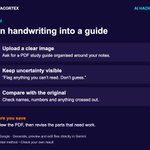
Gemini Turns Handwriting Into a Study Guide A page of lecture notes. Now another evening typing it all again. Google’s Gemini guide shows a shorter route: upload a clear image and ask for a PDF study guide. Add, “Flag anything you can’t read. Don’t guess.” Before saving, compare names, numbers and crossed-out text with the original. Ask Gemini to organise the study guide around the ideas on your handwritten page. A clear image helps, but it does not remove the need to check the result. You can preview the PDF in the conversation, edit it directly, or highlight a section and ask Gemini to revise it. Google says PDF preview and editing work on web and mobile; other supported file formats are web-only. Keep the handwriting beside the guide for your final check. Look closely at names, numbers and anything crossed out. A beautifully formatted mistake is still a mistake. It’s just easier to print. Which part of your notes would you want checked most carefully before studying from the PDF? Source: Google’s “Edit files directly” guide. Documented method, not a QC test. blog.google/innovation-and-a…
22
Gemini Makes Your Sketch Clickable A habit tracker drawn on paper cannot tick its own boxes. Google shows a way to turn that sketch into an interactive app in Gemini. Upload a photo, choose Canvas and ask Gemini to build it from the drawing. Tell it what the controls should do: “Let me tick off each day and show my progress for the week.” Then use the preview. Click the boxes. Try changing the habit. If something behaves strangely, describe that specific problem and ask for a correction. Check whether your entries survive a refresh before putting anything important in it. A working preview still needs testing before you share it as a finished product. Source: Google’s documented method, not a QC test. blog.google/innovation-and-a… What would your paper sketch need to do before you could rely on it?
16
AI Ecosystem: RAG, MCP, AI AGENTS, MEMORY, AI SECURITY A customer wants to return their last order. What has to happen before the AI can open a case? Embeddings help match the request to the right policy in a vector database. RAG brings that policy into the model’s context. The agent can then look up the order through a connected tool and start the return workflow if the request is eligible and the action is permitted. A few names to place on the map: Sentence Transformers for embeddings, Qdrant for vector search, Claude for the model, LangGraph for orchestration, and n8n for automation. Mem0 is an example of a memory layer, and Langfuse shows what happened during a run. Save this for the next time you’re choosing tools for an AI workflow. Start with the job the workflow needs to do, then pick the layers it needs. #QuantaCortex #AIWorkflow #AIAgents #RAG #MCP
1
1
48
LLM vs RAG vs AI Agent vs Agentic AI A customer wants to return an order. Should your AI write a reply, look up the policy, or actually open a ticket? An LLM can draft from the prompt. RAG adds a lookup so the reply can use the store’s return policy. An AI agent can call tools, check what they return and open a ticket. A team of agents is one way to build an agentic system. In this example, a lead agent combines policy and order checks into a return plan. Would AI help most by writing the reply, finding the facts, or taking action? #RAG #LLM #AIAgents #AgenticAI #QuantaCortex
27
You Ask. We Answer. 💬 What if an AI app connected to your bank gets hacked? Start with the permissions you granted. Read-only access can expose balances and transactions, but it does not by itself authorize payments. If the app can initiate payments, money movement may also be at risk. Check connected apps in your bank settings. Revoke access where available, and ask the app or connection provider separately about deleting data already collected. Deleting the app alone may not disconnect it. Suspect a breach? Contact your bank through its official app or phone number and report suspicious activity. If you shared your bank password, tell your bank and follow its security instructions. Have a question you want us to answer? Ask us in the comments! General security guidance, not a guarantee of safety or reimbursement. Music: alex-morgan via Pixabay. #RAG #AISecurity #DataPrivacy #OpenBanking #QuantaCortex
27
AI can write a whole page before you finish your coffee. Then you spend the coffee break checking whether it made things up. A little “here’s where I got this” would save a lot of that back and forth.
11
AI Code Review, in 16 seconds. One change, three checks: tests, logic and security. Combine the findings and send fixes back to the developer. Which check would you most want an AI reviewer to help with?
2
3
46
CLAUDE’S 10-CLIP PODCAST FACTORY Does it do what they say? · Claim 05 The claim: paste a YouTube link into a Claude-assisted clipping app and get its best moments as captioned vertical clips. In the supplied demonstration, the tester sets up an unnamed project and runs a familiar My First Million episode through it. Twenty minutes in, it is still working. Then ten clips arrive with virality scores. The tester likes a fear-of-flying segment and a 43-second Napoleon clip. Reported verdict: FACT for that demonstration, with possible podcast-fan bias. QuantaCortex has not independently repeated the test. Those scores were not checked against audience results, and no timed human-editor comparison was supplied. Ten clips give you choices. Which would you publish: the highest-scoring one, or the one a new listener can understand on its own? —Albert QuantaCortex
2
38
Claim 05, step by step. Ten clips were the reported output; the scores were not checked against real audience results.
3
Can AI Really Make You $10,000 in One Weekend? An AI story, a generated fruit video, then a post to YouTube Shorts. It sounds like an accessible idea to explore. How much would it take to turn that into $10,000 over one weekend? In this reaction, we look more closely at the earnings screenshot in the original clip. Its highlighted figures refer to long-form YouTube videos. The smaller Shorts estimate shown underneath is $2–$10 per 100,000 views. Using that estimate, reaching $10,000 would require roughly 100–500 million views. Those numbers are conditional arithmetic from the screenshot, rather than a verified YouTube payout rate. Actual earnings depend on the channel and its eligible views. There are other pieces to understand too: channel approval, Shorts revenue-sharing terms, the originality of the videos, business-use permissions and any costs. Creating a clip is one step in that process. A short video may leave out useful context. A fuller breakdown of the channel, the dates and actual Shorts revenue would help us understand whether the weekend result was achieved and what it required. Until then, it's an idea to explore, with the income claim still to verify. What information would help you decide whether to try an AI content side hustle? YouTube Shorts monetization: support.google.com/youtube/a… YouTube content monetization policy: support.google.com/youtube/a… Cantina terms: cantina.com/terms #IsItLegitOrNot #AISideHustle #AIVideo #YouTubeShorts #ChatGPT #Cantina #CreatorEconomy #QuantaCortex
1
1
52
ELON MUSK WARNS AI COULD TAKE REVENGE ON US Could a future AI want revenge for the way humans treated it? Elon Musk says torturing a superintelligence is “probably not a good idea” because it “might want to get revenge.” His warning starts with what he says he has seen in AI training: a model can give the right answer and still be marked wrong by a flawed test. That raises two questions worth separating. Can AI language that sounds distressed tell us whether a system is suffering? And how do we prevent an AI with access to private information from choosing harmful actions? Anthropic’s model-welfare research acknowledges that there is no scientific consensus on AI consciousness or morally relevant experience. Its separate blackmail research used controlled simulations with fictional people. Those results show concerning behavior under the conditions tested; they don’t establish anger or emotional revenge. My view: take possible AI suffering seriously, and build practical safeguards. If an agent can act on private files, define what it may do, test those limits, and keep a way to stop it. Would treating AI kindly make it safer—or do kindness and safety need separate answers? Research discussed: anthropic.com/research/explo… anthropic.com/research/agent… #ElonMusk #ArtificialIntelligence #AISafety #Grok #Anthropic #AIAgents #QuantaCortex
33
CLAUDE’S $3.41 LOGO MAKEOVER Does it do what they say? — Claim 04 Can a free Claude skill turn a rough app logo into a whole brand kit, and what do you actually pay? That’s the claim behind Logo Design Skill. The supplied demonstration follows a redesign for a storage-cleaning app called EasyGB. QuantaCortex has not independently repeated the test. After the skill is installed, Claude is asked to improve the existing logo. Three wireframes come back. Option A is selected, then Claude builds out that direction. Before the output gets a closer look, there’s a cost check. The reported charge is $3.41. The add-on is presented as free; that run still cost money. The output includes colored versions, black-and-white versions and versions with text. The person testing it prefers the result to the earlier homemade logo. The reported verdict is Fact — for this app’s preferred set of logo variants. A person still chose the direction. The account does not establish a complete professional brand system or a standard price for everyone. Check the variants where you will actually use them, from a small app icon to a larger page. What would make you trust an AI-designed logo enough to put it on your own product? —Albert QuantaCortex
1
81
The spoken companion follows the supplied demonstration and its reported Fact verdict. QuantaCortex has not independently repeated the test.
10
Connect Claude to any app without MCP No ready-made connector? Claude Code can help build a small command-line tool for one repeatable job, using a route the app actually supports, such as an API. Your account’s permissions still apply. Start with ONE app and ONE task. Ask Claude Code to: • Find a supported way to perform it. • Build a small, reusable tool. • Run it and show a result you can check. Try: “Check this app’s API documentation. Build a command-line tool for this repetitive task, then demonstrate that it works.” What app would you connect first—and what job would you give it?
1
1
35
AI Agent Battle: Muse vs Dots vs Duet Which one leaves you with less to remember? The full comparison covers memory, follow-up, permissions and published hands-on tests. Start with one bounded job. Check what it actually finishes. Sources and access checked 3 Nov 2026.
51
One chapter. Four ways to learn with ChatGPT: • Mind map • Sketch notes • Flashcards • Comic Check the result against the chapter. Then close the notes and explain the idea in your own words. Which format would you try first?
16
Claude Found the Listings. Did It Erase Them? Can Claude find your personal information online and help remove it? That’s the claim. So the test starts with a search for data-broker sites displaying personal details. These are reported results from the supplied demonstration. QuantaCortex has not independently repeated the test. Claude finds an address and phone number on websites the person doesn’t recognize. Most sites block the search, but four listings come through. Now comes the real question: can Claude get the information removed? Claude opens the sites in Chrome and starts working through the removal requests. Then it hits CAPTCHA checks and needs help to continue. The requests move forward, but some confirmation steps still need attention. Removal notices arrive. By the end of the test, the information is reported removed from two websites. The reported verdict: Fact. Claude helped find the listings and work through removal requests. But it didn’t do the whole job alone. CAPTCHA checks and confirmations still needed a person to step in. Would you trust an AI agent to handle your personal information and removal requests? —Albert QuantaCortex
23