

Robust algo trading Edges for traders using AmiBroker & EasyLanguage. For serious traders focused on risk, robustness & realism.
Europe
Joined August 2018
- Tweets2.8K
- Following284
- Followers3.2K
- Likes704





Pinned Tweet
Black Friday is one day.
A sample size of one.
I don't trade sample sizes of one, so I'm not running a promotion on one either.
BlackMonth. All of November.

BlackMonth closes November 30.
ko-fi.com/s/5cbd9c2f24

Each monthly delivery is a deployment pack, not signals:
Plain English rules
AFL (AmiBroker)
ELD (TradeStation)
Python notebook
Historical trades file
Daily timeframe. Liquid ETFs. Long or short. One every month since January 2024.
New subscribers also get the SPY Portfolio.
20 systems on SPY. Low correlation between them. Every one passed the full battery: IS/OOS, walk-forward, Monte Carlo, parameter permutation and many more.
Passing my tests does not guarantee future results. Nothing does.
Subscribe to ProTrade Annual in November:
November 2026 Edge, free
December 2026 Edge, free
All 12 Edges of 2027
14 systems for $600. $42.86 per system instead of $50.
So the lesson isn't "stops don't work". It's narrower and more useful.
A stop is not free insurance. It's a trade you make against your own strategy, and the bill arrives in the positions that would have recovered — the ones you never see, because you closed them.
Being right about which trades to kill is a different thing from profiting by killing them.
August's edge — IYR, "The Absent Landlord" — ships without this overlay, and now I can say exactly why
The obvious answer is "then move the stop".
I tested that: every fixed distance from 1 to 12 ATR, plus three different calibrations. Widen it and you keep more of the return — but it stops protecting anything worth protecting. Nothing tested cleared the bar.
It isn't a tuning problem.
Where the money went, in full:
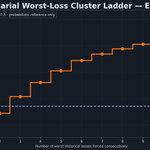
Cutting losses early saved +14.1 points. Losses that got worse on the fill cost −27.7. Seven trades that were on their way back to profit got closed before they got there: −39.1.
Net: −52.7.
Seven interrupted recoveries cost more than every successful rescue combined.

It cost about 40% of the money.
Same entries, same signals, same everything — the only difference is the stop. Compounded across the evaluated history, $100 finishes near $535 with it and near $910 without.
And it didn't buy safety in exchange. The worst single trade got worse. So did the deepest drawdown.

The rule was built honestly, which matters for what follows.
For each trade, the stop sits where previous winning trades had already proven they never went. Nothing from the future. Nothing from the trade's own outcome. Gaps fill at the open, conservatively.
No cheating, no hindsight. Just a well-aimed seatbelt.
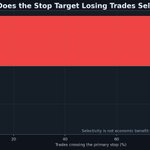
I added a disaster stop to this month's IYR system and tested twenty-five years of trades with it.
It caught 78.6% of the trades that went on to lose money.
It touched only 4.7% of the winners.
Almost perfect aim.

So the honest map isn't "works everywhere".
Strongest in violent markets. Dependable in quiet ones. Unproven in the ordinary middle. Weakest when price goes nowhere.
That map is worth more than any single headline number — it tells me which results to trust and which are just the tide.
August's edge — IYR, "The Absent Landlord" — is written up in full → check bio.
Sideways markets are the outright soft spot: in both the normal and volatile ranging states, the cautious end of the range dips below zero.
Two more states had too few trades to judge at all, and I'd rather say that than dress up three trades as a finding.
Now the uncomfortable one.
The market this system trades most often — normal volatility, gentle uptrend, 48 trades, 23% of everything it has ever done — is the one where I can least prove it's clever.
The returns there are reliably positive. But against random entries in the same conditions, the timing advantage doesn't hold up. It made money; I can't show the entries were the reason.

And across all nine states taken together, none of a thousand random-timing versions of the system matched that spread of results.
Breadth is the part people skip. One great regime can be luck. Positive evidence holding across several different market environments is harder to fake.
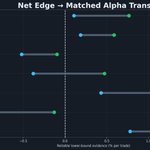
Demand that even the cautious end of the range stays above zero, and nine becomes five.
In four of those five, the trades also beat random entries taken in the same market conditions — so not just profitable, but better-timed than chance.

It also made money in all nine market types. Every single one, positive on average.
Which proves less than it sounds. A rising tide covers a lot of mediocre timing, and 25 years of property prices contain a lot of tide.
So the number that matters isn't "did it profit". It's "where does the profit survive scrutiny".

The strongest state, by a distance: volatile and falling.
Sixteen trades, +2.69% each on average — roughly triple what the same system earns in an ordinary quiet market.
It's a long-only system. It buys. Its best environment is the one where everyone else is selling.
The method, on this month's IYR edge.
Every trade gets tagged with the market it was born into: calm, normal or violent, crossed with rising, falling or going nowhere.
Nine combinations. Then you ask the same question of each one.
