

Content Creator | Ambassador | CM | Supporter @injective
Crypto
Joined May 2021
- Tweets2.5K
- Following1.3K
- Followers1.5K
- Likes5K






Injective journey from a small dorm room in 2018 to the Nasdaq opening bell is a story worth following.
On November 6, @injective CEO Eric Chen joined Canary Capital CEO Steven McClurg to ring the Nasdaq opening bell and celebrate the launch of the Canary Staked $INJ ETF.
Just a few years ago, Injective was an early idea built by a small team.
Today, $INJ has its first U.S. listed ETF, giving traditional investors another way to access the ecosystem.
The ETF holds actual $INJ tokens and aims to stake at least 90% of its holdings under normal conditions.
Investors can get exposure to $INJ price and potential staking rewards through regular brokerage accounts without managing crypto wallets or private keys.
The fund also has a 1.10% annual sponsor fee and shares part of its staking rewards through fees.
So it's important to understand that buying $INJC means owning ETF shares, not directly holding $INJ.
For me, the biggest part of this moment is the journey behind it.
Injective started with an idea around better financial systems and has continued building through different market conditions.
The Nasdaq bell is a big milestone, but it doesn't mark the finish line.
Injective next chapter will be shaped by real adoption, useful products and the growth of its onchain financial ecosystem.

Injective journey from a small idea to the Nasdaq opening bell is a big moment for the ecosystem.
On November 6, Eric Chen from @injective and Steven McClurg from Canary Capital joined the Nasdaq opening bell ceremony to celebrate the launch of the Canary Staked $INJ ETF - $INJC.
The event brought the Injective and Canary teams together in Times Square, with the Nasdaq billboard celebrating the new ETF.
But the bigger story is what this launch represents.
$INJC holds actual $INJ tokens and aims to stake at least 90% of its holdings under normal conditions.
Investors can get exposure to $INJ and potential staking rewards through traditional brokerage accounts without managing wallets or private keys.
There are costs to consider, including a 1.10% annual sponsor fee and a share of staking rewards going toward fees.
Investors also own ETF shares, not $INJ directly.
Injective is reaching a new group of investors while continuing to build its onchain financial ecosystem.
The Nasdaq bell was one big moment, but the real work is building long term value through adoption, useful products, and activity across the network.
The journey is still moving forward.

Injective has officially opened a new door for $INJ in the U.S. financial market.
The Canary Staked $INJ ETF is now live on Nasdaq, giving millions of investors and institutions access to $INJ through traditional brokerage accounts.
Its first trading day brought a positive start, with $INJC reaching $26.37, up 5.48% from its previous close.
But the bigger story is how this ETF works.
Unlike a product that only tracks price movements, $INJC holds actual $INJ and aims to stake at least 90% of its holdings under normal conditions.
Net staking rewards are reflected in the fund’s NAV, allowing investors to gain exposure to INJ while also benefiting from its staking activity.
BitGo handles custody, and the fund charges a 1.10% annual sponsor fee.
Staking related fees can also take a share of the rewards.
Another important detail is accessibility. Investors can buy $INJC through eligible U.S. brokerage accounts without managing crypto wallets, private keys, or exchange accounts.
This is an important step for Injective because it connects its native asset with a much wider investment market.
Of course, the ETF is still new. Trading volume, investor demand, staking performance, and long-term adoption will matter more than one positive trading day.
@injective has spent years building onchain financial infrastructure. Now, $INJ has another path into traditional finance.

Injective has officially brought $INJ to Nasdaq through $INJC, the first U.S. ETF tracking its native token.
Launched on November 5, the Canary Staked $INJ ETF gives people a way to get exposure to $INJ through a regular brokerage account.
They don't need a crypto wallet, private keys, or an exchange account.
The ETF holds spot $INJ, with BitGo handling custody.
It also plans to stake up to 90% of its INJ holdings, and the net staking rewards are automatically added back to the fund.
This means investors can get price exposure to $INJ while the ETF also takes part in Injective's staking system.
The fund is designed to bring both features into a familiar investment product.
And there is real network activity behind the ticker:
• 3B+ transactions
• $1B+ in tokenized assets
• 7.2M+ $INJ bought back and burned using onchain revenue
• Infrastructure for RWAs, perps, trading, and privacy
@injective has also made progress with institutions through its SEC-registered transfer agent, the LG tokenization project, and Institutional Rail for banks and businesses.
$INJC adds another route for traditional investors to access $INJ.
For Injective, this is a new step in connecting its blockchain with traditional financial markets.

Injective is creating more opportunities for builders to turn ideas into real products.
The network has announced its first-ever Injective Hacker House, a 10-day builder program taking place in Bangkok from December 1–10, 2026.
Only 20 teams will be selected to work closely with the @injective team, mentors and industry partners.
The main focus areas are real world assets privacy and AI powered applications.
Builders will get the chance to work with Injective latest technology, including the $SICI GPU Compute Index and its new options infrastructure.
Projects can explore areas such as AI trading agents, AI payments, tokenized assets, derivatives and decentralized AI.
Selected teams will receive accommodation, meals, flight support, and $4,500 in AWS credits per eligible entity.
They will also get technical guidance, workshops, and direct feedback from experienced builders.
The program is organized with HackQuest, with support from AWS, Animoca Brands, SMBC Nikko, OpenTensor, and Gulf Labs.
Standout teams may also get opportunities for grants and incubation after Demo Day on December 9.
This is more than a regular weekend hackathon.
Giving builders 10 days of direct support and access to new financial tools can help turn early ideas into working applications.
Applications close on November 10, 2026.
The next wave of useful applications will come from builders who get the right tools and support.
$INJ
x.com/injective/stat…
Rayan retweeted

$INJ HAD A STRONG Q3.
The price surged 63%, from $4.54 to $7.41, hitting a quarterly high of $8.18.
But price action wasn't the only highlight.
Here’s what Injective achieved in Q3:
-MiCA white paper covering ~30 European markets
-SEC-registered transfer agent status
-$1B+ in mortgage records onchain
-INJ launched on Solana
-Two major INJ ETF filing amendments
-Meridian upgrade for regulated RWAs and unified markets
Regulatory progress, institutional adoption, and RWA expansion.
Injective is building.
🤖 Made with AI

Injective is taking onchain derivatives beyond perpetuals with a new options primitive.
The newly introduced Injective Options infrastructure lets developers build options markets around real world indices and commodities, with trades settled in native USDC.
The first testnet markets cover $SICI, the US500, US Tech, gold, silver and WTI crude oil.
The SICI market is especially interesting because it tracks GPU rental prices across five NVIDIA GPUs, using hourly data from LO:TECH.
Here’s what makes the design different:
Options are fully collateralized, with capped payouts. Writers lock the maximum payout upfront, so the system doesn’t rely on borrowing, margin calls or liquidation mechanisms.
Buyers can see their premium, maximum profit, maximum loss and breakeven before confirming a trade.
That creates some practical use cases.
A GPU provider could use SICI puts to hedge against falling rental prices, while a business exposed to rising compute costs could explore calls.
Developers can also build their own options interfaces and derivatives products on top of the underlying infrastructure.
@injective is building more than markets where users speculate on price movements.
Options introduce another tool for managing risk, which could become useful as onchain exposure expands across financial assets and computing markets.
There are still important limits. The initial markets are on testnet, access is rolling out in stages, and writing options is initially restricted to whitelisted participants.
These products also carry risk, even when maximum losses are defined.
Perpetuals provide exposure. Options add another layer of risk management.
That’s a meaningful expansion for Injective’s finance native infrastructure.
$INJ
Injective is opening the door to more than dollar-based onchain markets.
South Korea has a large and active crypto market, but most stablecoin activity still revolves around the U.S. dollar.
The KRW1 initiative with BDACS introduces a different possibility: using the Korean won as a settlement currency for tokenized assets on @injective.
Think about the practical side. If a Korean company wants to settle a tokenized bond or trade receivable, a won backed stablecoin could help it avoid unnecessary conversion into dollars.
It could also create a foundation for connecting local currency payments with onchain trading and financial products.
Injective already has experience in this area, with more than $7.5B in RWA volume and Korean firms such as POSCO International and LG CNS involved in onchain trade receivables settlement.
For me, the bigger idea is giving onchain finance a way to serve different local markets, instead of making every transaction depend on the same currency.
Native USDC can support dollar-based activity, while KRW1 could eventually serve institutions that need won settlement.
One important point: KRW1 on Injective is still at the partnership stage.
The MOU does not mean open access is live today, and minting and redemption depend on institutional approval and regulatory requirements.
If the initiative moves forward, it could help connect Korean financial activity with global onchain markets while keeping the Korean won at the center of settlement.
More currencies, more ways to build onchain finance.
$INJ

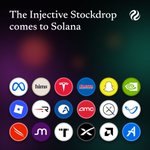
Injective is bringing tokenized stocks into the $INJ ecosystem.
The second @injective Stockdrop is here, and this time the stock rewards are coming through Solana.
Users who joined the latest Community BuyBack get a chance to receive one random tokenized stock.
The list includes names like $NVDA, $TSLA, $META, $AAPL, and $COIN.
The BuyBack has another purpose too. Users commit $INJ, which gets permanently burned, and participants can earn a share of ecosystem revenue.
One thing to remember: the stock reward is based on each eligible wallet’s chance, not on how much $INJ it commits.
It’s also tokenized stock exposure, not necessarily direct ownership of the actual shares.
Combining $INJ burns, revenue sharing, and tokenized stock rewards gives people another reason to take part in Injective ecosystem.
Now the important part is seeing how this model grows with more users and real onchain activity.

Injective is making moves toward regulated finance in the US.
On October 24, @injective shared that CEO Eric Chen and members of its team had met with officials from the White House, SEC, and CFTC in Washington, D.C.
These meetings show Injective focus on working with regulators as finance moves onchain.
But they did not announce any new approvals or deals.
Injective already has some important steps in place. Its institutional service is registered with the SEC as a transfer agent, and $INJ futures are listed on CFTC regulated US markets.
The team is also working on tools for tokenized stocks, funds, and other real-world assets.
Bringing real assets onchain needs more than fast transactions.
It also needs clear rules, trusted ownership records, and access to regulated markets.
Injective is working on these areas, and that could matter as tokenized finance grows.
The next step is turning this progress into real use by institutions.


Injective is bringing traditional financial markets right into its core trading system.
Today, 47% of @injective active perpetual markets are linked to real world assets, with 135 RWA markets now live onchain.
These markets cover company stocks, currencies, gold, oil, market indexes, and pre IPO companies like SpaceX and OpenAI.
Traders can take long or short positions on price changes without owning the actual assets. These markets use perpetual contracts so they have no fixed end date.
This shows how much RWA trading has become part of Injective. It is no longer limited to a few tokenized assets.
Traders can access many types of traditional markets through the same onchain system.
Injective has also recorded over $1.1 billion in RWA perpetual trading volume in 2026 so far. That activity adds to the growing range of markets available on the network.
Of course, market count and trading volume alone do not prove long term success. These markets still need strong liquidity, fair prices, and steady trader interest.
But with 135 RWA markets already live, Injective is building a place where crypto and traditional market exposure can exist side by side.
The next step is to keep making these markets more useful, active, and reliable for traders.
$INJ

Injective is expanding its RWA ecosystem into Korean won settlement.
The partnership with BDACS to bring KRW1 onto @injective has now gained coverage from The Block and Cointelegraph.
KRW1 is designed to be backed 1:1 by Korean won, giving institutions a potential way to settle tokenized assets directly in their local currency instead of relying entirely on dollar-backed stablecoins.
When Korean institutions use USD stablecoins for won-based markets, they can face additional foreign-exchange exposure.
Native KRW settlement could help reduce that friction and create a more direct path for Korean assets to move onchain.
Injective already has over $1B in tokenized assets issued and more than $7.5B in RWA trading volume.
Its work with Korean companies like POSCO International and LG CNS also gives this development a wider institutional context.
RWA adoption needs local-currency settlement, not just tokenized assets.
If KRW1 moves forward, it could help connect Korea’s financial market with onchain trading and settlement through Injective.
One important detail: this is still an MOU.
Institutional minting and redemption remain subject to regulatory approval, so the full rollout is not yet guaranteed. $INJ

A new wave is coming to @injective.
Injective has been making big moves, and this latest teaser has me watching closely.
The new whitepaper shows a bigger plan for onchain finance, including real-world assets, stablecoins, and trading tools for large investors.
Privacy is another area to watch. CypherOS is being developed to support private trading and transactions. This could help traders keep some deal details private instead of showing everything publicly.
Injective is also working on quantum-resistant technology to help protect the network against future security risks.
Alongside this, Injective continues to build partnerships and bring real-world assets onto the blockchain. Its work with KRW1 could also help bring Korean won-based payments to onchain markets.
The next step could be about more than just adding new features. Better privacy, stronger security, and more real-world financial use cases could make Injective’s ecosystem even stronger.
We still don’t know what this teaser is about, so I’m waiting for the official announcement.
The next wave could bring another important step for Injective.
$INJ

Injective next real world use case could extend from mortgage records to the AI systems that help manage them.
Pentiv, Pineapple Financial new operating brand, plans to bring records for its full $10 billion real estate portfolio onto @injective, covering more than 29,000 funded mortgages.
Over $1 billion in residential mortgage records is already onchain, giving the project a starting point for a much wider rollout.
The plan goes beyond recording data. Pentiv is developing AI-powered tools for mortgage brokerages, with a longer-term goal of bringing more of those operations onchain and using $INJ within its agentic workflows.
The full portfolio move is a target, not a completed migration, and the records represent existing loans rather than ownership of the physical properties.
Other developments this week add to the picture.
Gulf Labs has gone live as an institutional validator, Injective latest upgrade has made gas requirements more predictable, and new Circle CCTP routes through LIFI and Jumper make it easier to bring USDC onto the network.
Injective also reports more than 3 billion lifetime transactions and $370 million in DEX volume over the past seven days.
Those figures show network activity, while Pentiv points toward a different kind of use: connecting financial records with the software and workflows built around them.
The bigger test is whether this model can expand beyond one company and support real mortgage operations at scale.
If Pentiv delivers, Injective could play a role not only in storing financial data, but also in powering the AI-driven processes that use it.
Injective keeps pushing its ecosystem forward with another $INJ Community BuyBack round.
The Community buyback event is now LIVE, with around $251K worth of $INJ in the current reward pool.
Participants commit a certain amount of $INJ, which is permanently burned at the end of the round.
In return, they receive a share of the revenue generated across the Injective ecosystem. The amount of rewards depends on each participant’s contribution.
This round also brings an extra opportunity to earn bonus tokenized stocks on Solana through Injective’s Stockdrop program.
The program has already burned more than 7.27M $INJ across previous rounds. The current round also displays an estimated 19.99% ROI based on historical data, but actual returns can vary and are not guaranteed.
This is a strong way to connect ecosystem activity with $INJ tokenomics.
The community can take part in reducing the token supply while receiving a share of ecosystem revenue in return.
@injective continues to build a model where ecosystem activity and token utility work together.

Injective is bringing the Korean won onchain through KRW1.
Through its partnership with BDACS, Injective plans to bring a won-backed stablecoin to its RWA markets.
This could let supported tokenized assets be traded and settled directly in Korean won instead of relying only on dollar stablecoins.
South Korea has seen around $10.4B in net stablecoin outflows over 18 straight months, as money moves to offshore platforms.
Using the local currency onchain could give Korean investors and institutions another way to access digital markets.
@injective already has ties with major Korean companies. POSCO International and LG CNS have chosen the network for trade-receivables tokenization.
KRW1 could add a local-currency settlement option to this growing activity.
Injective reports over $7.5B in RWA trading volume and more than $1B in tokenized assets. Adding the Korean won could help support more onchain trading in real-world assets and foreign exchange.
The deal is still at the MoU stage. KRW1 minting and redemption are expected to be limited to approved institutional partners and remain subject to regulatory requirements. It is not yet a public launch for everyone.
Onchain finance needs more than dollar-based markets. Bringing the Korean won into Injective could help local institutions trade and settle tokenized assets in their own currency.
$INJ
Injective is taking low-cost trading a step further with IIP-709.
Low gas fees are already one of @injective strengths. Now, the focus is making transaction costs more predictable.
IIP-709 introduces fixed gas fees for key exchange operations, including placing and canceling orders, deposits, withdrawals, and subaccount transfers.
Traders, market makers, and trading bots can use published gas values instead of repeatedly estimating the cost of each transaction.
This can reduce preparation time, lower latency, and help prevent failed transactions caused by incorrect gas estimates.
For institutions and applications handling frequent transactions, that kind of predictability can make integration and execution easier to manage.
One important detail: fixed gas does not mean free transactions, and it does not change maker or taker trading fees.
Those remain separate.
To me, this is the kind of practical upgrade that matters when a blockchain is built for financial activity.
Low costs are useful, but reliable execution matters too.
Injective is working to make onchain trading not just fast and affordable, but more predictable.
$INJ
Injective just made onchain trading more predictable.
The IIP-709 upgrade is now live on mainnet, bringing fixed gas fees to key trading and transfer actions.
Placing or canceling spot and perpetual orders, moving funds between subaccounts, and other supported exchange actions now have predictable gas costs.
For traders, this means more clarity when planning transaction costs.
For market makers and institutions, it makes costs easier to manage across frequent onchain activity.
@injective already offers low gas fees.
Now, users get more certainty about what they’ll pay for supported actions.
And importantly, trading fees remain unchanged - this upgrade affects gas fees only.
Private transactions are also expected to benefit from this fixed-fee approach in the future.
For a finance-focused chain, predictable costs are a big part of making onchain markets easier to use at scale.
Low fees are good.
Knowing what you’ll pay is even better.
Injective keeps moving forward.
$INJ
Injective is taking its onchain finance vision straight to Washington.
@injective CEO Eric Chen met with officials from the White House, SEC, and CFTC alongside members of the team.
The discussions reflect a broader effort to shape how tokenization and DeFi can develop within the U.S. regulatory system.
Injective is also building around that goal. Its affiliate, Injective Institutional Services, became an SEC-registered transfer agent in August, while Injective Mint gives issuers tools to bring real-world assets onchain.
$INJ futures listed under CFTC regulation also add another connection between Injective and traditional financial markets.
The work extends beyond meetings.
Injective has submitted policy proposals and comment letters to the SEC on DeFi, and its Policy Institute continues engaging with lawmakers on tokenization, lending, and onchain perpetual markets.
Clear rules matter because builders and institutions need to understand what they can launch, how assets can be managed, and which requirements apply before they commit to a market.
Injective is working on both sides of that challenge: developing the infrastructure and taking part in the policy discussions that may shape its use in the U.S.
