

The AI career edge. Prompts, tools, and strategies that get you promoted, paid, and future-proof.
Planet Earth
Joined May 2020
- Tweets3.2K
- Following34
- Followers484
- Likes8K

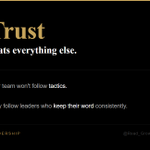




Leadership under pressure reveals everything.
Here's what separates the real leaders from the pretenders:
1. They delegate decisions, not just tasks — giving people authority to act without checking back every hour.
2. They communicate the "why" first, then the "what" — people need context more than instructions when chaos hits.
3. They make 70% decisions fast instead of 90% decisions slow — perfect is the enemy of progress under fire.
4. They stay visible but not in the way — showing up where needed without micromanaging every move.
5. They acknowledge what they don't know — saying "I don't have all the answers" builds trust, not weakness.
6. They focus on what's controllable — wasting energy on external forces kills momentum when pressure mounts.
The best leaders I've worked with got promoted during crises, not despite them.
Your team watches how you handle pressure more than they listen to your words.
Follow @Read_Grow_Lead
4
Your university's entrepreneurship program isn't the problem.
The real barrier is that 89% of venture capital partners are still men making funding decisions based on pattern recognition — and women don't fit their mental model of "successful founder."
Follow @Read_Grow_Lead
2
Better AI creates worse oversight.
When your AI gets more reliable, your people get more complacent.
The best systems still need the sharpest eyes watching them.
Follow @Read_Grow_Lead
2
The best leaders adapt fast.
Here's what separates great leaders during disruption:
1. They ask better questions instead of pretending to have all the answers.
2. They invest in their people's skills before the change hits, not after.
3. They communicate the "why" behind every major pivot — repeatedly.
4. They stay curious about technology without losing sight of human impact.
5. They make tough decisions quickly but explain them thoroughly.
6. They admit when they're wrong and course-correct publicly.
Your leadership style that worked 5 years ago won't work today.
The leaders who thrive are the ones who evolve their approach faster than their industry changes.
Follow @Read_Grow_Lead
Real leaders feel like frauds daily.
The ones who don't are the actual problem.
Follow @Read_Grow_Lead
The loneliest job isn't CEO.
It's being right when everyone disagrees.
Follow @Read_Grow_Lead
1
Most leaders fail because they think leadership is about them.
It's about making everyone else better.
Follow @Read_Grow_Lead
3
AI safety for teens matters.
Most companies build AI tools thinking only about adults.
Smart developers now have age-specific guardrails.
Your product serves everyone — build like it.
Follow @Read_Grow_Lead
3
AI safety isn't your IT team's job.
It's every leader's responsibility now.
The bugs aren't in the code — they're in how your people use it.
Follow @Read_Grow_Lead
1
1
3
When everything's on fire, leadership shows.
Here's what separates real leaders from the pretenders:
1. They delegate authority, not just tasks — your team needs power to act, not permission to breathe.
2. They communicate 3x more than normal — silence during chaos kills trust faster than any mistake.
3. They make decisions with 70% of the info — waiting for perfect data means you're already too late.
4. They show up physically where the problems are — your presence signals priority better than any email.
5. They admit what they don't know — uncertainty shared builds credibility, fake confidence destroys it.
6. They protect their team's time from panic meetings — crisis doesn't mean every conversation needs 15 people.
The best leaders I've worked with got stronger under pressure.
They didn't just survive disruption — they used it to build better systems.
Follow @Read_Grow_Lead
4
Your university's entrepreneurship program failed you.
They taught you to pitch.
They didn't teach you how the old boys' club really works.
Follow @Read_Grow_Lead
4
Better AI creates worse oversight.
When your models get more accurate, your teams get more complacent.
The 99% reliable system fails at the worst possible moment — and nobody's watching.
Follow @Read_Grow_Lead
1
The hardest leadership calls aren't obvious.
After 2 decades leading teams, here are 7 decisions that separate good leaders from great ones:
1. Firing someone you personally like but who isn't performing — your team's watching how you handle this.
2. Saying no to a profitable opportunity that doesn't align with your long-term vision — short-term pain, long-term gain.
3. Promoting the person who challenges you most instead of the one who agrees with everything you say.
4. Admitting you were wrong in front of your entire team — your credibility goes up, not down.
5. Choosing to invest in people development when budgets are tight — this is when it matters most.
6. Making the unpopular decision that's right for the business even when it hurts morale temporarily.
7. Walking away from a "sure thing" because your gut tells you something's off — trust that instinct.
The toughest choices reveal who you really are as a leader.
Follow @Read_Grow_Lead
7
Big tech CEOs aren't different.
They just do 5 things consistently:
1. They make decisions with incomplete information — waiting for perfect data kills momentum.
2. They hire people smarter than them in specific areas — ego is expensive.
3. They communicate the "why" before the "what" — context creates buy-in.
4. They take full responsibility for failures — blame destroys trust faster than any mistake.
5. They obsess over 2-3 metrics that actually matter — everything else is noise.
6. They stay curious about what they don't know — the moment you stop learning, you start dying.
Your leadership philosophy matters less than your daily habits.
Follow @Read_Grow_Lead
7
The best leaders never feel qualified.
If you're not questioning your decisions daily, you're probably not growing fast enough.
Follow @Read_Grow_Lead
3
Nobody prepares you for this.
The loneliness at the top isn't metaphorical — it's 2 AM panic attacks about decisions affecting 500 families.
Follow @Read_Grow_Lead
5
Great leaders don't manage creativity.
They protect it.
Your job isn't to have all the answers — it's to create the space where the best ideas can breathe.
Follow @Read_Grow_Lead
2
Lessons from surviving an 80% crash.
Vlad Tenev's crash course in crisis leadership taught me these brutal truths:
1. Your fancy org chart becomes toilet paper when survival's on the line.
2. "Founder mode" isn't a buzzword — it's cutting 23% of staff and doing the work yourself.
3. Corporate bloat hides until the money runs out, then it's everywhere.
4. Your investors will turn on you faster than you think when things get messy.
5. The media narrative writes itself — you just choose if you'll control it or let it control you.
6. Growth at all costs works until costs become everything you have.
Crisis doesn't build character.
It reveals it.
Follow @Read_Grow_Lead
5
When plans fail, character wins.
5 lessons from Bill Marriott's 60-year journey from root beer stand to hotel empire:
1. Your first business won't be your last — he opened his first hotel at 55 after decades in food service.
2. Small problems teach you big lessons — managing a 9-seat root beer stand prepared him to manage 8,000 hotels.
3. Consistency beats perfection — he focused on reliable service over flashy amenities for 30 years.
4. Your people determine your ceiling — he promoted from within and treated employees like family before it was trendy.
5. Adapt without losing your core — he evolved from root beer to restaurants to hotels but never compromised on customer service.
The best leaders don't follow master plans.
They follow principles.
Follow @Read_Grow_Lead
3
Most CEOs talk about AI strategy.
The best ones are buying the shovels — data centers, power grids, fiber networks.
While others chase the gold rush, smart leaders invest in what makes it possible.
Follow @Read_Grow_Lead
2