

Paul Burns, Pre Cinema Historian. Author, researcher and compiler of THE HISTORY OF THE DISCOVERY OF CINEMATOGRAPHY. I post daily here on X.
Toronto
Joined April 2016
- Tweets129K
- Following314
- Followers2.8K
- Likes64.5K




5/5
READ the static version of Arthur Mason Worthington’s ‘A Splash of a Drop’ first published in 1895 here at Project Gutenberg @gutenberg_org gutenberg.org/cache/epub/271…
See the photographs Magical Media Museum used to make the animation. -30-


Worthington appreciates "the inventors of the sensitive plates," which have provided him "the first really comprehensive objective images that have been obtained with anything approaching so brief an exposure."

Worthington notices differences between his first drawings of droplets and his photos, which he attributes to the imagination's pursuit of perfection.
He states “the mind of the observer is filled with an ideal Auto-Splash whose perfection may never be actually realised.”
Worthington tells us as a “school-boy at Rugby” some twenty years earlier, he had wondered about how falling drops of liquid looked when they landed, so he went on to define how falling drops of milk, mercury, and water appear to be “lying unbroken” or have essentially been in a “violent exercise.”

1877-1895
THE SPLASH OF A DROP
From Arthur Mason Worthington (1852-1916). His studies into how drops of milk and mercury look when they land, have been brought to life through this Magical Media Museum @magicalmotionmuseum animation.
1877-1895
THE SPLASH OF A DROP
From Arthur Mason Worthington (1852-1916). His studies into how drops of milk and mercury look when they land, have been brought to life through this Magical Media Museum @magicalmotionmuseum animation.
Pre Cinema History 📷🎞️🇨🇦 🏴 retweeted

This Day in Buster… October 26, 1919
"The Hayseed,” Buster Keaton’s penultimate movie with Roscoe Arbuckle & Comique, is released.
#oldhollywood #silentfilm
MUYBRIDGE ZOOPRAXISCOPE
A simply fabulous and well done 4-minute video on how Muybridge did it. Chocolate Films / Kingston Museum.
WATCH beginning at 1:24, and see how the famous flying filly Sallie Gardner photographs were transposed onto glass discs for the Zoopraxiscope. Runs 4:05
Pre Cinema History 📷🎞️🇨🇦 🏴 retweeted
Movie Monday—"Good Night, Nurse!” 1918—a romp from start to finish with its fair share of dark humor. Roscoe Arbuckle ends up in a sanatorium, escapes, finds ‘love’ with Dr. Buster, escapes again, wins a race, and then comes around from surgery.
#oldhollywood
5/5
WHAT COULD THE AUDIENCE HAVE SEEN
Brewster's proposal went beyond simply making a human figure appear as a ghost. He explored several additional effects:
🎬 Lifelike movement: A real person could walk, gesture and move in actual clothing, avoiding the limitations of painted lantern slides and advancing the spectre to an unbelievable standing.
🎬 Changing size: By moving the apparatus and adjusting the optics, the image could be enlarged or diminished.
🎬 Transformations: One figure could be replaced by another, producing the appearance of a transformation.
🎬 Apparent decapitation: In his Fig. 8, Brewster proposed inserting a prism into the optical system to separate the image of a figure's head from its body. He described how the detached head might appear to be lifted away and subsequently restored.
🎬 Multiple figures: He also discussed using prisms to produce two or more images of a person.
These are effects Brewster described as technically possible; his text does not, by itself, establish that he constructed and publicly demonstrated the complete apparatus. -30-

WAS IT ACTUALLY BUILT
This is an important question that has been impossible to answer so far. My leaning at this point is no, it wasn’t built. At least, I haven’t found otherwise.
Brewster's description is a documented proposal, complete with optical diagrams and practical considerations. But various sources have not established that Brewster personally built it, staged a public performance with it, or had it manufactured commercially.
The distinction matters because later accounts sometimes describe his invention as though it were an established show apparatus.
There is, however, a significant later parallel: Pepper's Ghost used reflected images of living performers to create apparently spectral figures on stage.
The technique became famous at the Royal Polytechnic Institution in London in the 1860s.
Brewster's proposal anticipated the general principle of using real people rather than painted ghosts, but I would not claim a direct line of influence without further documentary evidence.
The important historical point remains that Brewster documented the proposal in the early 1830s. The question still requiring evidence, is whether the apparatus was ever constructed.
READ Sir David Brewster’s ‘Letters on Natural Magic,’addressed to Sir Walter Scott, Bart., Letter IV, Catadioptrical Phantasmagoria here at the Wellcome Collection iiif.wellcomecollection.org/…
Brewster described an arrangement of three principal elements:
1. A real person and a concave mirror.
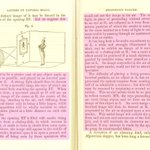
The living figure, labelled AB, stands before a large concave mirror, MN. The mirror produces a smaller, inverted optical image of the person, labelled ab.
2. A large lens.
A lens, LL, is positioned to form a distinct, upright image of the person on the screen. Its magnification compensates for the reduction produced by the mirror.
3. A transparent screen.
The resulting image appears on screen PQ, with the spectators watching from the other side.
Brewster also proposed mounting the optical apparatus on a movable carriage so that the image could change in size and different figures could be substituted.
The name explains the principle. Catadioptrical refers to the combination of reflection (from the concave mirror) and refraction (through the lens).
Brewster's original apparatus is illustrated as Fig. 7 in Letter IV, printed on page 86. He was interested in the ways optical devices could produce extraordinary visual effects—and how such effects could deceive the observer.
By the early nineteenth century, the Phantasmagoria had established a way of projecting ghostly images, often making them appear to approach or recede in darkness.
But the images were usually painted on transparent slides.
Brewster identified a fundamental weakness: when small, hand-painted figures were enlarged, their imperfections became conspicuous.
He argued that the solution was to use actual people, wearing real clothing and committing natural movements, rather than painted representations.
In ‘Letters on Natural Magic,’ he wrote that the new apparatus could produce phantasms of the “most perfect delineation,” dressed in real garments and displaying the movements of life.
1833
CATADIOPTRICAL PHANTASMAGORIA
SIR DAVID BREWSTER (1781–1868)
Scottish physicist Sir David Brewster proposed an optical apparatus called the Catadioptrical Phantasmagoria, described in Letter IV of his ‘Letters on Natural Magic’ beginning on page 56.
Seeking to overcome the defects of painted Phantasmagoria slides, Brewster suggested improvements by projecting images of living people using a large concave mirror and a lens.
The mirror formed a reduced, inverted image of the person, which the lens then projected as an upright image upon a transparent screen.
By moving the apparatus and adjusting the optics, the projected figure could be changed in size in a pre dolly or pre zoom type of way.
Brewster also described using a prism to separate the image of a person's head from the body, creating an apparent decapitation (his lines of vision on p88 below).
Although the apparatus is illustrated and described in detail, I have found no evidence that Brewster's complete design was ever constructed or publicly demonstrated.
Brewster’s Catadioptrical Phantasmagoria is a particularly interesting proposal in pre cinema history because it attempted to replace the painted ghosts of the traditional Phantasmagoria with life-size, moving images of real human beings, produced optically using mirrors and lenses.


Pre Cinema History 📷🎞️🇨🇦 🏴 retweeted

1908 THE " ACTORLOGUE' TALKING PICTURES from 118 years ! Has anyone ever heard/seen one of these?

11/11
Later in 1903 Levison developed his ‘Fluorescent Mineral Viewing Box.’ He based it on the recently introduced hand-held Fluoroscope, a newly introduced device that allowed doctors to view real-time X-Ray images of patients.
- Daniel Russell -30-


Levison did make a small name for himself in the world of New York photography that revealled a fascination for motion pictures he had, and a joy in preserving movements that had previously been only a blur.
Pictured is Wallace G. Levison in his Brooklyn study. Also Levison camera US patent No. 415513, granted the 19 November 1889 mentioned in post 1.
From the Gordon Hendricks Motion Picture History Papers Collection, Smithsonian.
All of these photographs are by Wallace Goold Levison:
🎞️ Associate J. M. Cornell jumps
🎞️ Mildred Grimwood jumps off a chair
🎞️ New York Tribune building in lower Manhattan
🎞️Daughter Zelma Levison jumps in the backyard of her home


Go to the X timeline of historian Peter Domankiewicz who in 2023 visited the Smithsonian and dug up the Levison camera.
This X video @Domankiewicz explains it all and you can go directly to youtu.be/XDcAolHX_og .
Thank you, Peter, for your excavation of the Wallace Levison camera and for sharing these photographs with me. All photographs Peter sent me are in chapter 16 precinemahistory.com/chapter…


