Father, writer, and seeker of truth. Exploring memory, faith, the moral weight of history, and my enduring love for Poland. Memento Mori. Veritas Manet.
USA
Joined May 2021
- Tweets13.6K
- Following534
- Followers33.5K
- Likes26.4K



Pinned Tweet
Long post: 😊
As someone not of Polish descent, I approach Polish history with an objective and committed perspective.
My passion for uncovering and sharing these often-overlooked stories comes from a deep respect for the resilience and sacrifices of the Polish people.
In my journey to shed light on these narratives, I’ve faced criticism, name-calling, censorship, and the spread of falsehoods.
Some deliberately distort history for personal gain or to diminish the significance of Polish experiences or simply out of malice.
I refuse to remain silent in the face of such lies.
The truth matters, both to history and to the dignity of those who lived it.
As a real Christian, I believe that truth, honor, and integrity are essential virtues.
To follow Christ is to value honesty and stand for justice, even when it’s difficult or unpopular.
This belief guides my work in exploring Polish history and every other aspect of life.
Whether analyzing past events, current issues, or personal struggles, I am committed to revealing the truth. In a world rife with misinformation, this pursuit is a reflection of the gospel’s call to love, humility, and justice.
Yet, I’m not afraid to confront evil and call out manipulators for what they truly are.
I believe in speaking honestly and directly, as truth requires boldness and integrity.
This commitment reminds me that all people, regardless of nationality, are made in the image of God and deserve dignity and compassion.
Just as I seek to honor Poland’s history and legacy, I strive to live a life dedicated to truth in all areas.
From addressing injustices in my own country to confronting global issues, I am committed to shedding light on what truly matters.
Falsehoods must be challenged for the betterment of humanity, wherever they arise.
To those who intentionally manipulate facts or distort history, I say this: the truth cannot be silenced.
You may mislead for a time, but truth always prevails.
Your actions dishonor the memory of those who suffered and are currently suffering.
Accountability is not optional, it is essential for justice and healing.
Poland’s history is not only a tale of oppression and struggle but a testament to the strength of the human spirit, the fight for freedom, and the belief in justice.
These ideals fuel my broader mission to promote truth, compassion, and integrity.
The challenges and betrayals I witness in my own country inspire me to uphold the values of honesty, compassion, and justice.
Today is a special day for me as I welcome another member of my family, my namesake, Theodor (“Gift from God”).
I am eager to teach him the knowledge I have, share with him the truth, and, God willing, see him become a better man than I.
I also want to take a moment to thank everyone who has supported my work.
Your encouragement and willingness to share my research inspire me to continue, even in difficult times.
It is because of you that I remain committed to sharing the truths that must be heard.
You remind me that standing by the truth, regardless of the challenges, is always worth it.
To everyone who believes in the power of truth: thank you.
Together, we honor the past and work toward a future grounded in honesty, dignity, and faith.
Let us continue seeking the truth, confronting falsehoods, and ensuring that the legacies of courage and hope endure.
Fiat Lux et Veritas

By October 25, 1944, the Warsaw Uprising had been over for just over three weeks. Following the capitulation on October 2, after 63 days of resistance, the Polish Home Army had been forced to capitulate.
Still, for Warsaw, the nightmare continued as German forces systematically demolished buildings, burned libraries, destroyed cultural treasures, and reduced entire neighborhoods to rubble.
Hundreds of thousands of civilians had been expelled from their homes. Families were separated, and many were deported to forced labor or concentration camps.
This was not simply the destruction caused by battle - much of Warsaw was deliberately demolished after organized resistance had ended.
The Germans sought to destroy more than a city. They sought to erase its history, culture, and identity, yet Warsaw would rise again.
Today, its rebuilt streets and historic buildings stand as a testament to a people who refused to allow their capital, or their memory, to disappear.

231 years ago today, Russia, Prussia, and Austria agreed to the final partition of Poland.
A nation that had existed for centuries was extinguished as an independent state. Its territory was divided, its sovereignty destroyed, and its people placed under foreign rule. For the next 123 years, Poland would not exist as an independent country, still, a nation is more than its borders.
Poland survived in its language, its literature, its music, its faith, and above all, in the determination of generations who refused to surrender their identity. Children were born, lived, and died without ever knowing a free Poland, yet they preserved the memory of a homeland they hoped their descendants would one day reclaim.
In 1918, after 123 years, Poland returned to the map of Europe. Empires had attempted to erase a nation and they failed.

70 years ago today, thousands of Hungarians took to the streets of Budapest demanding freedom from Soviet captivity.
The revolution began with a demonstration of solidarity with Poland, where political upheaval earlier that month had raised hopes for reform across Eastern Europe.
Protesters gathered at the statue of Polish General Józef Bem, a hero of both nations.
As the Hungarian Revolution unfolded, ordinary Poles organized blood donations, medical supplies, and humanitarian aid for their Hungarian friends and neighbors.
Although Soviet forces ultimately crushed the uprising, the events of October 1956 became a lasting symbol of courage and friendship between Poland and Hungary.


On October 21, 1939, just weeks after invading Poland, German forces carried out public executions across Greater Poland, murdering innocent Polish civilians in a systematic campaign designed to brutalize the population and eradicate the nation’s intellectual, political, and social leadership.
In towns including Leszno, Gostyń, Krobia, and Poniec, German firing squads executed teachers, merchants, public officials, veterans, and other respected members of Polish communities. In Gostyń alone, 30 Poles were murdered, while another 20 were executed in Leszno. Most victims had been identified in advance because of their patriotism, education, or influence within Polish society.
The murders were part of Operation Tannenberg, a broader German campaign to destroy Poland’s leadership and undermine its national identity. Between October 20 and 23, during what became known as the Three Days of Terror, approximately 275 Poles were murdered across 14 towns in Greater Poland.
These were not casualties of battle but deliberate executions of civilians whose only supposed crime was being Polish citizens whom the occupiers considered obstacles to German domination.
87 years later, we remember these innocent men and women, their families, and the communities forever scarred by their deaths.


On October 21, 1943, the German Gestapo arrested Irena Sendler, a brave Polish social worker who had risked her life helping rescue Jewish children from the Warsaw Ghetto. Working with Żegota, the Polish underground organization dedicated to saving Jews, Sendler and her fellow rescuers helped children escape almost certain death, arranging false identities and shelter in Polish homes, orphanages, and convents. She carefully preserved records of their real names and hiding places, hoping that surviving family members might one day be reunited with them.
After her arrest, Sendler was imprisoned in Warsaw’s notorious Pawiak prison, where the Germans brutally interrogated and tortured her, beating her so severely that she suffered lasting injuries to her legs and feet. They demanded information about the children, their hiding places, and the members of the underground network helping them. Despite all the suffering and the knowledge that her own execution was approaching, she refused to betray the children or her fellow rescuers - not a single name was surrendered.
Sentenced to death, Sendler survived only because members of Żegota managed to bribe German officials and secure her release. Even after enduring torture and narrowly escaping execution, she continued her clandestine rescue work under a false identity, knowing that another arrest could mean certain death.
Irena Sendler survived the war and was later recognized as Righteous Among the Nations. Her story reminds us that extraordinary courage does not always appear on the battlefield, and that sometimes the greatest act of resistance is simply refusing to betray another human being, whatever the personal cost.
She could have saved herself by speaking. Instead, she chose to protect those who could not protect themselves. May her courage, humanity, and sacrifice never be forgotten.

October 20, 1939, ten-year-old Erwina Barzychowska died after weeks of unimaginable suffering, just four days after her birthday.
On September 1, during the German assault on the Polish Post Office in Gdańsk, Erwina was doused with gasoline and set ablaze with a flamethrower after the defenders surrendered. Engulfed in flames, she ran across the courtyard. Somehow, she survived, only to die weeks later without adequate medical treatment.
An orphan, she had been raised by Jan and Małgorzata Pipka, caretakers of the post office. Jan died from his burns the following day. Małgorzata, severely burned and blinded, was later tortured by the Gestapo but survived the war.
No one was ever brought to justice for Erwina’s murder - she was only ten years old. A child who should have had an entire lifetime ahead of her.

When Germany occupied Poland, it did not wage war only against the Polish Army, the underground, or the men and women who might one day take up arms. It waged war against the very foundations of Polish national life: against memory, language, education, faith, culture, and the confidence of a people in their own right to exist. The occupier understood that a nation can be weakened not only by killing its citizens, but by cutting them off from the stories, books, teachers, and traditions that tell them who they are.
Schools were closed or restricted to the most basic instruction. Polish history and literature were forbidden. Libraries were looted, archives seized, monuments destroyed, and works of art carried away. Professors, teachers, writers, priests, lawyers, and community leaders were targeted precisely because they preserved the intellectual and moral life of Poland. The purpose was not merely conquest. It was to reduce Poland to a population without a past, without educated leaders, and therefore, so the occupier hoped, without a future.
Regardless, Poland answered in a way that remains one of the most remarkable chapters of the Second World War.
The underground did not hide only pistols, ammunition, radios, and printing presses - it also hid books. It protected manuscripts and archives. They created clandestine schools and universities, where teachers risked arrest, deportation, torture, and death in order to teach young people the subjects their occupiers had forbidden them to learn. In private apartments, basements, parish rooms, and behind drawn curtains, students studied Polish literature, history, geography, philosophy, medicine, law, and languages. A lesson held at a kitchen table became an act of defiance.
The Home Army was the armed heart of the Polish Underground State, but it existed beside another kind of resistance, one no less necessary. There were men and women who fought with weapons, and there were men and women who fought by ensuring that Polish children could still read Mickiewicz, learn the history of the Commonwealth, understand the partitions, and believe that Poland was more than the occupied territory they saw outside their windows.
A rifle could defend a street, a railway line, or a barricade, yet a secret lesson defended something even more enduring: the future of the nation.
The Germans could burn books, destroy buildings, loot museums, and murder professors. They could try to terrorize a people into silence. Still, they could not fully erase a country whose teachers continued to teach, whose families continued to read, whose writers continued to write, and whose children were quietly taught that Poland had existed before the occupation and would exist after it.
That is why the history of the Polish Underground cannot be told only through sabotage, assassinations, intelligence operations, and armed uprisings. It must also be told through the hidden classroom, the concealed library, the copied poem, the forbidden history lesson, and the teacher who chose to take the risk. Resistance was not only an act of fighting.
Sometimes it was a whispered lecture, sometimes it was a hidden book, or sometimes it was the quiet, stubborn refusal to allow a nation to be forgotten.

On October 19, Poland remembers its steadfast clergy and, above all, Fr. Jerzy Popiełuszko.
He was not a politician or a soldier - he was a young priest who stood with workers, celebrated Masses for the Homeland, spoke plainly about truth and human dignity, and refused to let fear become the language of public life.
In communist occupied Poland, that was enough to make him an enemy of the state.
On the night of October 19, 1984, officers of the communist Security Service abducted Fr. Jerzy as he returned from a pastoral visit. He was beaten and murdered. Days later, his body was recovered from the Vistula Reservoir.
Still, the regime could silence his voice, but it could not erase what he had represented. At his funeral, hundreds of thousands of Poles came to mourn and to bear witness that the nation had not surrendered its conscience.
Today is the National Day of Remembrance for Steadfast Clergy: priests, religious sisters, and lay believers who, across the German and Soviet occupations and decades of communist rule, kept faith with God, with truth, and with Poland.
And today, Fr. Jerzy’s words still endure: “Overcome evil with good.”

On this day in 1849, Fryderyk Chopin died in Paris. He was only 39 years old.
He never returned to the Poland of his childhood. After the failure of the November Uprising, he remained in exile while his homeland lay partitioned and absent from the map of Europe - still, Poland never left him.
It was there in the rhythms of his mazurkas, in the grandeur of his polonaises, and in the grief and tenderness of his nocturnes. Through his music, he gave voice to the beauty, sorrow, and longing of a nation denied its freedom.
Before his death, Chopin asked that his heart be returned to Warsaw. His body remained in Paris, but his heart came back home and rests today in the Church of the Holy Cross.


On the 15th of October 1941, the German occupation authorities issued one of the most terrifying decrees imposed on occupied Poland.
Jews who left the ghettos without authorization faced death - and so did those who knowingly gave them shelter (the death penalty often affected the entire family of Poles that helped Jews).
This is the context in which we must remember Poles who aided their Jewish neighbors: not as a political slogan, and not as a denial of the fear or moral failures that existed in all occupied society but as acts undertaken under a penalty of death.
The aim was not only to isolate and destroy Jewish lives, it was also to sever human bonds: neighbor from neighbor, Pole from Jew, conscience from compassion.
After all this, the Polish still smuggled food, carried messages, found hiding places, forged documents, and risked everything to preserve another person’s life.

October 12, 1939, just six weeks after the German-Soviet destruction of Poland, Hitler signed the decree creating the General Government.
This was not a Polish state, it was an occupation regime designed for terror, exploitation, forced labor, expulsions, and the destruction of Polish national life.
Parts of western Poland were simply annexed to the Reich. Much of what remained was treated as a colonial possession, ruled from Kraków by Hans Frank.
The invasion had not ended with the last shots of September. - it was becoming a system.


Edward Reid retweeted

#OTD in 1943, SS man Wilhelm Claussen personally shot 54 Polish prisoners at the Auschwitz concentration camp. They had been arrested on suspicion of involvement in the camp resistance movement.
Murdered at the Wall of Death beside Block 11, the victims included leading members of the Polish underground organization within Auschwitz.

ALT Caricature of SS-Oberscharführer Wilhelm Claussen in uniform, facing two rows of prisoners at Auschwitz I. The inscription identifies him as the camp’s first roll-call officer (IPN Archives)
Edward Reid retweeted
When the Warsaw Uprising was crushed, Heinrich Himmler demanded the total destruction of Warsaw in revenge for the revolt.
#OTD in 🗓1944, he gave an order: “No stone can remain standing. Every building must be razed to the ground”. What was left of Warsaw was soon destroyed completely.

ALT The ruins of Warsaw's Old Town pictured in 1945 (public domain)
In modern terms, this was ethnic cleansing and part of a broader genocidal campaign against the Polish nation.
Forcibly expelling nearly a million people only because they were Polish …and then seizing their homes, then replacing them with German settlers was not ordinary wartime occupation. It was an effort to erase Poland from its own land.
Combined with the mass murder of Polish elites, Germanization, the kidnapping of Polish children, forced labor, and policies meant to destroy Polish culture and identity, it fits the wider Nazi German project of destroying the Polish nation as a nation.

Adolf Hitler signed an illegal decree incorporating parts of the seized Polish territories into the Third Reich on October 8, 1939.
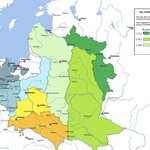
➡️Pomerania, Silesia and Greater Poland, the Suwałki region, a large part of the Łódź Voivodeship, the northern and western areas of Mazovia, and the western fringes of the Kraków and Kielce voivodeships were annexed to Germany.
➡️Nearly one million Poles from these territories were immediately expelled under inhumane conditions to the General Government, which had been established in the remaining German-occupied Polish territories.

ALT Adolf Hitler passes through Marshal Józef Piłsudski Square during a German military parade in Warsaw, held before Hitler following the end of the campaign in Poland, October 5 1939. (IPN Archives)
Hitler came to Warsaw for a victory parade and waiting along his route was half a ton of explosives.
On October 5, 1939, only a week after Warsaw’s capitulation, Adolf Hitler entered the devastated Polish capital to inspect a German “victory parade.” The spectacle was intended to show the world that Poland had been conquered and its resistance extinguished, but the Polish resistance was already preparing to strike.
Members of the newly formed Służba Zwycięstwu Polski, the Service for Poland’s Victory and forerunner of the Home Army planned to assassinate Hitler as his motorcade passed through the intersection of Nowy Świat and Aleje Jerozolimskie.
Approximately half a ton of explosives had been concealed near the route. Observers were supposed to confirm that Hitler was present, allowing Major Franciszek Niepokólczycki to give the order to detonate them.
Yet, unexpectedly the Germans sealed central Warsaw and the were forbidden, under threat of death, from leaving their homes or even approaching windows overlooking Hitler’s route. Polish communications were severed…. Niepokólczycki could not reach his position, observers were forced to withdraw, and the signal never came. (archiwum.ipn.gov.pl)
The explosives remained silent and Hitler completed his parade (when he should have died), left Warsaw, and never returned.
The assassination failed, but the attempt revealed something remarkable, that the occupiers did not yet understand. Poland’s capital had fallen only days earlier - still beneath its shattered streets an underground state was already taking shape.
Hitler came to Warsaw to celebrate the death of Polish resistance, but Polish resistance, burning with defiance was already waiting for him.


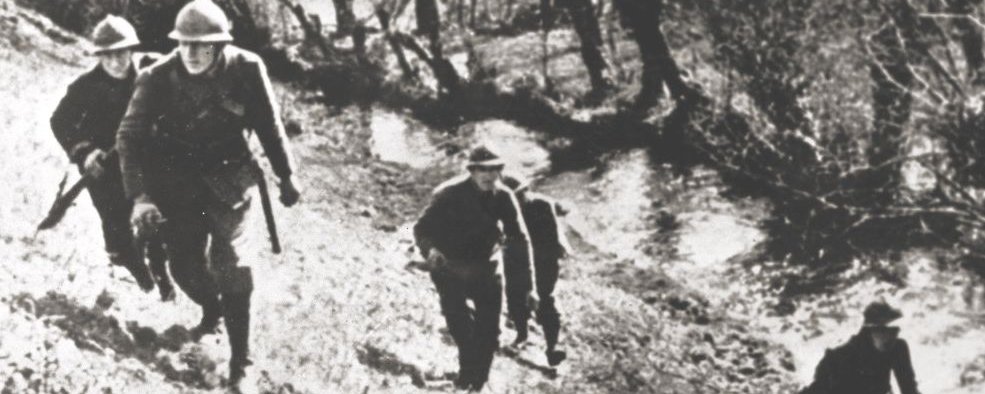
On October 4, 1918, General Józef Haller was appointed commander of the Polish Army in France - known as the Blue Army for its French blue uniforms, it grew to nearly 70,000 soldiers.
When its troops and equipment arrived in Poland in 1919, the country was newly independent and its borders were still being fought over. The army brought trained soldiers, artillery, aircraft, and armored vehicles, real strength at a time when the reborn state needed to defend itself.
Haller’s men fought on the Polish-Ukrainian front and later in the Polish-Bolshevik War. The army also mattered diplomatically, for its existence helped Poland take its place among the victorious Allies at the Paris Peace Conference.
The Blue Army was created far away from Poland, by people who had kept faith with a nation they hoped to see free. In 1919, many of them finally came home and helped defend the independence they had spent years preparing to restore.


On this day in 1944, after 63 days of almost unimaginable sacrifice, the Warsaw Uprising came to an end. The men and women of the Polish Home Army had fought street by street, cellar by cellar, often with little food, medicine, or ammunition.
They had faced one of the most powerful war machines in Europe and held out far longer than anyone could reasonably have expected. When the agreement ending the fighting was signed, the surviving insurgents were granted prisoner-of-war status.
For Warsaw’s civilians, however, the suffering was not over. They were driven from the ruined city, leaving behind homes, churches, schools, family photographs, and the graves of people they loved. Warsaw itself had been shattered, but the spirit behind the uprising was not.
October 2 is now observed in Poland as the Day of Remembrance of the Civilian Population of the Warsaw Uprising - it is a day to remember not only those who fought with weapons in their hands, but also the ordinary people who endured hunger, bombardment, executions, displacement, and the destruction of almost everything familiar to them.
Yes, the uprising ended, but the memory did not.