






Renata Duarte retweeted

A remarkable sighting in Zimbabwe: a herd of elephants was observed swimming an impressive 7 kilometres from the mainland towards an island in Lake Kariba, within Matusadona National Park.
Renata Duarte retweeted

This little dragon isn’t AI, it’s a real lizard called a crested gecko (Correlophus ciliatus)

Renata Duarte retweeted

The sound that clears an African waterhole fastest is a human being talking calmly, and it beats a lion's growl by a distance.
In 2023 researchers hid speakers at waterholes across the Kruger and played recordings to whatever came to drink. Lions snarling. Gunshots. Dogs barking. And men and women chatting in an ordinary voice.
Giraffe, zebra, leopard, hyena, rhino, warthog. They were twice as likely to bolt from the conversation as from the lions, and they cleared out 40% faster.
In Kenya, elephants can tell a Maasai man's voice from a woman's or a boy's, and they bunch up and back away only for the man. He is the one who carries the spear.
In California, pumas walk away from a fresh kill at the sound of talk radio.
In Britain, badgers are more frightened by a recording of people reading aloud than by a bear.
None of these animals has seen a dietary guideline. They are working from 2 million years of experience, and the experience says the upright one with the quiet voice is the most dangerous thing that has ever lived.
No animal has ever fled a gorilla eating celery.
Every species at the waterhole knows exactly what you are. The only one still unsure is holding an oat latte.


Renata Duarte retweeted

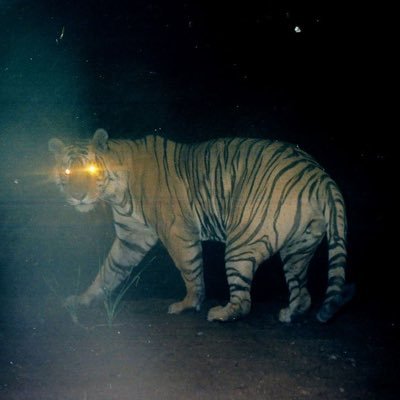
Wild animal casualties of war are seldom mentioned, but their injuries and disabilities must be endured alone, however terrible.
This is a rare Persian leopard, his leg likely blown off by a landmine according to rangers.
There are only 750-1,044 left on Earth—the able-bodied leopards find it hard enough to survive.
Such injuries are common in the region. According to WWF, three of the ten leopards recorded in Armenia since 2002 have lost a limb.


Renata Duarte retweeted
The synchronized dance of the fiddler crab species Austruca perplexa, performed by males to attract females.
Renata Duarte retweeted

They carried fire into total darkness and built something 1,000 feet from daylight.
In Bruniquel Cave in France, 336 metres from the entrance, around 400 broken stalagmites were arranged into 2 rings.
The pieces were snapped to similar lengths and stacked deliberately, about 2.2 tons of stone altogether.
Fires were lit on them, and the scorch marks are still there.
The rings were dated by uranium series in 2016 to roughly 176,500 years ago.
Homo sapiens had not reached Europe, so Neanderthals built them.
The purpose has never been established.
There are no remains, tools, or anything that tells you what happened in that chamber.
Whatever it was, it was worth going that far into the dark for, and that is the oldest known structure anybody built anywhere.




Renata Duarte retweeted
When whalers emptied the Southern Ocean, the krill the whales had been eating should have gone through the roof. Instead it fell by more than 80%.
Over the 20th century the factory ships killed something like two million whales in the southern hemisphere. Antarctic blue whales went from roughly a quarter of a million animals to a few hundred. A blue whale can put away around 16 tonnes of krill in a day, and before the harpoons the great whales down there were eating an estimated 430 million tonnes a year. Take the mouths away and you'd expect shrimp from horizon to horizon. In the 1970s the experts expected exactly that, and the trawlers went south to collect it.
The glut never came. The krill went the other way and has stayed down.
The answer turned out to be at the whale's other end.
The Southern Ocean is short of one thing, and it's iron. Without iron the algae can't grow, and without the algae the krill have nothing to eat. A whale feeds deep, comes up to breathe, and empties itself at the surface in a cloud the colour of the krill that went into it. That cloud carries iron at about 10 million times the concentration of the seawater around it, delivered to the exact layer where the sunlight is. The whale eats in the dark and fertilises in the light, season after season, across an ocean the size of a continent.
The whale fed the algae, the algae fed the krill, the krill fed the whale. Nobody had to pay for the fertiliser, because it came attached to the customer.
So when the ships took the krill's predator out of the sea, they took its farmer with it. To feed the whales that used to be there, the ocean would need about five times the krill it carries today.
Every system on earth that has ever fed itself has an animal in the middle, eating the crop and putting it back. The whale did it in the ocean. The bison did it on the prairie. The cow does it on a hill in Wales that grows nothing else.
The Dutch government is currently paying livestock farmers to shut down near its nature reserves, so that nature can recover.
The ocean has already run that experiment. It cost 80% of the krill.
