

Adjunct Lecturer of Urdu language & literature, University of Naples "L'Orientale". Sufism, Indian Ocean, language enthusiast, poetry, too filmy.
Naples
Joined July 2011
- Tweets4.9K
- Following2.7K
- Followers2.3K
- Likes22.3K




Pinned Tweet
Preparing my talk for 'Entangled Seascapes: More-than-Human Histories Across Oceanic Worlds '(22–24 Jan) at Academia Belgica, Rome. Excited to present my recent research on Sufi plural ecologies of the Indian Ocean!
#Sufism #IndianOcean #SouthAsia #MoreThanHuman

Annalisa Bocchetti آنّالیسا retweeted

Adoration of Sita in the form of Kali/Chandi after she destroys Ravana's army on the battlefield. From the Urdu version of 'Janaki Vijaya' by Munshi Shankar Dayal 'Farhat'. Published in 1863 by Naval Kishor Press.
Sita is the central character in this version of the Ramayana.

Annalisa Bocchetti آنّالیسا retweeted

'Ek raaz hai jo tumko bataya nahi kabhi...'
🔗 Watch the complete #YoungPoetsMushaira here: yt.openinapp.co/4kxui
Ameer Hamza Halbe captures the exact feeling of losing what was never yours. The crowd's reaction at the Young Poets Mushaira says it all.
@MiltonHomewares @myTRIDENThome @HCLConcerts @Vedanta_Group
#AmeerHamzaHalbe #UrduPoetry #JashneRekhta #Urdu
Annalisa Bocchetti آنّالیسا retweeted

This paper was published as a chapter of this edited volume. It took me a long time and multiple revisits to understand the thematic arguments the book wanted to put forward. And it's incredible.


Annalisa Bocchetti آنّالیسا retweeted
Ziauddin Farooqui (1947–2024), recognized by his pen name 'Zia,' was a renowned Urdu poet and critic, known for his impactful ghazals and contributions to Urdu literature. Born in Hardoi and later establishing his literary base in Bhopal, his fifty-year career bridged classical traditions with modern narratives of societal struggle and resilience. His definitive masterpiece, Kanpur Nama, chronicles 250 years of the city's history in verse, standing alongside celebrated, award-winning collections like Raqs-e-Ghubar. Honored with the Nawab Siddiq Hasan Khan Award, his mastery extended seamlessly across poetry, short stories, and rigorous historical research.
Experience the enduring depth of his literary voice by reading his complete works on Rekhta at rekhta.org/poets/zia-farooqu….
#ZiaFarooqui #UrduLiterature #UrduPoetry #Rekhta #Ghazals

Big news! I’m officially the new Lecturer of Urdu Language & Literature at L’Orientale University of Naples for the upcoming academic year! So excited to share the vibrant world of Urdu with a new generation of students. Let’s get started! 💫
Annalisa Bocchetti آنّالیسا retweeted
Born in 1953, Basir Sultan Kazmi is an esteemed poet, playwright, and educator who moved to the UK in 1990. After studying at the University of Manchester, he worked as a BBC news editor and taught at various British schools and universities. His comprehensive literary output includes the 2015 collected works Shajar Honay Tak, featuring numerous poetry collections and plays. Many of these acclaimed works, such as Bisaat, have been translated into English and performed at regional theatres. Kazmi has also dedicated time to writing about his father, the renowned Urdu poet Nasir Kazmi. His elegant verse, celebrated for bridging Urdu tradition with world literature, has been publicly displayed in UK hospitals and carved in stone in Slough. In recognition of his profound impact on the literary arts, Kazmi was awarded an MBE for Services to Literature in 2013.
#BasirSultanKazmi #UrduPoetry #UrduShayari #Rekhta

Annalisa Bocchetti آنّالیسا retweeted
Fahmida Riaz was a prominent Pakistani Urdu poet, writer, and translator recognized for her fierce feminist and anti-establishment ideals. Born in Meerut in 1945 and raised in Sindh after her father's early passing, she began her career as a newscaster for Radio Pakistan. Her dedication to writing led her to manage the liberal Urdu publication Aawaz, which was later banned for its revolutionary critique of the government, forcing her family into a seven-year exile. Despite these challenges, she held major leadership roles, including Managing Director of the National Book Foundation and the Urdu Dictionary Board. She leaves behind a massive literary legacy, having authored numerous books like Godaavari and translated major historical works from Persian and Sindhi into Urdu.
#FahmidaRiaz #urdupoetry #urdushayari #rekhta
Annalisa Bocchetti آنّالیسا retweeted

“Snakes are attached to the ears of someone who eavesdropped at the door” – from a 19th-century Eastern Turki manuscript depicting punishment in the afterlife. More here: publicdomainreview.org/colle…

Annalisa Bocchetti آنّالیسا retweeted

Please submit and share widely. All rules here: alijawadzaidi.com/2026-detai…

Annalisa Bocchetti آنّالیسا retweeted
Some examples of the plays of 'Janab Mister Shakespeare Sahab Marhoom' adapted for theatre performance into Urdu by Mirza Nazeer Baig:
Left: 'Ishq-e Firoz Laqa o Gulnar' (Romeo & Juliet), Agra, 1905
Right: 'Pyar o Muhabbat Ka Josh o Kharosh' (Merchant of Venice), Agra, 1904


A genuine question for those defending every casting decision in The Odyssey…
If someone adapted Shakespeare’s Romeo and Juliet and completely reimagined the nationality, appearance, or traditional portrayal of several iconic characters…
Would you still say:
“The best actor should always get the role.”
Or would you suddenly start talking about staying faithful to Shakespeare?
That’s why this debate fascinates me.
Should we judge every classic by the same standard…
Or do we only defend creative freedom when it’s our favorite director

Annalisa Bocchetti آنّالیسا retweeted

Ancient sailors believed the ocean was crowded with beings that existed beyond human understanding. Sea serpents, krakens, mermaids, and strange fish appeared regularly in ship logs and maps, especially in those places marked simply: "Here be monsters." #FairyTaleTuesday

Annalisa Bocchetti آنّالیسا retweeted

𝙼𝚢 𝚙𝚊𝚕𝚊𝚝𝚎 𝚊𝚗𝚍 𝚕𝚒𝚙𝚜 𝚊𝚛𝚎 𝚠𝚘𝚞𝚗𝚍𝚎𝚍 𝚏𝚛𝚘𝚖 𝚎𝚟𝚒𝚕, 𝚒𝚍𝚕𝚎 𝚝𝚊𝚕𝚔, 𝚊𝚗𝚍 𝚕𝚒𝚎𝚜.
𝙼𝚊𝚢 𝚢𝚘𝚞𝚛 ﷺ 𝚗𝚊𝚖𝚎 𝚞𝚙𝚘𝚗 𝚖𝚢 𝚝𝚘𝚗𝚐𝚞𝚎 𝚋𝚎 𝚝𝚑𝚎 𝚋𝚊𝚕𝚖 𝚏𝚘𝚛 𝚝𝚑𝚒𝚜 𝚠𝚘𝚞𝚗𝚍.

Annalisa Bocchetti آنّالیسا retweeted
al-Qazwīnī writes about the Wāqwāq tree on Wāqwāq Island, which bears fruits resembling human heads:
“Mūsā ibn al-Mubārak al-Sīrāfī said: I entered upon her (i.e. the queen of the island) and saw her naked upon a throne, with a crown of gold upon her head, and in her presence

Annalisa Bocchetti آنّالیسا retweeted

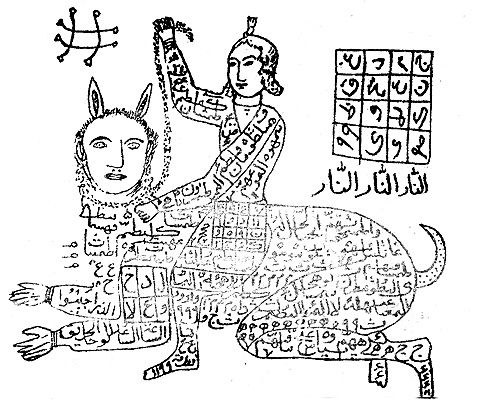
Illustrations from a Persian edition of Ṭilasmāt-i Ṭamṭam Hindī ("The Talismans of Ṭamṭam the Indian"). They depict talismans for making a man obedient to a woman, love (maḥabbat), siyāhī ("blackening," making a woman repulsive to a man), and creating discord.


Annalisa Bocchetti آنّالیسا retweeted

like many cultures, medieval Islamic authors wrote about the existence of dragons. But unlike the winged, fire-breathers everyone knows, the dragons of the Islamic world were giant serpents living in the deep of the ocean & were cosmic dangers
this one has many heads & a face…

ALT Brown serpent with human head and 6 other snake like heads
Annalisa Bocchetti آنّالیسا retweeted
i love medieval Islamic manuscripts so much because they have cat-fish-jinn creatures

ALT Fish with cat head in an Arabic manuscript
Annalisa Bocchetti آنّالیسا retweeted

Khwaja Bandanawaz Gesudaraz, a Chishti Sufi saint, anchored divine love in the Deccan. Through ishq and accessible Urdu literature, he united diverse souls in harmony.
#sufinama | #sufism | #sufi | #sufiteachings | #KhwajaBandanawazGesudaraz |


Annalisa Bocchetti آنّالیسا retweeted
The wondrous creatures of Ajaib al-Makhluqat seem to have made their way to this Hindi version of 'Kabir Manshoor' that I got recently. They depict some 'yonis' (life forms) out of the traditional 84 Lakh yonis in the book's worldview (which is centered on the poet-saint Kabir).


Annalisa Bocchetti آنّالیسا retweeted
Interestingly, Qazwini's cosmographical work 'Aja'ib al-Makhluqat' (The Wonders of Creatures/Creation) continued to be translated, copied & printed till the 20th century. This Urdu version was published in 1912 by Naval Kishore Press, Lucknow.


