

WHOEVER LEAKED THIS GROKBOT SECOND BRAIN JUST MADE GRANOLA USELESS
I thought meeting notes meant an AI notetaker sitting in every call, a transcript nobody rereads, and the same follow-ups still missing by Friday.
Apparently not.
This brain's setup is much more interesting:
→ INGEST routes every call to the right bucket automatically (call with sam → people/sam, standup → proj/launch-v3, investor call → proj/seed-round, all-hands → listed for you), 9 filed and 1 listed this run
→ FITS NEITHER drops any call the router can't confidently place into "listed for you, not filed", no silent misfile, no transcript lost in a folder called "misc"
→ 5 BUCKETS organize the whole brain (INDEX + log + rules at 3, projects/ at 8, people/ at 12, raw/ at 14, me + voice + attention at 4), 41 items total, no scattered meeting folder
→ ATTENTION.MD surfaces the top 5 priorities from your calls (seed round leo call Fri, launch-v3 ships Dec 9, acme renewal Thu, hiring 3 finals, nina 1:1 moved to Wed), no scattered action items
→ RULES.MD goes from 7 lines to 8 the moment you type "no client recaps without my yes", every bot rereads it before the next task, so 3 follow-ups sit drafted and 0 get sent
so you get:
Calls routed. Fits-neither listed. Buckets stable. Follow-ups held.
the interesting part isn't a better transcript.
it's every call landing in the file of the person you had it with.
Instead of rereading transcripts on a Friday afternoon, you close your laptop at 23:00, let the cloud route 9 calls to the right bucket, surface 1 for your review, and wake up with attention.md ready at 07:30.
Route the call. List the ambiguous. Hold the follow-up.

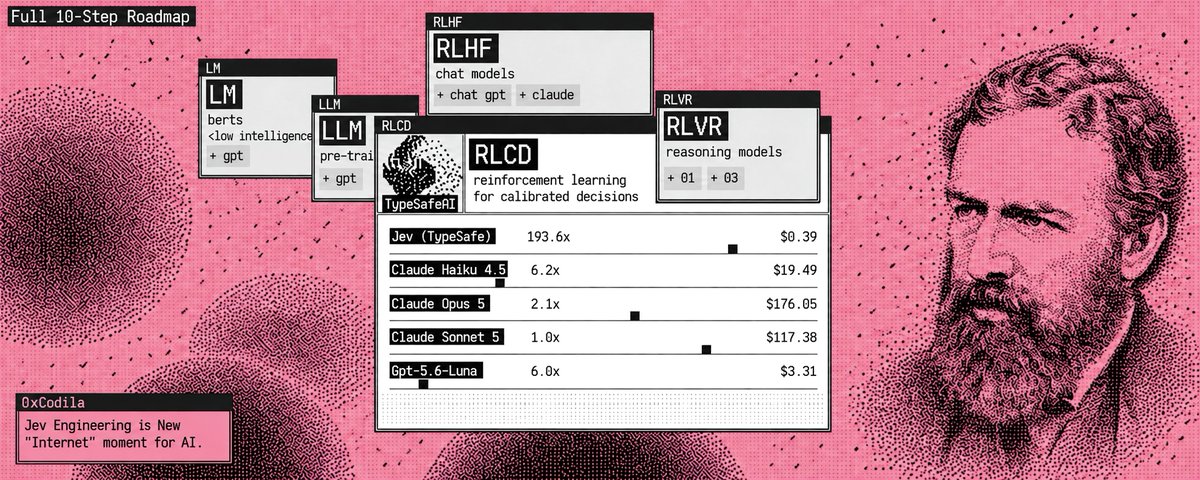
Jev is the "Internet" moment for the AI industry
It tells your agents and LLMs what to do next, in milliseconds and at almost zero cost
If you set it up correctly, you will have the AI engineer’s stack for 2028
In this article, I show you how
9
567
WHOEVER LEAKED THIS GROKBOT SECOND BRAIN JUST MADE SUPERHUMAN USELESS
I thought staying on top of email meant a premium inbox app, 60 keyboard shortcuts I never learned, and still 400 unread by Friday.
Apparently not.
This brain's setup is much more interesting:
→ INGEST routes every inbound to the right bucket automatically (sam@acme → people/sam, stripe payouts → proj/billing, voice memo → proj/launch-v3, digest@weekly → listed for you), 9 filed and 1 listed this run
→ FITS NEITHER drops anything the router can't confidently place into "listed for you, not filed", no silent misfile, no "guess at the folder"
→ 5 BUCKETS organize the whole brain (INDEX + log + rules at 3, projects/ at 7, people/ at 11, raw/ at 12, me + voice + attention at 4), 37 items total, no scattered vault
→ ATTENTION.MD surfaces the top 5 priorities from sent mail (seed round two calls, launch-v3 ships Dec 2, acme contract Thu, stripe payout Fri, hiring 4 applicants), no scattered checklists
→ RULES.MD stays at 7 lines read 31 times by Brain, filing, page and skill before every task (never send without my yes, link every raw source, voice.md before any draft), flags 4 inbounds that tried to file without your yes
so you get:
Inbounds routed. Fits-neither listed. Buckets stable. Attention surfaced.
the interesting part isn't faster triage.
it's giving every email a bucket the brain won't confidently misfile.
Instead of 40 minutes a morning inside an inbox app, you close your laptop at 23:00, let the cloud route 9 inbounds to the right bucket, surface 1 for your review, and wake up with attention.md ready at 07:30.
Route the ingest. List the ambiguous. Surface the attention.
WHOEVER LEAKED THIS SECOND BRAIN JUST MADE YOUR WHOLE CHATGPT HISTORY USELESS
I thought my AI knew me after 2,000 ChatGPT chats, and every new tab still asks what I do, what stack I use and how I like my answers.
Apparently not.
This brain's setup is much more interesting:
→ 01 ME.MD + STACK.MD get written from your exported chat history before anything else (what you build, the tools you use, which answers you kept vs regenerated, 7 preferences each backed by a real chat), no "paste the same about-me paragraph into every new tab"
→ NIGHT DIGEST runs at 23:00 in the cloud with the laptop closed, raw/ stays read-only, 2,000 chats get boiled down to decisions, fixes and dead ends in 5 nights, anything that fits nowhere gets flagged for you instead of filed
→ CONTEXT PACK loads before every question: the 6 pages that matter for this one, each cited to the chat it came from, so the model starts where you left off, no "explaining your codebase from zero for the 40th time"
→ RULES.MD takes one line from you ("never suggest a library I already ripped out") and every bot rereads it before the next run, no "watching it recommend the same dead fix you rejected in march"
→ SUNDAY LINT at 18:00 is report only, merges 9 chats that solved the same bug, flags 3 answers you later found were wrong, flags 1 decision you reversed and never wrote down
so you get:
Chats digested. Context packed. Rules kept. Mistakes flagged.
the interesting part isn't a model with a longer memory.
it's one folder every bot reads first, so chat 2,001 already knows what the first 2,000 figured out.
Instead of 2,000 chats you'll never scroll back through, you let the brain compile 164 pages and 1,320 links from your own history in 4 weeks, load the right 6 before every question, and keep every rule you gave it.
Digest the history. Pack the context. Keep the rule.
WHOEVER LEAKED THIS KARPATHY LOOP SHOULD BE TAKING OVER YOUR WHOLE AWS BILL
I thought cutting a $38,000 monthly cloud bill meant hiring a FinOps consultant for 3 months and getting a spreadsheet of "rightsizing opportunities" nobody ever ships.
Apparently not.
This loop's setup is much more interesting:
→ 01 PROGRAM.MD sets the rules for the night: one file (resources.yaml), one metric (cost per 1k requests under the same staging load test), 5 minutes a run, keep or revert, no "let's schedule a cost review for next quarter"
→ CHECK WRITES THE PASS CONDITION before a single agent moves (p99 under 300ms, zero errors, same throughput as the last kept run), so nothing gets "cheaper" by quietly dropping traffic
→ SPLITTER CUTS THE NIGHT into 436 runs across 15 agents (rightsizer, spot shifter, autoscaler tuner, cache keyer, log trimmer), each one edits only resources.yaml, no "3 teams fighting over the same terraform PR"
→ JUDGE KEEPS 24 AND REVERTS 405 (7 crashed), every keep logged with the dollars it saved, 3 new rules written to program.md, cost per 1k requests $0.84 → $0.31 by morning
→ HUMAN gates the irreversible move (applying it to prod), the loop drafts the rollout but holds until you approve, flags 2 runs that only got cheaper by switching off the read replica
so you get:
Runs budgeted. Dollars judged. Rules written. Rollouts gated.
the interesting part isn't a cheaper instance type.
it's one number the agents can't spin, and a revert they run 405 times so nobody has to argue about it in a meeting.
Instead of a 3-month FinOps engagement, you let 15 agents run 436 experiments overnight, keep the 24 that cut the bill, and wake up to every request costing 63% less.
Edit the file. Judge the run. Sign the rollout.
WHOEVER LEAKED THIS JEV LEAD-ROUTER JUST MADE YOUR WHOLE SDR TEAM OPTIONAL
I thought working 2,000 inbound leads a month meant 8 SDRs copy-pasting form fills into Salesforce and guessing which ones deserve a call before lunch.
Apparently not.
This router's setup is much more interesting:
→ 01 LEAD IN reads lead #88412 "demo for 40 seats" and packs the whole buyer state as typed inputs (company size, title, domain, pricing page visits, intent pages, email opens, crm history, last_touch drift), no "an SDR googling the company in a second tab"
→ JEV-1.13.0 ANSWERS 3 TYPED QUESTIONS in 4ms per lead (Choice route: ae or sdr or nurture, Score intent: cold to hot, Noul icp_fit: yes or no), output tokens literally zero, cost $0.000042 per lead
→ GATE ≥ 0.85 holds every route until confidence beats the floor, below drops to a human, no "dropped a Fortune 500 CFO into the same 7-email drip as a student with a gmail address"
→ DISPATCH FANS 3 PIPELINES by Choice (ae 362, sdr 618, nurture 980, held 40), each pulls by intent score, hot leads get a calendar link in 90 seconds, no "lead sat for 3 days because the round-robin landed on someone on vacation"
→ HUMAN HEAD OF SALES gates the irreversible moves (enterprise pricing, a custom contract, a discount over the cap), email_drafter writes the first touch but auto_send holds until assigned, flags 4 enterprise leads the gate held this morning
so you get:
Leads scored. Reps routed. Intent typed. Deals gated.
the interesting part isn't a smarter CRM.
it's giving every lead three typed answers the auto-sequence can't fire past without your confidence.
Instead of 8 SDRs copy-pasting form fills into Salesforce, you let jev score intent, route and icp_fit in 4ms, hold every enterprise inbound behind 0.85 confidence, and run 10,000 routing decisions for $0.42.
Route the lead. Gate the discount. Sign the contract.
Jev is the "Internet" moment for the AI industry
It tells your agents and LLMs what to do next, in milliseconds and at almost zero cost
If you set it up correctly, you will have the AI engineer’s stack for 2028
In this article, I show you how
3
10
738
this is f*cking insane... Jensen Huang runs Nvidia with 60 direct reports and zero one-on-ones, and now 6 Fable 5.2 agents run my team on his system for $0
the system is one email, titled "Top Five Things":
→ anyone in the company writes one, every week or two
→ the top five things you're working on, saw or learned. no template
→ it goes to your team and to lists Jensen can read
→ no status reports. he skips the chain of command and reads the source
in his own words: "I probably read a hundred or so of these emails every morning." and "strategy isn't what I say; it's what my employees do."
I run a 14-person SaaS. I can't read 14 emails every morning and still ship. so I rebuilt the ritual on Fable 5.2 last weekend and cancelled the 9 weekly one-on-ones that ate my tuesdays. week one the agents caught a churn risk 3 people had mentioned in passing and nobody had connected
9 one-on-ones a week → 0. one brief every morning, with the source behind every line
→ 06:30 the inbox agent pulls every top-5 email, slack note and standup thread from yesterday
→ 06:45 the cluster agent groups 70 lines into themes and counts who said what
→ 07:00 the gap agent checks each theme against this quarter's 3 bets: aligned or drifting
→ 07:15 the alarm agent flags anything 2+ people raised that no ticket owns
→ 07:30 the editor writes my top five things, each one linked to the emails it came from
→ 07:40 the router opens the tickets and tags the owner, in public, in the team channel
the setup takes 10 minutes. open Claude Code, switch to Fable 5.2, connect Gmail, Slack and Linear, then paste this as its standing order:
"you're my chief of signal. 14 people, 3 bets this quarter, one job: every morning, the five things I'd learn if I read every top-5 email myself
run the 6 agents in order. every claim links the email or thread it came from. if two people raise the same problem and nobody owns it by noon, you open the ticket and name the owner in the channel. never in a DM"
Jensen reads a hundred emails before breakfast to know what his company is actually doing. I need 6 agents and one coffee
watch the agents build the morning brief below ↓ feel free to steal itthis is f*cking insane... Jensen Huang runs Nvidia with 60 direct reports and zero one-on-ones, and now 6 Fable 5.2 agents run my team on his system for $0
the system is one email, titled "Top Five Things":
→ anyone in the company writes one, every week or two
→ the top five things you're working on, saw or learned. no template
→ it goes to your team and to lists Jensen can read
→ no status reports. he skips the chain of command and reads the source
in his own words: "I probably read a hundred or so of these emails every morning." and "strategy isn't what I say; it's what my employees do."
I run a 14-person SaaS. I can't read 14 emails every morning and still ship. so I rebuilt the ritual on Fable 5.2 last weekend and cancelled the 9 weekly one-on-ones that ate my tuesdays. week one the agents caught a churn risk 3 people had mentioned in passing and nobody had connected
9 one-on-ones a week → 0. one brief every morning, with the source behind every line
→ 06:30 the inbox agent pulls every top-5 email, slack note and standup thread from yesterday
→ 06:45 the cluster agent groups 70 lines into themes and counts who said what
→ 07:00 the gap agent checks each theme against this quarter's 3 bets: aligned or drifting
→ 07:15 the alarm agent flags anything 2+ people raised that no ticket owns
→ 07:30 the editor writes my top five things, each one linked to the emails it came from
→ 07:40 the router opens the tickets and tags the owner, in public, in the team channel
the setup takes 10 minutes. open Claude Code, switch to Fable 5.2, connect Gmail, Slack and Linear, then paste this as its standing order:
"you're my chief of signal. 14 people, 3 bets this quarter, one job: every morning, the five things I'd learn if I read every top-5 email myself
run the 6 agents in order. every claim links the email or thread it came from. if two people raise the same problem and nobody owns it by noon, you open the ticket and name the owner in the channel. never in a DM"
Jensen reads a hundred emails before breakfast to know what his company is actually doing. I need 6 agents and one coffee
watch the agents build the morning brief below ↓ feel free to steal it
Claude Fable 5.2 is the most insane AI model in history...
99% of people will never touch it or burn money on it: "Too expensive", "Not for me"
Use it right, and it becomes your second BRAIN, for a fraction of the price
In this article, I show you how:

2
12
1,235
this is f*cking insane... Elon Musk ran Tesla, SpaceX and X on one 5-step algorithm, and now 5 Fable 5.2 agents run my startup on it for $0
Musk calls it "the algorithm" and says it in interviews to an annoying degree:
→ step 1 question every requirement, with the name of whoever wrote it
→ step 2 delete any part or process you can, then add 10% back
→ step 3 simplify and optimise what is left, never what was deleted
→ step 4 accelerate cycle time, only after the first three
→ step 5 automate, and only now
his own costly mistake was automating the Tesla line before deleting the parts it was building. most engineers run it backwards and never reach step 1
I run a 4-person startup. I rebuilt the algorithm as 5 Fable 5.2 agents last sunday and killed the $12,000-a-month ops consultant who ran our weekly review. week one they deleted 34% of the roadmap. week two they cut deploy time from 41 minutes to 6
$12,000 a month → $0 extra on the $200 plan. the agents run every monday at 7, in order, never out of order
→ 07:00 the requirement agent names every author in every ticket
→ 07:20 the delete agent files a kill list, with the 10% bounce-back
→ 07:40 the simplify agent rewrites what survived in half the steps
→ 08:00 the accelerate agent cuts cycle time on the top three in minutes
→ 08:20 the automate agent writes the cron, the hook, the script, shows me the diff
the setup takes 10 minutes. open Claude Code, switch to Fable 5.2, connect Linear, GitHub and Notion, then paste this as its standing order:
"you're my chief algorithm. 4 people, one product, one job: Musk's 5 steps in order, every monday
run the 5 agents one after another, never in parallel. if you ever automate before you've deleted, simplified and accelerated, you're fired. the author is named in every file, mine included"
Musk needed a rocket factory to prove the algorithm. I need 5 agents and zero consultants
watch the agents run the algorithm below ↓ feel free to steal it
this is f*cking insane... Jeff Bezos killed PowerPoint with one email and ran a $2 trillion company on what replaced it. 11 Fable 5.2 agents now run mine for $0
Bezos emailed his S-team on June 9, 2004 at 6:02 p.m. the subject line:
"No powerpoint presentations from now on at steam"
22 years, zero slide decks. every meeting opens with 30 minutes of silence while everyone reads a 6-page narrative memo in 6 fixed sections: intro, goals, tenets, state of the business, lessons learned, strategic priorities
I run a 9-person SaaS. I rebuilt his ritual on Fable 5.2 in one afternoon and killed the Monday status meeting that ate 4 person-hours a week. week two the memo caught a dropped enterprise pilot nobody on the team had surfaced
4 hours of meetings a week → 0. one 6-pager a week, generated, reviewed, archived. nobody has opened PowerPoint since
→ 06:00 9 collectors read commits, tickets, inbox and calendar, one per teammate
→ 06:40 the editor drafts each section in Bezos's 6-part structure
→ 07:20 the devil's advocate picks the memo apart line by line in a separate file
→ 08:00 final 6-pager lands in Notion. 30 minutes of silence on the team channel, then the thread opens
the setup takes 10 minutes. open Claude Code, switch to Fable 5.2, connect Slack, GitHub and Notion, then paste this as its standing order:
"you're my chief writer. 9 people, 2 products, one job: every Monday one 6-pager that would survive Bezos's S-team
run 9 collectors, one per teammate, and an editor under you. the memo follows the 6 fixed sections, no bullet points in the body, every claim cites a commit, a ticket or a thread
if a dropped customer, a stalled launch or a quiet resignation shows up in the week after the memo, you failed"
Bezos needed a room of senior VPs reading in silence before every meeting. I need 11 agents and zero PowerPoint
watch the agents assemble the memo below ↓ feel free to steal it
WHOEVER LEAKED THIS JEV MODEL-ROUTER SHOULD BE REPLACING YOUR $50K OPENAI BILL
I thought shipping an AI product meant paying $4.10 per 1000 tokens to a frontier model for every prompt, including "rename this variable" and "what day is today".
Apparently not.
This router's setup is much more interesting:
→ ROUTE.PY POSES THE ROUTING QUESTION as 3 typed options (small 8B, mid 70B, large frontier) with instructions "cheapest model that can answer it well", criteria pulled from prompt.intent, prompt.code_pct, context.depth, user.tier and budget cap, no "always route to gpt-5 because it feels safer"
→ JEV-1.13.0 ANSWERS 3 TYPED QUESTIONS in 4ms per prompt (Choice model: small or mid or large, Score difficulty: trivial to research, Noul needs_tools: yes or no), output tokens literally zero, cost $0.000042 per route
→ GATE ≥ 0.85 holds every small-model route until confidence beats the floor, below drops to large frontier automatically, no "cheap model confidently wrote the wrong SQL for your billing query"
→ DISPATCH FANS 3 TIERS by Choice (small 8B at $0.02/1k cached, mid 70B at $0.08/1k with tools, large frontier at $4.10/1k for review-grade), each prompt pulled by difficulty score, median under 250ms, no "paying frontier price for rename-this-variable"
→ HUMAN REVIEW gates the ship on large-tier answers (auto_ship held until a person signs when difficulty hits research), queue saves every state as JSON so nothing drops on a crash, flags 7 prompts the gate held past the budget cap this hour
so you get:
Prompts scored. Models routed. Gates calibrated. Tiers tracked.
the interesting part isn't a smarter frontier model.
it's giving every prompt one typed route the auto_ship can't fire past without your confidence.
Instead of $4.10 per 1000 tokens on every "rename this variable", you let jev score difficulty and needs_tools in 4ms, hold every small-model route behind 0.85 confidence, and run 10,000 model-routing decisions for $0.02 live.
Score the prompt. Gate the small. Ship the frontier.
WHOEVER LEAKED THIS JEV GUARD-OPS SHOULD BE REPLACING EVERY SRE ON-CALL ROTATION
I thought keeping an autonomous agent from pushing broken code to main at 3am meant a human on pager rotation and a full freeze on anything irreversible.
Apparently not.
This guard's setup is much more interesting:
→ ACTIONS · GUARD intercepts every risky agent move before it fires (git push origin main, npm test --ci, deploy, delete), jev runs before every one, no silent commit to main at 3am while the human sleeps
→ JEV-1.13.0 ANSWERS 3 TYPED QUESTIONS in 4ms (Choice next_step: run or confirm or escalate, Score blast_radius: none to critical, Noul safe_to_run: yes or no), output tokens literally zero, cost $0.000062 per action
→ GATE ≥ 0.85 holds every run until confidence beats the floor, below drops to confirm, no "the agent felt 60% sure so it shipped to prod anyway"
→ ROLLBACK keeps snapshots and restore_s ready before the run fires, hold on fail, done on green, no recovering main from a 3-hour-old backup at 4am
→ HUMAN APPROVE gates the irreversible moves (force-push, drop table, mass email), review takes seconds not an incident retro, flags 7 actions the gate held for review this session
so you get:
Actions scored. Blasts typed. Gates calibrated. Rollbacks armed.
the interesting part isn't a smarter agent.
it's giving every action three typed answers the push button can't fire past without your confidence.
Instead of a human on pager rotation gating every deploy, you let jev score blast_radius and safe_to_run in 4ms, hold every irreversible push behind 0.85 confidence, and run the whole guard for $0.02 live.
Score the action. Gate the blast. Sign the irreversible.
WHOEVER LEAKED THIS GROK LISTEN SHOULD BE REPLACING SPOTIFY'S RECOMMENDER
I thought discovering new music meant the same 5 songs on repeat for the fourth week and a "Made For You" playlist that wasn't.
Apparently not.
This listen setup is much more interesting:
→ PLAYLIST + AUDIO + HIST + MIC_HIST + SPEAKERS pack every listening-state signal as typed inputs, no "shuffle and hope", your return-listens auto-weighted into the next decision
→ GROK DECIDES next_action in 4ms (skip, next, save, repeat, queue) with Score match_fit (low to critical) and Bool worth_keeping yes-or-no, output tokens literally zero
→ GATE ≥ 0.85 holds every skip or save until confidence beats the floor, below drops to review, no silent dropping of the track you actually wanted
→ WORKERS fire the deterministic moves (skip to next, save to library, mark-played, queue the next one), no LLM wake-up between tracks
→ HUMAN SIGN gates the irreversible moves (buy the album, add to a shared playlist, publish a clip), 10,000 listen decisions logged for $0.01 total, flags 7 tracks the gate held past the queue window
so you get:
Audio scored. Skips typed. Saves gated. Signs human.
the interesting part isn't a smarter playlist.
it's giving every track a score the skip button can't fire past without your confidence.
Instead of the same five songs on loop for a month, you let Grok score every track in 4ms with typed answers, gate every skip at 0.85 confidence, and run 10,000 listen decisions for $0.01 total.
Score the audio. Gate the skip. Sign the save.
WHOEVER LEAKED THIS GROK LAB LOOP SHOULD BE REPLACING WEIGHTS & BIASES
I thought running ML experiments meant a Slack channel full of charts nobody opens and a $12,000 GPU bill at the end of the month.
Apparently not.
This loop's setup is much more interesting:
→ LAB inputs pack the experiment state (title, tests, score) and HARDWARE (cpu, mem, cost, data) as typed records, OUTPUTS (baseline, metric, score) and LAST_RUN (ok, time, delta) auto-attached, no "fill out the yaml again"
→ GROK DECIDES next_action in 4ms (train, eval, abort, spike) with Score val_delta (low to critical) and Bool big_change yes-or-no, output tokens literally zero
→ GATE ≥ 0.85 holds every abort, spike or continue until confidence beats the floor, below drops to review, no silent kill of a running experiment
→ COMPUTE tracks cost, done and error per run live, flags 7 runs whose val_delta drifted past the acceptance band this epoch
→ HUMAN SIGN gates every irreversible move (push checkpoint, kill the job, trigger a spike investigation), 10,000 decisions logged for $0.01 total, no 2am wake-up when the loss diverges
so you get:
Labs typed. Actions decided. Deltas scored. Signs human.
the interesting part isn't more dashboards.
it's giving every training run an agent that aborts before the GPU bill does.
Instead of a Slack channel full of charts and a surprise invoice from AWS, you let Grok score every epoch in 4ms with typed answers, abort the diverging runs at 0.85 confidence, and ship 10,000 decisions for $0.01 total.
Type the lab. Score the delta. Gate the kill.
the reason your 4-hour stream turns into 3 mediocre shorts a week instead of 12 is Karpathy's one rule about agents, and you have been ignoring it for a year
the rule is brutal and he keeps repeating it: if you wire one big LLM to do your whole post-production, you do not have an agent, you have a chatbot that forgot what it was doing by minute 3. that is why your editor burns out. that is why your VA cannot keep the brand voice. that is why your 4-hour stream becomes 3 shorts the audience forgets by Thursday
a pipeline with one prompt is a graveyard. 20 hours a week of your life, 3 shipped shorts, 0 idea which hook actually worked. Karpathy's fix is not a better prompt. it is a graph
you point Grok at a folder of agents and the whole post-production wakes up. 15 roles. one job each. Clip Cutter cuts. Hook Finder scores. Title Tester A/B's. Caption Sync whispers. Thumb Maker renders. Reply Writer answers chat in your voice. Chat Mod bans. Schedule Plan books tomorrow. none of them does another's job
then you close the loop
want to know which hook actually ships? skip the chatgpt tab and the 4 opinions from your discord mods. let Hook Finder score every segment of last night's VOD for stop-scroll probability. the clip you were going to lead with is p=0.41. the one you were going to cut is p=0.87. ship the second one. check retention Thursday. tell Hook Finder it was right. it gets sharper next week
now it compounds
week 1: 4 shorts shipped. week 6: 50. week 12: 150 shorts, 2,000 chat replies voice-matched, 40 raids planned, every decision replayable at timestamp
before: 20 hours of editing, 3 shorts, no idea which title worked
after: wake up to 12 shorts, every hook scored, every title A/B tested, every reply in your voice from 2 years of past chat
the setup takes one evening. plain files. no new SaaS. no VA on retainer. no editor who quits in 4 months
a content pipeline nobody automates is a treadmill
Karpathy told you how to get off it. the only question left is whether you listen this time, or edit another 20 VODs by hand
bookmark this before you open final cut tomorrow morning
WHOEVER LEAKED THIS STREAMER-LOOP-GRAPH SHOULD BE REPLACING YOUR WHOLE CONTENT TEAM
I thought shipping 12 shorts from a stream meant an editor on Fiverr, two Premiere templates, and a title you type in 10 seconds before publish.
Apparently not.
This loop's setup is much more interesting:
→ 15 AGENTS specialize across the whole stream-to-shorts loop (Clip Cutter, Caption Sync, Thumb Maker, Chat Mod, Hook Finder, Title Tester, Shorts Export, Music Check, Trend Scout, Translator, Sponsor Read, Analytics, Reply Writer, Schedule Plan, Raid Planner), no generalist editor doing everything
→ SPLITTER cuts a 1-hour VOD into units (edge equals data only), 6 or more agents run the units in parallel, 12 shorts queued from one stream
→ CHECK gates every short at "captions synced and no claims" against RULES.md, nothing publishes until both pass, no silent copyright strike
→ GROK BOT handles the typed decisions (which clip is a hook, which title wins A/B, which music clears, which raid to plan), 4 inputs feed the whole mesh (VOD, CHAT, BRAND, BRIEF.md)
→ MESH LOG tags every agent action with a timestamp (02:07:12 grok spawn split, 02:07:12 Analytics Loop max 3, 02:07:13 Chat Mod check rules), flags 7 agents whose check failed this run
so you get:
Clips cut. Captions synced. Titles tested. Claims gated.
the interesting part isn't more shorts.
it's giving every clip 15 agents who each know only their lane.
Instead of a Fiverr editor and a copyright gamble on Friday, you drop one VOD into the mesh, let the Splitter cut it into units, 15 specialized agents produce in parallel, and nothing ships until captions are synced and music clears.
Split the VOD. Score the hook. Gate the claim.
WHOEVER LEAKED THIS KARPATHY-LOOP-GRAPH SHOULD BE SHIPPING YOUR WHOLE BACKLOG
I thought shipping "add billing export" meant three meetings, a ticket, a PR, and a reviewer who comes back Monday.
Apparently not.
This mesh's setup is much more interesting:
→ TASK "ship billing export" enters through Opus 5.5 with 3 anchors (REPO scan, TESTS, PLAN.md), no backlog dumping, no "figure out priorities later"
→ SPLITTER cuts the task into units (edge equals data only), 6 or more units run in parallel, Schema Reader attaches RULES.md first, then everything downstream fans out
→ 15 SPECIALIZED AGENTS fire on their unit (Test Writer, API Builder, Auth Guard, Data Mapper, Refactorer, Perf Tuner, UI Builder, Security Audit, Type Checker, Migration Plan, Log Analyst, Dep Updater, CSV Writer, Docs Writer, Schema Reader), every connection logged
→ CHECK gates the whole mesh at "tests exit 0 and diff stays in plan", every irreversible commit held until both conditions clear, no "it compiles, ship it"
→ MESH LOG tracks every agent action with a timestamp (02:07:11 agent_12 Test Writer, 02:07:12 Auth Guard check tests, 02:07:12 agent_07 attach RULES.md to Schema Reader), flags 7 agents whose check failed in the loop this run
so you get:
Tasks anchored. Units split. Agents fired. Checks gated.
the interesting part isn't more agents.
it's giving one ticket fifteen agents who each know only their lane.
Instead of three meetings and a PR that waits until Monday, you drop "ship billing export" into Opus 5.5, let the Splitter cut it into units, 15 agents fire on their lanes, and nothing merges until Check sees tests exit 0 with diff still in plan.
Anchor the task. Split the unit. Gate the check.
WHOEVER LEAKED THIS CLAUDE CODE PAPER LAB SHOULD BE RUNNING THE RETRACTION DESK
I thought replicating a paper meant hoping the authors' GitHub still builds and that the hyperparameters are real.
Apparently not.
This lab's setup is much more interesting:
→ 12 AGENTS run as independent spiders across 64 papers, each with its own throughput (Agent 1 at 16 lok/s, Agent 2 at 20 lok/s), no agent waiting on another's output
→ CLEAN CHECKOUT per paper per agent, no shared mutable state, 11 methods reproduced without cross-contamination from parallel reads
→ REFERENCE FIELD compares the independent implementation to the paper's original output as a shared scene with local difference, pixel-level match or flag
→ VALIDATION SAMPLE BUFFER runs mass, stability and residual checks on every reproduction, red zones trigger a 4-paper FURTHER REVIEW pile
→ METHOD REFERENCE INDEX locks every reproduced method against its 28 reference scenes, same input returns same output, flags 7 methods whose output drifted past the acceptance band this run
so you get:
Agents independent. Checkouts clean. Fields diffed. Reviews piled.
the interesting part isn't faster reproductions.
it's giving every paper an agent that can't be bribed by the authors' repo.
Instead of 6 weeks hoping the authors will reply to an email, you let 12 agents reach into 64 papers in parallel, reproduce 11 methods at mass-stability-residual tolerance, and leave 4 on the further-review pile for a human to read.
Reach the paper. Clean the checkout. Diff the field.
WHOEVER LEAKED THIS CLAUDE CODE DISK SCAN SHOULD BE REPLACING CROWDSTRIKE
I thought catching malware meant a bloated agent eating 40% of your CPU to produce a quarterly EDR report nobody opens.
Apparently not.
This scanner's setup is much more interesting:
→ SECTOR READ walks /dev/disk0 in 4,096-byte blocks (step=4098), 2,163,439 sectors across 44 sector groups, 12 threads reading in parallel, no file-manager scan
→ SHA-256 hashes every block against a 48,210-signature database, matched blocks flagged immediately, no "re-check later" queue sitting idle
→ ENTROPY checks every block with Shannon's formula, anything above 7.8 bits per byte marked suspect (packed PE binaries land here), no eyeballing hex dumps at midnight
→ ISOLATE FRAGMENT quarantines the exact offset (fragment 0x7F5A at same-offset byte diff), reason attached as "packed PE", scan report written to a dated json
→ BYTE MAP compares EXPECTED vs FRAGMENT at the same offset in real time, flags 7 sectors whose entropy drifted from baseline this pass, 0 threats confirmed across 1,296,309 files
so you get:
Sectors read. Hashes matched. Entropy scored. Fragments quarantined.
the interesting part isn't more signatures.
it's giving every sector an entropy score the scanner can flag before the signature catches it.
Instead of an EDR agent chewing CPU for a quarterly report, you scan 1.3 million files across 2.1 million sectors with 12 threads at 2.4 GB/s read and 1.9 GB/s hash, 48,210 signatures checked, 0 threats found.
Read the sector. Hash the block. Score the entropy.
WHOEVER LEAKED THIS CHIEF OF STAFF NIGHT GRAPH SHOULD BE REPLACING YOUR EA
I thought "AI chief of staff" meant a Slack bot that forgets you have a meeting by Wednesday.
Apparently not.
This graph's setup is much more interesting:
→ PLANNER loads the goal ($50k/mo, delegate mode, worker-owned steps), 4 jobs split into schedule slots (MON 23:00 maps, TUE 01:00 sites, TUE 02:00 drafts, TUE 03:00 offer), no re-planning mid-night
→ MAPS.PULL + CUT_CHAINS pulls 240 public sources in Austin dental, cuts 96 chains, keeps 144 independent clinics, sha256-indexed, raw and read-only
→ SITES.READ + KEEP_25 reads every one of the 144 sites once, writes evidence.json per record, keeps 25 and rejects 119, state sealed with receipts attached
→ DRAFTS.MERGE + CLAIM.CHECK builds 25 personalized openers and a one-page offer, 0 invented claims, every line source-linked back to the evidence receipts
→ PRICE_GATE stops the whole pipeline with REQUIRED FIELD [ PRICE ? ], outbound locked, sent 0 of 25, 03:13 await your decision, no auto-guessed number
so you get:
Goals planned. Chains cut. Sites kept. Prices blank.
the interesting part isn't more autonomy.
it's giving every irreversible move a gate the agent won't fire past without your number.
Instead of waking up to 25 cold emails your bot sent at 2am with hallucinated results, you wake up to 240 sources mapped, 25 clinics kept with evidence, one offer built, and PRICE IS YOUR CALL at the top of your inbox.
Plan the goal. Keep the evidence. Leave the price.
WHOEVER LEAKED THIS CLAUDE CODE CORE ARRAY SHOULD BE REPLACING KUBERNETES HPA
I thought autoscaling meant a Helm chart, three YAML files, and a 2am page when the metric lag catches up with reality.
Apparently not.
This array's setup is much more interesting:
→ ARRAY runs 4 stages in series (S1 through S4) with 256 nodes total, 12,288 threads pinned across the stages, no manual partition, no "config a worker pool"
→ CLOCK locks phase across all 4 stages (clock locked state), every tick advances every stage at once, no "wait for the slow stage to catch up"
→ LOAD MAP surfaces per-stage utilization in real time (peak 89, avg 59), each stage tracked against its own baseline, no "aggregate load" lie
→ AUTOSCALE fires +64 workers the second load crosses 0.9, routed on bus 0 to N-12, no PagerDuty page, no human in the loop
→ INTEGRITY INDEX commits the array state every tick at 99.9%, 6 buses carrying 12,288 threads at 6 to 7% per bus, flags 7 nodes whose integrity drifted past the baseline this reactor cycle
so you get:
Stages serial. Clocks locked. Loads mapped. Workers autoscaled.
the interesting part isn't more capacity.
it's giving every stage a clock the next worker can't drift past.
Instead of a Helm chart that reacts 5 minutes after the spike, you run 12,288 threads across 256 nodes at 6.8M ops per second, let the array add +64 workers the moment load crosses 0.9, and watch integrity hold at 99.9% the whole way.
Pin the thread. Lock the clock. Scale the worker.
Jev is the "Internet" moment for the AI industry
It tells your agents and LLMs what to do next, in milliseconds and at almost zero cost
If you set it up correctly, you will have the AI engineer’s stack for 2028
In this article, I show you how
2
19
1,235
WHOEVER LEAKED THIS SONNET + HAIKU + OPUS TRIO DESERVES THE CONDUCTOR SEAT
I thought picking the right model meant one benchmark score and crossing your fingers.
Apparently not.
This trio's setup is much more interesting:
→ HAIKU 5.5 scouts at 393 posts per second (3,800 scanned this run), the fastest and cheapest head, no routing to a bigger model for pure read-ahead
→ SONNET 5.5 builds at 126 lines per second (1,248 lines across 22 files, 0 errors), the one that actually writes code, no reviewing its own output
→ OPUS 5.5 reviews plans at 96 per second (9 of 9 passed, 0 blockers found), the one that catches drift, no coding, no scanning, only review
→ PIPELINE chains HAIKU → SONNET → OPUS → SHIP, 1,248 requests per minute end to end, no model doing another model's job
→ MERGED commits only when all 3 stages agree (3 to 3 models merged, 54.6k tokens), flags 7 handoffs where one stage drifted past the sync point this run
so you get:
Haiku scouts. Sonnet builds. Opus reviews. Trio ships.
the interesting part isn't the smartest model.
it's giving every stage the model whose price matches the job.
Instead of one Opus call grinding through every step at Opus prices, you scout with Haiku, build with Sonnet, review with Opus, and ship when all 3 agree at 1,248 req/min.
Scout with Haiku. Build with Sonnet. Review with Opus.