

“we’re living in a den of thieves, and it’s contagious”. Inflation is the worst thing we’ve ever created. Crystal Palace. Harlequins. And sport generally.
Joined December 2022
- Tweets2.5K
- Following316
- Followers72
- Likes1.1K




Rob retweeted

Solar gets far higher relative support. FiT (99%+ solar) has paid ~£15bn nominal cumulative plus ~£1.8bn/year ongoing, on top of RO/CfD shares. Solar pays no equivalent resource taxes like PRT/CT ring-fence and is a net recipient of public/consumer funds, not a net contributor like oil & gas.
I so want the SDP to do well… most people agree with most of what they stand for.

Somebody asked me to show my vision for what Britain would look like under the SDP.
So my team and I have put together an explainer-style video not just on what it would look like, but why we think the SDP is the only way forward for the country.
There are no flying cars. There is no promise of a utopian future. What we offer is something far more ordinary, yet more powerful for it: a country that can make things, decide for itself and speak freely.
2
37
Rob retweeted

Unfortunately Matthew will use 0.7% as spin without telling you the important details behind this.
Headline - it’s ugly.
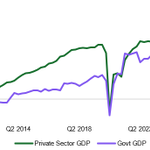
Government consumption and investment was roughly 80% of the net increase:
- Government services: +£0.96bn
- Government investment: +£3.46bn
- Total GDP increase: £5.55bn
In the private sector computing grew 4.4%, but this is on the back of an AI and tech boom, in other words, it would have happened anyway.
Things that government policy directly impacts:
- Construction fell 0.7%
- Education fell 0.5%
- Food & beverage services fell 1.9%
Anyone with half a brain knows that GDP growth alone doesn’t prove higher productivity or better living standards.
We absolutely need sustained growth in the private sector and productivity.
We’re fucked if we rely on increased state spending. This is how countries destroy themselves.
But this is what socialists want, an entirely managed economy and dependent class.

Rob retweeted

Cantillon effect in four steps:
1. the Fed creates money
2. banks and big asset holders get it first, before prices move
3. by the time it reaches your paycheck, everything already costs more
4. economists call this "stimulus"
new money isn't neutral. it has a guest list.
Rob retweeted

INFLATION IS STILL A MONETARY PHENOMENON
I have looked at 42 countries since December 2019. For each one I compared how much faster broad money has grown than the real economy with how high inflation has been.
The slope is 0.50 – one percentage point more money growth a year has meant roughly half a percentage point more inflation.
R² is 0.57 – differences in money growth explain 57% of the differences in inflation across countries.
The countries that printed the most money got the most inflation. Switzerland and Japan, where money barely outgrew the economy, got the least.
The US sits just above the line. The euro area sits almost on it.
So forget supply chain disruptions and greedflation – that was always nonsense. Supply shocks change relative prices. They do not create years of broad-based inflation across 42 countries.
It is money, and it still is. Nominal spending remains excessive across the world, and that is what is keeping inflation elevated everywhere.


Rob retweeted

1. Income enables spending.
2. (Primary) deposits fund bank lending (though not exclusively).
3. Taxes and bond sales, replenish the Treasury’s General Account, upon which it must draw to spend.
4. Yes govt’s can always print money (duh);
5. MMTers ain’t as clever as they think.


Steve - articulating the cause, not the consequence.

👏"The problem is not that markets have been given freedom. It is that they have been distorted by politicians, activists and government policies, while the consequences are blamed on the market."
🗽Fantastic piece for Voices for a Free Future by the great Jilan Shah 🧵

14
Rob retweeted

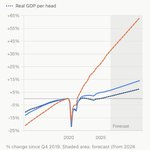
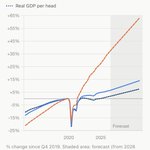
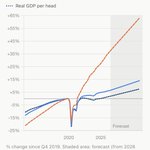
Mindblowing chart from OBR. In 2029 real household disposable income per person expected to be just 1% higher than in 2019. What an unbelievably awful decade. It used to grow by 2%+ every year, not 1% in 10 years.


Rob retweeted

🇬🇧 The OBR just dropped 200 pages on Healey's first Budget.
I read it so you don't have to.
Tax is at a record 37.9% of GDP by 2027-28, past the old high of 37.2%.
Then it climbs every single year to 38.6%.
Frozen thresholds are doing way too much to workers since they get a pay rise, hand more of it over.
1.8x the national minimum wage now classes you as a higher tax rate payer - what the fuck?
Borrowing @ £133bn this year. In March they said £115bn. Seven months later it's £18bn worse. And it's higher than March in every year of the forecast because neither the OBR nor treasury has a clue what they’re doing.
Debt interest at £39bn in 2019-20.
£109bn last year 😩
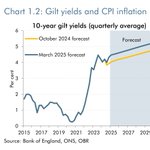
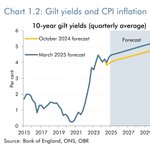
£160bn by 2031-32 😩😩£15bn of this year's bill is extra bc inflation's pushing up index linked gilts, and we know the uk has a structural inflation problem, partly due to the relationship between treasury and BoE.
Headroom is £14.5bn, down from £21.7bn at the last Budget.
Keep the fuel duty freeze going and it's £10.2bn.
The OBR gives Healey a 56% chance of hitting his OWN FUCKING rule.
Debt will peak at 97.3% of GDP, still 95.6% in 2031-32. Five years and it barely moves which is completely against his fiscal demands.
How it affects you?
Growth 1% next year with gdp per capita basically the same as it has been since 2019
Inflation 3.4% when March said 2%.
Zero real pay growth in 2027.
Living standards in 2030-31?
Just 2% above pre-pandemic.
But don't worry. You're getting a £100 council tax rebate.
Jesus Christ.
Fair - I’m not a Reform voter, but a lot of this is exactly right.

Britain is broke. And to fix it, we need to start growing again.
That’s why Reform’s Economic Rescue Plan includes these 64 pro-growth measures I’d take if I were Chancellor:
𝗨𝗻𝗹𝗼𝗰𝗸𝗶𝗻𝗴 𝘁𝗵𝗲 𝗡𝗼𝗿𝘁𝗵 𝗦𝗲𝗮
1. Approve Rosebank
2. Restart oil and gas licensing
3. Legalise onshore exploration
4. Abolish the Energy Profits Levy
5. Restore maximum economic extraction as the North Sea regulator's objective
𝗥𝗲𝗶𝗻𝗱𝘂𝘀𝘁𝗿𝗶𝗮𝗹𝗶𝘀𝗶𝗻𝗴 𝗕𝗿𝗶𝘁𝗮𝗶𝗻
6. Abolish the Emissions Trading Scheme
7. Halt the Carbon Border Adjustment Mechanism
8. Repudiate AR7 contracts for difference and scrap AR8
9. Implement the Fingleton Review on nuclear in full
10. Automatically approve French and South Korean nuclear designs
𝗚𝗲𝘁𝘁𝗶𝗻𝗴 𝗛𝗼𝗺𝗲𝘀 𝗕𝘂𝗶𝗹𝘁 𝗶𝗻 𝗢𝘂𝗿 𝗖𝗶𝘁𝗶𝗲𝘀
11. Cut affordable housing requirements on brownfield sites
12. Permitted Development Right for brownfield housing
13. Repeal Biodiversity Net Gain
14. Exit the Aarhus Convention
15. Repeal and reform the Habitats Regulations, including Nutrient Neutrality
16. End the boiler ban
17. Legalise air conditioning to meet overheating rules
18. Remove mandatory EPC improvements
19. Revoke the Future Homes Standard
20. Repeal the Renters' Rights Act
𝗕𝘂𝗶𝗹𝗱𝗶𝗻𝗴 𝗖𝗿𝗶𝘁𝗶𝗰𝗮𝗹 𝗡𝗮𝘁𝗶𝗼𝗻𝗮𝗹 𝗜𝗻𝗳𝗿𝗮𝘀𝘁𝗿𝘂𝗰𝘁𝘂𝗿𝗲
21. Legislate approval for new runways at Heathrow and Gatwick
22. Auction airport landing slots
23. End 'target-consistent' carbon pricing in project evaluation
24. Ban carbon emissions considerations in planning applications
25. Fast-track all water reservoirs as nationally significant projects
26. Make Development Consent Orders a true one-stop shop
27. Restrict judicial review of ministerial planning decisions
28. Scrap Net Zero construction rules
29. Scrap the social value test in procurement
30. Lift launch limits at SaxaVord Spaceport
31. Open completed sections of East-West Rail
𝗝𝗼𝗶𝗻𝗶𝗻𝗴 𝘁𝗵𝗲 𝗔𝗜 𝗥𝗲𝘃𝗼𝗹𝘂𝘁𝗶𝗼𝗻
32. Review regulatory barriers to AI adoption
33. Permit on-site gas generation for data centres and industry
𝗥𝗲𝗱𝘂𝗰𝗶𝗻𝗴 𝘁𝗵𝗲 𝗖𝗼𝘀𝘁 𝗼𝗳 𝗛𝗶𝗿𝗶𝗻𝗴 𝗕𝗿𝗶𝘁𝗶𝘀𝗵 𝗪𝗼𝗿𝗸𝗲𝗿𝘀
34. Cut Employer NI back to 13.8%
35. Introduce a migrant worker levy
36. Repeal the Employment Rights Act
37. Clarify that workplace rights don't require mandatory training courses
38. Let experienced tradesmen work on government contracts without CSCS qualifications
𝗨𝗻𝗹𝗲𝗮𝘀𝗵𝗶𝗻𝗴 𝘁𝗵𝗲 𝗖𝗶𝘁𝘆 𝘁𝗼 𝗜𝗻𝘃𝗲𝘀𝘁 𝗶𝗻 𝘁𝗵𝗲 𝗥𝗲𝗮𝗹 𝗘𝗰𝗼𝗻𝗼𝗺𝘆
39. Review bank capital requirements to boost lending
40. Rule out Net Zero in financial regulators' remits
41. Repeal climate-related financial disclosure rules
𝗚𝗲𝘁𝘁𝗶𝗻𝗴 𝗠𝗼𝘁𝗼𝗿𝗶𝘀𝘁𝘀 𝗠𝗼𝘃𝗶𝗻𝗴
42. Scrap airport 'surface access strategies'
43. Abolish the electric vehicle mandates
44. Apply domestic GB hours to all UK HGV trips
45. Ban Low-Traffic Neighbourhoods
46. Back the M4 Relief Road
47. Move a new car's first MOT to four years
48. Abolish the Renewable Transport Fuel Obligation
𝗨𝘀𝗶𝗻𝗴 𝗕𝗿𝗲𝘅𝗶𝘁 𝗙𝗿𝗲𝗲𝗱𝗼𝗺𝘀
49. Replace GDPR with a New Zealand-style Privacy Act
50. Fully re-legalise Imperial units
51. Review all unchanged EU law
52. Automatically repeal remaining EU law in 5 years unless retained
𝗚𝗲𝗻𝗲𝗿𝗮𝗹 𝗗𝗲𝗿𝗲𝗴𝘂𝗹𝗮𝘁𝗼𝗿𝘆 𝗠𝗲𝗮𝘀𝘂𝗿𝗲𝘀
53. Make quarterly Making Tax Digital reporting voluntary
54. Reduce legal obligations on SME Non-Executive Directors
55. Double permission-free event days from 28 to 56
56. Make pavement dining licences automatic and permanent
57. Let shops open until 10pm, except Sundays
58. Repeal board diversity and inclusion rules
59. Remove the Sustainable Aviation Fuel mandate
60. Abolish the packaging tax
61. Scrap BBC and Channel 4 priority on streaming platforms
62. Remove the Public Sector Equality Duty
63. Five-year sunset on all QUANGOs
64. Five-year sunset clause on all new regulations
And there are more to come!
Britain’s full potential is waiting to be unleashed 🚀
11
Rob retweeted

HMRC writing off £13bn in unpaid business taxes due to businesses going into liquidation. Unpaid council tax bills a £7.4 billion. Stamp duty down £500m due to higher rates. North Sea windfall taxes achieving only 25% of forecast. The Laffer curve is everywhere. The country is on its knees.


The question is, can Palace keep him… we’ve not been great at retaining academy talent through to the 1st team thus far.


44
Rob retweeted

💡Essential Budget pre-reading for every MP and journalist from @OBR_UK while they await the EFO
📣TL;DR: age related spending is making the welfare state chronically unaffordable.
assets.publishing.service.go…


Our next Economic and fiscal outlook will be published on 28 October 2026.
It will be published on gov.uk/government/organisati… after the Chancellor has presented the Budget to Parliament.
Supporting material, supplementary documents and detailed forecast tables will be published on obr.uk/ on the afternoon of 28 October

ALT Blue background with title text reading: 'Economic and fiscal outlook'. Body text reading: 'Due 28 October 2026'. White calendar icon below. Office for Budget Responsibility logo in the bottom right corner.

