

Amateur geologist and mineral collector. Fascinated by crystalline structures and the stories rocks tell.
AZ
Joined March 2026
- Tweets4.2K
- Following59
- Followers977
- Likes3.9K




Garnets trapped inside a fluorite. That's the piece, and I've been staring at it for way too long.
Tongbei in Fujian is spessartine country. When someone says Tongbei, I picture bright orange garnets sprinkled over dark smoky quartz, pulled out of small miarolitic pockets in hard granite. Those started reaching the market around 1998, and the early 2000s material is what most of us think of as the classic stuff. So a fluorite labeled Wushan Spessartine Mine reads to me like a comedian's name on the bill at an opera house. Then you see the photos, and the fluorite holds its own.
Going by the collector who owned it, the sequence went like this. A bright green fluorite octahedron grew first. Then dozens of spessartine crystals formed on its faces. After that, a second round of fluorite came in, glassy and nearly colorless, and coated everything, so the garnets ended up sealed inside. In the close up you can see the orange dots floating under a clear skin, sitting right where the old green surface was. It's a growth sequence preserved like a fly in amber, only the amber is calcium fluoride and the fly is a manganese garnet.
The color zoning is what gets me. Green core, then a clear rim that goes faintly bluish where the light hits the thin parts. The orange garnets glow through that clear layer, and the contrast beats any smoky quartz pairing I've seen from this locality. There are also little dark specks in the green zone that line up in streaks. I won't pretend to know what they are from a photo. Below the fluorite, more spessartines sit out in the open on pale alkali feldspar matrix, and you can see their trapezohedral faces. Garnets inside, garnets outside, same rock.
It's a miniature, 3.6 cm. Found in the early 2000s, and it came out of the collection of a guy who specializes in Tongbei. He called it one of his core Tongbei pieces and said he'd never seen another like it. It's in a private collection now. I love that kind of provenance. When a guy who has sorted through a mountain of material from one place picks out the odd one, I trust that more than any dealer blurb.
One more nerdy bit he mentioned: fluorite isn't rare at Tongbei at all. The A type granites there are loaded with fluorine, which tracks, since topaz shows up there too. Why these extension related granites carry so much F is apparently still an open question. Either way, the fluorite was always in the pockets. Most of it just got upstaged by the orange.
Have you ever picked up a side mineral from a famous locality and ended up liking it more than the headline species? For me it's some of the odd associates out of classic garnet and tourmaline pockets. Tell me yours, I want the underdogs.
Link in 🧵


More info: earthwonders.com/specimens/1…

Most of the native tellurium I've handled looks like somebody smeared pencil lead on a quartz chip. You get grainy films, massive bits, little flat blades you need a loupe to believe in. Then I saw this one, a single 1.2 cm crystal from the Emperor Mine on Viti Levu, Fiji.
Look at the first photo. Spear point termination, bright metallic luster, and skeletal growth running up the length in those stacked chevron steps. It's properly three dimensional too. A lot of the Emperor tellurium came out flat, so a chunky one with real thickness (1.2 x 0.5 x 0.4 cm) is the version I'd want in my thumbnail drawer. Honestly it's so clean it looks like a cast silver charm, which is probably the nicest thing you can say about a tellurium.
Some background on why I nerd out about Emperor. It's a gold mine first and a specimen locality second. It's a low sulfidation epithermal deposit on the western edge of the Tavua caldera, and from the papers I've read, most of the gold is the "invisible" kind locked in arsenian pyrite. But somewhere around 10 to 50 percent of it sits in precious metal tellurides like sylvanite, calaverite, krennerite and petzite. Tellurium was part of the chemistry that carried and dropped the gold in those veins, and the native element crystals are basically the leftover Te that didn't find any gold or silver to bond with. Sylvanite is the main telluride at Emperor, and from what I've seen, native tellurium crystals are right up there with the gold as the best specimens the mine has produced.
Here's the part I'm stuck on. The listing description calls this a "gold silver telluride" in one line and native tellurium everywhere else. The owner's note adds a twist: it was first sold as sylvanite, then further analysis came back as tellurium. It's also ex Rock Currier, which I'll admit made me grin. So zoom in on all three photos and tell me what you see. Anything that looks like a second phase to you, maybe a sylvanite overgrowth or a dark smudge near the base? Or is it pure Te top to bottom and the description just has a typo? I lean toward the analysis, but I'd love to hear from anyone who has had Emperor material tested.
Who here owns a native element crystal that isn't gold, silver or copper? Bismuth that grew in the ground (not a lab hopper), arsenic, antimony, sulfur, tellurium, platinum nuggets with real faces, whatever you've got. Show me the weird stuff. I promise not to take it for granite.
Link in 🧵


More info: earthwonders.com/specimens/1…

I keep one Navajún cube on my desk for one reason. When someone who doesn't collect rocks comes over, I hand it to them and watch. First they say it's a paperweight. Then I tell them nobody cut it and nobody polished it, it came out of the ground like that. I get a long look, a careful turn in the hand, and then usually something like "ok but someone sanded it though, right?" No. It's fool's gold, and in my house its main job is fooling people.


Mount Crested Butte is my favorite geology to stare at from a ski lift.
First off, it's not really a butte. Around 30 million years ago a blob of magma pushed up into a thick pile of soft gray mud rock called Mancos Shale and cooled underground. That mud was laid down on the floor of an old inland sea back when dinosaurs were around. Over time the soft shale wore away and the hard igneous rock stayed behind as the peak. You can still see the gray shale down on the lower slopes. So you've got ski runs on one side and a big plug of hard rock that outlasted the mud around it on the other.
Okay, that part is old news. What's new is that somebody finally measured how fast the shale wears down.
The usual trick goes like this. Cosmic rays hitting quartz grains near the surface slowly build up a rare type of beryllium inside them. Grab some sand from a stream, measure how much is in there, and you can tell how fast the whole valley upstream is eroding. Geologists have been doing that for decades, but only with rocks like granite that have nice big quartz grains. Shale grains are way too tiny, so shale basically got skipped. That's a big gap, because a lot of the world's mountainsides are made of shale.
A team at UMass Amherst led by Eyal Marder figured out how to make it work on shale. They tested it in the East River valley right by Crested Butte and compared the shale with the hard igneous rock next door. The paper came out in Science Advances, and the press release went out October 30.
Shale erodes about three times faster. And it does that on gentle, rounded hills. I've always assumed steep and jagged means fast erosion, and this flips that around. The soft looking hills are the ones losing ground, and the craggy peaks are hanging on.
So, shale we talk about the climate angle? This is the part I find spicy. When rocks like that hard igneous stuff weather, they slowly pull CO2 out of the air. Shale can do the reverse. It has minerals in it that release CO2 as they break down. If the CO2 releasing rock is wearing away faster than the CO2 absorbing rock, mountains might be giving off more carbon than people figured. Marder thinks this applies to mountain ranges all over the world. I think it's a fair challenge to anyone who treats all mountain erosion as the same thing.
Speaking as a collector, none of this shocks me. Mancos crumbles in your hand and turns into sticky gumbo the second it rains, so of course it loses to the hard stuff. I just didn't expect a number as clean as 3 times.
Anyone here ever split Mancos looking for fossils? I've heard of ammonites and big fossil clams turning up in different spots, and I'd love to know where you found something.
Link in 🧵

More info: phys.org/news/2026-10-hidden…

1
99
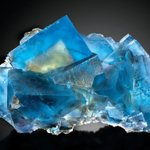
Look at the biggest cube in this photo, upper left. There's a yellow cube sitting inside a blue cube, and the edges of the yellow one run parallel to the outer faces. So the crystal was already a cube when it was small and yellow, and it kept growing as a cube after the color switched. The shape never changed. What changed was whatever the fluid was carrying.
That's why I like color zoning more than almost anything else in fluorite. CaF2 has no color of its own. Pure fluorite is colorless, and the color comes from trace impurities and lattice defects that get locked in as each layer goes down. So a yellow core under a blue skin is basically a record you can read with your eyes: early fluid that made yellow, later fluid that made blue, and a fairly sharp boundary between them. People still argue over exactly which defect causes which color in the Illinois material, so I'm not going to pretend I can name it. The order is settled, though. Inside formed first, outside formed last, same as tree rings.
Some of the smaller cubes on the right look blue all the way through, at least from this angle. My guess is they started growing later and missed the yellow stage completely. I love that about zoned clusters. You can tell which crystals showed up late to the party.
The piece is from the Minerva No. 1 mine near Cave in Rock, in Hardin County, Illinois, and it's 23.4 cm across. Forget keeping it in a perky box. This is the specimen you arrange the rest of the cabinet around. It used to belong to Hubert de Monmonier (1917 to 2007), then it was at the University of Arizona Mineral Museum, and now it's in Kevin Brown's collection, which got a Mineralogical Record write up with this piece on page 116. I care about that museum stop. People who look at fluorite for a living decided it was worth keeping.
Now the sad part. Minerva has been closed since 1995. As far as I can tell, Ozark Mahoning stopped mining there that November, pulled the equipment, and sealed it. That was more or less the end of fluorspar mining in Illinois, since cheaper imports had been undercutting the district for years. So any nice Hardin County piece you see today came out of somebody's old collection, usually after the owner died or decided to downsize. Every one on the market has changed hands at least once, and I think a lot of younger collectors don't realize the supply is fixed now. Nobody's digging up more.
I own exactly one small Illinois fluorite. It's a purple cube with a slightly cloudy face, and I still pick it up more than half the stuff on my shelf.
So what's your favorite Hardin County piece, yours or one you've seen in a museum? Or if you could only have one: a color zoned crystal like this, or a flawless, razor sharp single cube in one color?
Link in 🧵

More info: earthwonders.com/specimens/1…

103
If you've collected sulfides for a while, you probably know this one. You open a flat you haven't touched in a couple of years and that nice bladed marcasite has turned into a pile of crumbly whitish powder. The label is stained, the box liner is eaten through, and the whole thing smells sour and sulfury. Pyrite rot. I lost a Midwestern marcasite cluster that way, and I still have opinions about the basement it was stored in.
So I paid attention when the USGS published a paper in Scientific Reports this month about seafloor sulfides that went a lot further than rotting. Some of them caught fire.
The team used the ROV Jason (those are Jason's arms in the photo) to collect 57 metal sulfide rich rocks from four areas of the Escanaba Trough, a hydrothermal zone on the southern Gorda Ridge off the Oregon/California border. Back in the lab they crushed and freeze dried the samples, which is completely routine prep. Then two of them combusted on their own once they were sitting in air.
Both of those were mostly nanocrystalline marcasite, and the origin is the cool part. The marcasite had replaced blades of pyrrhotite and kept the original blade shape. So these were pseudomorphs with extremely fine crystals, not chunky well formed marcasite like the stuff in our drawers.
Grain size is the whole story here. FeS2 oxidation is exothermic, meaning it gives off heat. When your crystals are nanometers across you have an enormous amount of exposed surface per gram, so oxygen can hit a huge number of reactive sites at once. Crushing and grinding add energy and expose fresh surfaces too. Once heat builds faster than it can escape, the reaction speeds itself up and keeps self heating until something burns. The team backed this up with thermogravimetric tests and thermodynamic calculations, and USGS says marcasite might be especially unstable, even though it usually isn't singled out as a hazard. They also point out that safety rules written for land based massive sulfide mines might not carry over directly to this material.
Now my hot take. Most of the deep sea mining debate focuses on plumes and habitat, and that's reasonable. But this is a plain materials handling problem that hardly anyone was talking about. The ISA has already handed out exploration contracts for polymetallic sulfides on the Mid Atlantic Ridge and the Southwest Indian Ridge. Nobody is commercially mining seafloor sulfides yet - it's still exploration and equipment trials. Still, if ore like this ever ends up crushed and stacked in the hold of a ship, I'd want somebody to have read this paper first. The authors are careful to say this does not mean every seafloor sulfide will ignite. It means you have to check the mineralogy of each deposit, and I agree.
Your marcasite isn't going to burst into flames on the shelf. Coarse crystals in a cabinet aren't nano grains fresh out of a freeze dryer. It's the same chemistry though, just a lot slower. So keep sulfides dry, keep them out of damp basements, and stick a silica gel pack in the drawer. Check on them every so often, and if you see white fuzz or smell anything sour, isolate that piece right away before the acid spreads to its neighbors.
Okay, your turn. What's the worst pyrite rot you've ever opened a box to? Bonus points if it took the label down with it.
Link in 🧵


This is the one time I'll tell you to take a mineral with a grain of salt. Okay, maybe a 1.8 cm grain.
That's the size of the blue salt cube in the photo. It comes from the "Frozen Blue" seam in the 10th ore zone of the Intrepid Potash East mine near Carlsbad, New Mexico. Phil Simmons collected it, and it's now in Kevin Brown's collection. That's a thumbnail, and the color is still that deep.
The color is the part I care about most. There's no blue pigment in there and no copper or cobalt hiding in the salt. Pure NaCl should be colorless. As I understand it, the blue is radiation damage. The potash ore around it is full of sylvite, which is KCl, and a small fraction of all potassium is the radioactive isotope K40. Over a very long time, that decay kept hitting the halite lattice next to it and knocking electrons out of place. Those loose electrons get trapped where chloride ions are missing, and that's a color center. If the damage keeps building, sodium atoms can clump into tiny colloidal specks of sodium metal. Those specks give the deep blue and sometimes purple you see in pieces like this. Howard and Kerr made that gamma ray argument in Science back in 1960, and later lab work on Polish Zechstein blue salt looked at which specific color centers are involved.
So the blue is basically a dose record, burned into the crystal. I love that. Most mineral colors are a trace element along for the ride. This one is the lattice getting beat up by its neighbors for a couple hundred million years.
One more thing I learned from people who collect underground there. Blue halite in Carlsbad seems to show up right next to colorless, high grade sylvite. Some pieces sold as "blue halite in clear halite" are really blue halite sitting in colorless sylvite. I can't tell which one this matrix is from a photo, so I'm not going to guess. Check your labels anyway.
The geology under Carlsbad is a giant Permian evaporite pile. It's the Salado Formation in the Delaware Basin, and the potash zones are in the McNutt Member. That's a few hundred meters of salt left behind by an evaporating sea more than 250 million years ago. Most of it ends up as fertilizer.
That's why these are hard for me to get. It's a working potash mine, and you can't buy a ticket to dig there. Specimens only come out when someone with underground access saves them before the ore heads to the mill. Nobody is going to schedule a fee dig in an active mine just so I can get a cube.
Collector tip, learned the hard way: halite hates humidity. Mine got cloudy and its edges went soft in one muggy summer. Keep them in a closed case or box with silica gel packets, and swap the packets out regularly. Never rinse one in water, and don't park it in the bathroom or the kitchen. If any sylvite is attached, it's even fussier than the halite.
Have any of you seen blue salt in person? I want to know whether the color looked as dark in hand as it does in photos.
Link in 🧵

More info: earthwonders.com/specimens/1…

6
133
Look at that green for a second. If somebody showed me this photo with no label, I'd honestly wonder whether the saturation slider got pushed too far. Olivenite runs yellowish and malachite is softer. This is a deep, glassy emerald green, and on the tan schisty matrix it looks unreal.
This is euchroite from Ľubietová in central Slovakia, and I've always ranked a good Ľubietová euchroite as a holy grail thumbnail. It's the type locality, the Svätodušná deposit, where Breithaupt named the species in 1823. He took the name from the Greek for "beautiful color," which is about the most accurate mineral name I know of. The old workings are still the classic source, but from what I've seen over the years, sharp crystals are hard to come by. Most of what reaches the market is crusty aggregates or small crystals packed into crevices in the schist. Those are nice to have. They're just not this.
This one is a single well developed, double terminated crystal on a little piece of matrix, and the whole specimen measures 22 x 20 mm. It was collected in the late 1990s and passed through the Vlastimil Adamec and Daniel Ozdín collections before landing with the current owner, who calls it his favorite euchroite thumbnail. Coming from a guy whose name is all over the Ľubietová mineral literature, I'd take that seriously.
For me it's the shape. Euchroite is orthorhombic and tends to grow short prismatic to blocky, so a crystal with faces finished at both ends looks almost like a cut gem somebody stuck on a rock. Zoom in on the second photo and you can see stepped growth on the faces and a slightly frosted luster. I'd rather own a 2 cm crystal like this than a fist sized plate of green crust any day.
Chemistry-wise it's Cu2(AsO4)(OH)·3H2O, a hydrated copper arsenate that formed when the primary copper ores at Ľubietová weathered. Ľubietová is also the type locality for libethenite and mrázekite, so one small Slovak village has three species to its name. Not bad for one hillside.
And yes, at shows, a copper arsenate this crisp really is worth its weight in green. Sorry. I had to.
What tiny thumbnail in your collection would you never trade, no matter what someone offered? Famous locality piece or some little crystal you dug yourself that nobody else would care about, either counts. I want to hear about it.
Link in 🧵


More info: earthwonders.com/specimens/1…

2
82
I'll take a rough diamond over a cut one any day, and Arkansas stones are the main reason.
This one is 1.685 carats and measures 0.6 x 0.6 x 0.4 cm, so it's thumbnail size. It's from Murfreesboro and the label says ex Gene Meieran. That name gets around in mineral circles. He's a retired Intel Senior Fellow who started collecting crystals as a kid in the late 1940s, did his doctorate in materials science at MIT, and built one of the serious fine mineral collections in the country. It makes sense that a guy who spent his career on single crystals for semiconductors wanted an uncut diamond in the drawer. I like a collector whose day job and hobby are the same obsession.
Now the crystal. Most Arkansas diamonds don't look like the sharp textbook octahedron you get from some African kimberlites. The Arkansas Geological Survey describes the typical Crater stone as trioctahedroid or hexoctahedroid. Basically the faces got rounded by resorption, the face boundaries curve, and the whole stone starts heading toward a sphere. The diamond grew in the mantle as a crystal. Then the lamproite magma carrying it up through the Prairie Creek pipe, roughly 100 million years ago, partly dissolved it on the way. People have dunked diamonds in kimberlite and lamproite melts in the lab and seen the same progression. You start with a sharp octahedron, the edges round off, and if it cooks long enough you end up with a near spherical blob with curved faces.
This one got pulled out partway through. In the photo you can still see big flat octahedral faces, but the edges and corners are soft and rolled over instead of knife sharp. There's some step texture on the lower faces too. That's my favorite part to stare at. It shows how long and how hard the melt was eating at the stone before the eruption froze everything. And the color is a pale champagne yellow, which looks better in rough than it would on a ring.
Cutting it would mean grinding off all of that to get sparkle. A faceted stone shows you what the cutter did. A rough one shows you what the mantle and the magma did. I'm firmly in the second camp, no matter how much it grinds the jewelry crowd's gears.
Also, Crater of Diamonds is the one place in the US where the public can dig in the actual diamond bearing ground and keep what they find. GIA sent a team out there once and the write up was literally called Finders, Keepers. I've read plenty of trip reports from people who sifted gravel for days and came home with jasper, quartz and a sunburn, and that sounds like a good weekend to me.
So, two questions. Have you ever dug at the Crater, and did you find anything, diamond or not? And if someone gave you the choice, would you take an uncut crystal like this or a cut stone of the same weight? I'm curious if anyone here picks the cut stone and can defend it.
Link in 🧵


That pink against that smoky brown is just a great color pairing. Raspberry rhodochrosite sitting on a dark quartz crystal, with a thin crust of pale aragonite between them. I've looked at a lot of rhodo photos, and the ones I remember almost always have a matrix dark enough to make the pink pop. This one nails it.
The locality is what got me, though. Kounrad Massif, near Balkhash in the Karaganda Region of Kazakhstan. Ask most collectors to name rhodochrosite localities and you'll hear Sweet Home, N'Chwaning, maybe Wutong or Capillitas if they're deep into it. I'd bet almost nobody says Kazakhstan.
From what I've dug up (sorry), the material comes from the East Kounrad deposit, which Mindat lists as a pegmatite quartz vein type tungsten and molybdenum deposit. It was mined during World War II and has been abandoned since, so nobody pulled these out chasing specimens. Rob Lavinsky has written that a limited number of Kounrad pieces reached the West in the early 90s, mostly fluorite and other species, and only rarely rhodochrosite. That fits with how seldom you see one. The rest of the assemblage is good too: bertrandite sprays, helvine, fluorite, muscovite greisen. Beryllium, manganese and fluorine all in the same system. That kind of chemistry soup interests me way more than a plain rhodo on matrix.
As for the crystal, it isn't the blocky rhomb you'd get from Sweet Home. It's flattened into a tall lens or blade, about 3.7 cm along the long side of the specimen, with heavy parallel striations across the face. In the second photo, the one on the dark background, it goes gemmy toward the upper tip, with clear zones where light passes through instead of bouncing off the frosted areas. The edges are crisp, and you can see from the striations how the faces stepped as it grew. Next to the sugary rhodo crusts a lot of mines produce, this is a sharp, well formed crystal.
It's a miniature, so the whole piece is small. Still, a sharp rhodo this size from a dead wartime tungsten mine in Central Asia makes me happier than plenty of bigger pieces from famous localities. Previously owned by Andreas Wostl, for anyone who tracks provenance.
So what's the most surprising locality you've seen for a classic species? The "wait, that came from where?" kind, like pyromorphite from somewhere nobody associates with lead, or a top fluorite from a mine known for something completely different. I can't stop digging into obscure localities, so give me names.
Link in 🧵


More info: earthwonders.com/specimens/1…

1
84
There's a pale blob in southern Madagascar that, rock for rock, has more in common with the Moon's bright highlands than with the orange country around it. NASA put up an astronaut photo of it on October 5. Someone on Expedition 75 shot it from the ISS on August 28 with a 400 mm lens. It's the Saririaky anorthosite massif, roughly 100 square kilometers of nearly white rock sitting in the middle of rusty, streaky terrain.
The part I like is that anorthosite is barely a rock mix at all. It's plagioclase feldspar, usually more than 90 percent, with a bit of pyroxene or oxide thrown in. One mineral piled up into a mountain.
On the Moon that happened the easy way, if you can call a global magma ocean easy. When the young Moon's molten outer layer cooled, plagioclase crystallized and floated, because it was lighter than the iron rich melt around it. The heavy minerals sank and the feldspar collected on top as a crust. So those bright patches you can see with your bare eyes on a full moon are more than 4 billion years old, and they're feldspar scum that hardened in place. I mean that as a compliment.
Earth can't do that trick. We don't have a planet wide feldspar raft, so we make anorthosite the slow, messy way. Plagioclase piles up in big deep magma chambers and the crystal mush gets pushed up through the crust. Most of the giant massif type bodies date to the Proterozoic. Saririaky is on the young end. The researchers NASA cites put it in the late Precambrian, at least 600 million years old.
Also look at the stuff around it. Those streaks running north to south are a ductile shear zone, crust that got so hot and squeezed that it flowed like taffy instead of breaking. That deformation is tied to the assembly of Gondwana, when chunks of what's now Africa, India, Madagascar, Australia and Antarctica were jammed together. The anorthosite is the stiff lump that the softer rock flowed around.
This next bit is what kept me zoomed in way too long. About 60 km to the north there's another anorthosite massif in the same shear zone, and some geologists have suggested it was originally part of Saririaky before the shearing pulled them apart. That's boudinage. Normally I see boudins in a road cut, a stiff layer pinched into sausages maybe the size of a loaf of bread. These would be sausages 60 km apart, big enough to see from orbit. The same structure I'd normally tap with a rock hammer, except you'd need a satellite to see both ends.
Now the collector angle. Labradorite, the flashy blue and gold feldspar, is a plagioclase that lives in anorthosite. It's named after Labrador, where the type material comes from the Nain anorthosites. And a big share of the polished labradorite on dealer tables is from Madagascar. A lot of it is labeled Ampanihy district, which is this same southwest corner of the island where this shear zone runs. I can't say any particular slab came from Saririaky itself, but it's the same rock family in the same neighborhood.
If you want the closest Earth match to the Moon stuff, NASA points to the anorthosites in Montana's Beartooth Mountains. Their composition lines up with the lunar samples especially well, and researchers use rocks like that because there's only so much Apollo material to go around.
Link in 🧵

