

CRO for brands like Hears, Moov & FLÂNEUR | No CRO hacks here, only strategy
Amsterdam
Joined December 2023
- Tweets668
- Following193
- Followers283
- Likes1K


most brand owners judge the people they hire on their wins.
i'd look at how they explain a loss, and i say that because three years ago i couldn't explain mine.
back then i was a designer and copywriter, and a family business trusted me with their money. i worked on it for 2 months and got zero result.
the worst part was that i couldn't even tell them why it didn't work. that stuck with me.
so i went looking for answers, and after that came sixteen courses, four books and four mentors.
the biggest shift was getting away from gut feeling, because i needed a way to know why something worked or didn't.
that's why i look at the loss now. a loss you can explain still tells the brand where to go next, and a loss you can't explain is just their money gone.
2
2
155
if your agency sells urgency like it's a law, ask about the brands where it didn't work.
here's what happened for 5 different brands:
brand 1, added a timer: +9.5% cvr.
brand 2, added a timer: -1.4% cvr.
brand 3, removed a timer: -0.5% cvr.
brand 4, added a timer: -0.8% cvr.
brand 5, added a timer: -9.4% cvr.
1 winner, 3 flat, 1 loser.
at brand 1 the urgency was real.
products had often sold out.
it was a cheap product and people bought it in a very short time.
on higher-ticket offers, the timer did nothing.
there's no one size fits all.
that's the whole goal of testing: find evidence of what works for you and build on that.


2
63

your reviews are a free list of a/b tests. here's what i'd test for nude project, straight from theirs.
the same few things kept coming up. people ordered the wrong size and paid to send it back. they couldn't see what size the model was wearing. and delivery took longer than they expected.
none of that needs a redesign. it needs the right answer in the right spot.
so this is what i'd test on their product page:
the model's height and the size they're wearing, right on the photo.
a short "runs large" note right above the size selector, where people pick their size.
a concrete delivery date under add to cart, instead of "3 to 5 days".
reviews about fit and quality in the buy box, not at the bottom of the page.
photo swatches instead of colour squares, so people see the actual product.
every idea here comes from something their own customers wrote. none of it is tested yet, which is exactly why i'd test it.


2
287
if your agency can only run one test at a time, ask why.
early on, i thought the same.
i isolated every test, because what if one influenced the other?
it cost me a lot of traffic.
each test got half the data.
everything ran twice as long.
but every test already has to split outside influences evenly.
email traffic vs meta traffic.
higher converting countries.
specific ads.
the tool is built to make control and variant as identical as possible.
another running test is just one more influence.
it gets divided the same way.
the real exception is two tests on the same principle close together, like social proof in cart and social proof in checkout.
those can clash.
everything else can run at the same time.
3
280
tested removing expensive AI software to see if it actually held up the roi
cvr even improved
this brand was paying 2k+ each month for a tool that was costing them money lol
do not mean to sh*t on them so blurred the name
but just shows you: just because it might help does not mean you should add blindly to your store

1
2
144
we tested Trustpilot reviews in the checkout for one of our clients.
half the visitors saw them.
the other half didn't.
the version without Trustpilot converted better.
conversion rate: +22.7%
revenue per visitor: +23.5%
aov: flat
99% probability to beat control.
but it only ran one week, with 284 vs 233 orders.
that's not enough to call it a clear winner.
it is enough to say Trustpilot in the checkout didn't help.

3
4
281
before you raise your threshold to push aov, check where your orders actually land (saved our client 10% rpv)
-export your last 3 to 6 months of orders from shopify
-sort them by order value (before shipping)
-find your median: the order in the middle of the list
-count how many orders sit just below your threshold, and how many just above
-look at the orders just above it: what did they add to get there?
if most orders land well below your threshold, it's too high. people aren't stretching to reach it, they're paying shipping or leaving
for one of our client the threshold was €119. their median order was €99 and basket sizes averaged 1,4 items
we tested free shipping from €99
cvr +11%, rpv +10%, aov flat (basket sizes stayed the same)
people were either paying for shipping or leaving not adding more products to reach the threshold and it was costing sales
set it where your orders are, then splittest it

If you..
- generate 1,000 orders a month
- at a $60 AOV
- and raise it by $15
You'll spend $0 more on ads.
But you'll ADD ~$180k in revenue a year (same traffic).
Here's how to do it ↓
2
3
175
one of the biggest unlockers for our landing page and CRO wins was simply following the money.
test on the funnel steps with the most revenue.
launch landing pages on the angle with the most spend.
a 5% lift there does way more than a 20% lift on a low traffic part of the funnel.
and you get way more data, so you make better decisions faster.
that's always the main focus of our lp and ab testing programs.
2
1
80
i am platinum member for one of the brands i work with
spent €1500+ on them
this is what happens when you are constantly staring at a store
tricked my own mind into buying
not first time this happens
also buying from competitors
76
we call most tests on conversion rate, not revenue per visitor.
rpv is way harder to measure than cvr.
one big order can swing it.
so you need a lot more data before you can trust it.
conversion rate is the faster metric to reach significance.
but on offer, pricing and shipping tests we always look at rpv too.
that's where order value actually moves.
3
68
one of our 8 figure clients had one listicle doing most of the heavy lifting.
it scaled hard. but it was really general.
not built for one specific angle.
months later, new angles were scaling way harder.
one of them got about 80k in spend with no page that matched it.
that's not because nobody cares.
creative and media buying know landers matter, and they do work on them.
but challenging a page constantly takes bandwidth.
checking drop-off data.
checking attention data.
checking if new angles are getting spend, and if there's a page that matches them.
that's a job on its own.
and if nobody owns it, the page with the most spend just sits there.
1
106
one week in, a test was up 16% in conversion rate. 32,000 visitors. the testing tool already called it a winner.
i celebrated.
four weeks later, it ended at +1%.
since then:
- i set the runtime before the test starts
- i always run full weeks
- i never stop a test early because the numbers look good
the first week tells you almost nothing. the full runtime tells you the truth.
1
1
81
flâneur's buy box was hiding what people needed before add to cart. so we put everything up front.
sizes open as buttons. colours as image tiles. price higher. USPs under add to cart. less friction, clearer earlier.
result: +9.0% conversion rate at 93% probability to be best.
more people bought.
show people what they need before they ask for it.


1
193
now that AI makes landing pages easy, more and more creative and media buying teams are building them.
but most aren't consistent enough with challenging them.
a lander gets built when someone feels like it.
then it runs, and nobody looks at it again.
that's a lot of money left on the table.
someone needs to own it.
track where spend is flowing per angle.
check if the pages match those angles.
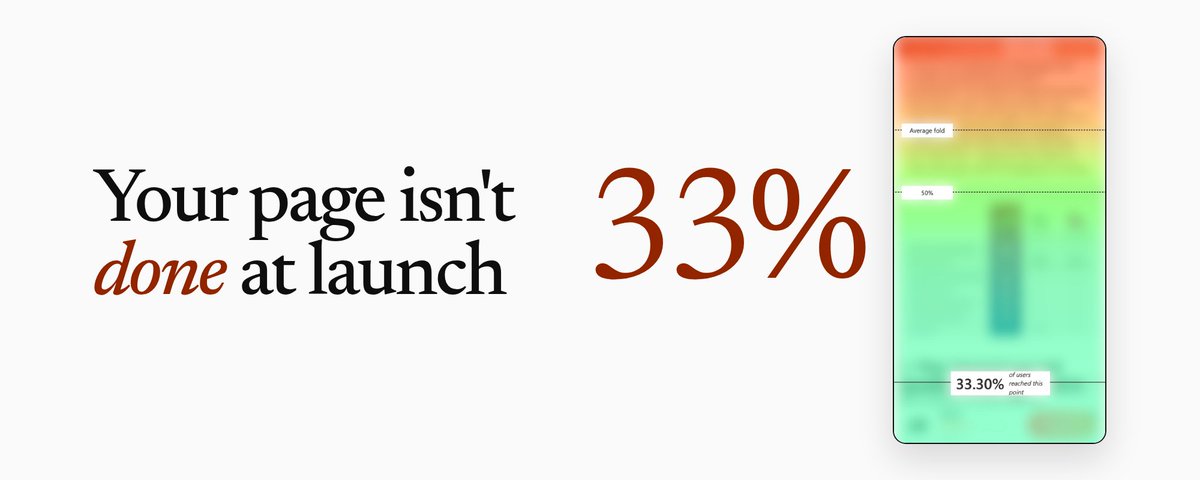
audit every page after launch. scroll rate, attention, clicks, revenue.
shape the next test.
building the page is the easy part.
if you're already doing media buying or creative, this is usually too much to take on as well.
so it starts by defining the role.
then deciding who owns what.
75
CRO entails so much more than i thought before i went into it.
at surface i thought it was smart designs. pick the best template for your niche and go.
turns out that's a race to average results. and average doesn't scale.
so i did the CXL courses. research, data, surveys, all of it.
honestly i was intimidated. i never expected this much depth.
you don't just put a survey live. what you ask, how you ask it, how you analyze it. every part matters.
then i rolled it out with my first clients and realized theory is just the start.
i knew i was filling gaps with guesses. so i got a mentor (she taught one of those courses).
that's when A/B testing finally clicked.
get a mentor with 10+ years of experience. but only after you've built and thought through every step yourself. then the ROI is huge.
landing pages were next.
some of them performed. but we weren't on top of the strategy behind them.
so i had to understand creative strategy. i did Stefan Georgi's course and went deeper into awareness levels, unique mechanisms and market fit.
that was a start.
then i built those pages. some of them never got traffic.
every media buyer had a different opinion on how to test them.
so we went back to the drawing board and built our own strategy.
now we know exactly where to make an impact in an account, and where to start.
and next to all that i was learning to run an agency. onboarding, communication, team, systems.
every level needs a new skill. that's the part i enjoy most.
+15.42% revenue per visitor for a fashion brand by adding one line to the cart drawer.
in our customer survey, about 20% said they doubted the brand. some thought it might be a scam.
the heatmap showed about half of all revenue came from visitors who clicked the return policy.
so we put it right under the checkout button: "free exchanges & easy returns."
result:
- +14.65% conversion rate
- +15.42% revenue per visitor
if buyers go looking for your return policy, stop making them look.


66