
Associate Prof at CUHK-Shenzhen. Prev: assistant prof @UofIllinois; postdoc @Stanford; visitor @AIatMeta Work on optimization of machine learning, DL, LLM.
Shenzhen, China
Joined December 2010
- Tweets139
- Following634
- Followers1.3K
- Likes450



Pinned Tweet
We’re excited to share our work "A Model Can Help Itself: Reward-Free Self-Training for LLM Reasoning".
An earlier version of this work has been on arXiv for a few months. We added more experiments and revised it to this new title.
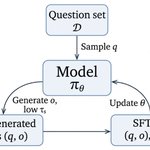
The recipe is simple: the model samples its own reponses at low temperature, learns from them with ordinary SFT training, and repeats.
No reward.
No verifier.
No fancy objective beyond standard SFT.
On Qwen2.5-Math-7B, mean Pass@1 over 6 math benchmarks improves 22.7 → 39.5.
Note that mean Pass@32 also improves 61.0 → 67.9, suggesting that this simple reward-free procedure unlocks more of the model’s existing reasoning potential.
See the updated paper directly at:
github.com/ElementQi/SePT/bl…
The arXiv link is:
arxiv.org/abs/2510.18814
The updated version will appear on arXiv shortly.
@Phanron_xli

OpenAI's list is here. And so is Nobel week.
I read about neutrinos—how they pass through the universe untouched, changed by nothing. I was moved.
I read about left- and right-handed molecules. I always use chirality when teaching determinants in linear algebra, but when students ask why life is single-handed, I have no answer. I'm glad people have studied this for a long time, and the solution of chemists has an interestingly algorithmic flavor.
The matrix multiplication story is moving too. From Strassen's algorithm to decades of grueling progress. I want to know if 2 is the limit. It just dropped below 2.25, but I don't see much discussion.
What about the Riemann Hypothesis? 3SUM? UGC? I hope someone tells their stories.
If you know a good math story, tell it. The world is listening.
#NobelPrize #Math #SciComm
Cannot wait to see how math starts to help solve problems in other complex domains.

Mathematical reasoning will transfer to any area that requires reasoning and building intuition over a complex domain. It might be that AI will not have all the necessary data to make the right conclusions in some cases, but it will be filling in all the necessary holes in data with high sample efficiency, just like humans.
Superhuman intelligence is here, and the same model that solved all these problems will be great at all other scientific and reasoning-bound tasks.
There are different types of math:
--proving conjectures using exisiting tools;
--creating brilliant tools for proving conjectures;
--creating new math frameworks for math;
--formulating math problems for an applied area;
----creating new math framework or theory for an influential new applied area (e.g. Turing, Shannon, Kalman).
I’m particularly interested in AI producing math theories for applied domains.
Unfortuantely, the last two tasks can be painfully difficult, especially the last one.
“Within 2 years” may be enough for proving some math results in applied domain journals, but not enough for making a real impact.
In many domains, the bottleneck may be a lack of data, both for training and inference. The input is no longer a half-page problem statement.
I would be glad if there is some promising sign in 5 years.
IMO, the next steps are:
Within 1 year: strictly better than human AI in all problem-solving aspects of math.
Within 2 years: producing mathematics becomes so cheap, AI will produce mathematical theories for all kinds of applied domains on the fly at need.
Mathematics becomes the true infrastructure of all of engineering and applied sciences (including AI, biology, optimization, cybersecurity, etc) where approaching things theoretically was too expensive to be practical.
Excited to share our paper on continual learning & reducing forgetting at #ICML2026 tomorrow!
📍 Poster Session 3: HALL A #2010 Wed, Jul 8, 2026 • 9:30–11:15 AM CST
Unfortunately, I'm not at ICML; but my students @SenmiaoWang will be happy to chat.
Forgetting is a challenge for continual learning, including sft.
1) Finding: Correlation of distance and forgetting.
We found that optimizers can converge to minima with similar SFT loss with different distances from the pre-trained model. The farther the model moves, the more pre-trained knowledge it tends to lose.
2) Algorithm: **MoFO**, a Momentum-Filtered Optimizer for LLM fine-tuning.
At each step, MoFO updates only the parameters with the largest momentum magnitudes within each block, leaving the rest unchanged.
This biases toward closer solutions, preserving more pre-trained knowledge while maintaining strong task performance.
No pre-training data required.
No extra model-weight storage.
Paper: arxiv.org/pdf/2407.20999
[TMLR, J2C Certification]
Glad to give a talk at Oxford this Tuesday at 1pm, as I continue my UK visit.
I will use Hessian and spectra — two classical mathematical objects — as entry points into my recent works on LLM training.
maths.ox.ac.uk/node/81480
Side: This post was first flagged as automated...how to prove that it is a human-written post?? tried a few times and failed; waited 20 mins to resend, got it posted.
Ruoyu Sun retweeted

Cool to see that on vision problems with unpaired data, relativistic GAN is still SOTA
openaccess.thecvf.com/conten…
I’m excited to share that I will give a plenary talk on neural network optimization at the SIAM Conference on Optimization (OP26) in Edinburgh, United Kingdom, at 8am, June 3. I'll describe my view of the optimizaiton foundation needed for neural net training, from both the global landscape and local structure perspectives.
Check out the conference program and more information here: siam.org/conferences-events/….
Hope to see you there! #SIAMOP26

SePT is built on top of verl, making it easy to plug into existing post-training pipelines.
The core loop is simple: Low-temp generation; Standard SFT.
If you're already using verl, you can adapt SePT in minutes.
🚀 Code: github.com/ElementQi/SePT
Our method, SePT, follows a simple iterative recipe: Sample questions $q$ $\rightarrow$ Generate low-temp responses $o$ $\rightarrow$ Update model via standard SFT $\rightarrow$ Repeat using the updated model.
Note the "online refresh" ingredient: By interleaving generation and training, the self-generated data is "refreshed" by the latest model.
