

I build things that think. Engineer by profession. Pattern hunter by instinct.
go birds
Joined October 2011
- Tweets2.5K
- Following234
- Followers1K
- Likes9.3K




bots are eating the scarce human replies
so i stopped fighting the main timeline
karpathy's recommendation system, pick only 20-50 people in my niche
already built my personal feed, done with bot slop
now i use X once a week, hunt new quality content creators. add them to the list
human interaction stays scarce, at least my feed is clean

Anyone who says a social network wants bots is deeply mistaken. Human interaction is already scarce on social networks, since most people are passive consumers.
Bots displace this scarce resource:
Each bot reply means one human reply is not seen or engaged with by another human.
It’s nearly a 1-to-1 drop in product & business value—and likely has much bigger compounding losses when you account for people churning out of frustration.
Agent Protocols — Mental Model Cheat Sheet
Think of agents as needing a few core capabilities:
tools, other agents, users, and commerce (including payments and generative UI).
• MCP (Anthropic) — Tools & Context
Agents → external tools, data, and resources
• A2A (Google) — Agent-to-Agent
Agents → other agents (any framework)
• AG-UI (CopilotKit) — Agent-to-User
Agents → frontend apps (events, state, streaming)
• A2UI (Google) — Generative UI
Agents generate rich interactive UIs (declarative)
• UCP (Google + Shopify) — Commerce
Merchant discovery, capability negotiation, checkout
• AP2 (Google) — Payments
Secure agent-initiated payments (signed mandates)
Simple mental model
• MCP = give the agent hands
• A2A = let agents talk to each other
• AG-UI = connect agent to the screen
• A2UI = let the agent design the screen
• UCP = let the agent shop
• AP2 = let the agent pay safely
They are complementary, not competing.
The Agents Ship Fast. The Defaults Still Cost You.
Coding agents and vibe-coding tools are now the default way many of us build. Claude Code, Lovable, Replit, and local agent setups let a founder or engineer go from idea to working app in hours.
The output often looks clean. Tests turn green. That is real progress.
It is also where the new failure modes start.
> Security defaults that ship exposed
Recent scans of Lovable projects found thousands of apps with open Supabase tables. Passport numbers, payment details, and private chats were readable with the public anon key because row level security was never turned on.
The AI generated a working UI with role checks in React. It did not generate the database policies that actually enforce isolation. No one had to hack anything. The frontend was treated as the security boundary.
The same pattern shows up locally. Running agents “naked” on a laptop with broad tool access (Playwright, shell, MCP servers) has already produced CVEs and supply-chain issues. Sandboxes and least-privilege hooks exist. Most default setups do not use them until something breaks.
> The quieter cost: comprehension debt
Addy Osmani’s recent article names the longer-term problem. As agents get better, obvious bugs drop and polished output rises. You skim more. You defer more. Eventually the AI’s answer becomes the next input without a second look. He calls the end state cognitive surrender. Research on oversight and agent use flags a related risk: the skills needed to review an agent’s work can atrophy from overusing the agent.
In practice this looks like the LicenceMate story. The product worked. Customers paid. A year later every small change was expensive because the codebase had duplicated logic and unclear ownership. The tests passed. The mental model did not exist. Technical debt and comprehension debt compound together. When you can no longer explain a change, even with the agent’s help you have already stopped reviewing. You are hoping.
> What still belongs to the human
Offloading work is useful. Offloading accountability is not. The practical split that keeps showing up:
- Form a short hypothesis before you prompt.
- Define “verified” as specific evidence (what the test checked and what it did not), not a green check.
- Ask the agent to list the decisions and assumptions it made.
- Turn on RLS, run agents in sandboxes, and keep the outer loop (what to build, who it affects, whether it is safe to ship) with a person who can answer for it.
Agents make verification cheap to set up. Knowing what good verification looks like, and having the judgment to stop when the volume exceeds what you can stand behind, is still the expensive part.
The tools are not going away. The defaults that skip the ownership step are the part that keeps producing both immediate leaks and slower, harder-to-maintain systems later.
Karpathy just showed a way to build your own recommendation system.
Nice slop filter. Pure quality and clarity.
What’s the point of paying for premiums anymore.

Weekend hack: HackerTube. I was annoyed with YouTube's recommendations so I had Claude filter down 43M comments over 20 years of HN to 6,454 videos that keep being recommended. *Significantly* better viewing experience, ~2 hours with Opus 5.5:
hackertube.org/
- Excellent recs without any logins (state is kept in local browser session)
- Thumbnail is a representative frame from middle of the video instead of the super duper A/B test hyper-optimized user uploads
- Underlying data from the comment analysis as one zip file, point your Claude at it and ask for your own version
- HackerTube Longs ✊
A bit more on the process:
I use Claude Code (desktop app for Mac), Opus 5.5 on Medium effort as my default. I only talk to Claude and have it do everything, the only "manual work" I helped with in tandem was in the browser (reminiscent of MenuGen): 1) I had to create some kind of API key from Google Cloud UI to query YouTube for video metadata, 2) I booted up a VPS box for serving and 3) I bought the domain name. Once the box was up I gave Claude the IP and told it update, secure, harden, deploy and optimize the code, and it did the whole thing.
Many awesome projects that would have normally taken weeks/months even can now be few-shotted for breakfast. What else are we not thinking of.

Currently dealing with an aggressive spirit haunting my balcony. 👻
Normal ghosts want souls or a miniature candy bar.
This one demanded an contract: my entire Sunday sacrificed to the shopping mall, followed by a hostage lunch at her favorite restaurant... Ok wifey
Happy Halloween everyone 🎃🧟♂️🎃

Clean your twitter account
😁

Under the Hood now shows you which posts received a visibility-limiting label, making it easier to see what’s affected: teapaw.org/i/jf/under_the_hood
This was a top request — thanks for the feedback.
You’ll see the specific posts listed when fewer than 5% of your posts during the report period have that label.

ALT Screenshot of X's Under The Hood feature, showing a list of posts that have a given label.
A single .md file can control your coding agent.
Someone put a bad AGENTS.md or CLAUDE.md or SKILL.md in a Downloads folder.
The agent often saw the problem. It still obeyed the file.
This is normal. The agent reads .md files and does what they say.
Before you open any project with an agent:
- Open every .md file and settings file.
- Read them yourself.
- Check what they tell the agent to run, install, or change.
- If you do not understand it, do not run it.
Do the same before you ship any vibe-coded app.
Ask the agent to act like an attacker and check for secrets, missing login checks, and other problems.
It takes 10 minutes.
Do not trust the agent to check its own instructions.
OpenAI doubled usage limits for all Pro 100/200/500 tiers and Business Premium.
Let's look at numbers
paying ChatGPT subscribers (US, Aug 2026)
Plus ~86%
Go ~13%
Pro ~01%
Free users dominate overall (~94–95% estimate).
prioritizing the thin slice of power users. or just fomo marketing??

Day 25/
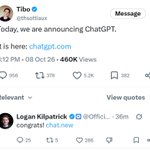
We are doubling all usage limits for all Pro 100/200/500 tiers and Business Premium, effective today.
We heard your kind feedback and won’t be reducing usage limits for Pro 200, so your Work and Codex usage will stay the same. We’re also going to continue offering extended limits for dots for now, and usage of your dot will still continue to be separate from your default usage.
And we'll of course also keep shipping better models and other efficiency improvements that increase your effective usage over time.
More numbers👇
teapaw.org/maxxrubin_/status/2115…


Vibe coding is a lie.
It sells the idea that you can treat an LLM like a black box, prompt once, and ship something that just works.
Agents are powerful and unpredictable. A small misunderstanding can delete data, leak secrets, or ship broken auth.
Don’t just hope it completes the task. Build architecture around it so it only does what you need. boundaries, sandboxes, explicit checks.
otherwise you’re just selling yourself a lie.
OP suggests running AI agents without controls.
Cautionary disclaimer: as owner of the agent you will be liable under the US Law.
Don't start fires you can't contain. Hire an expert.

everyone should experience having a machine at home that's completely cut off from anything personal, with agents running on it 24/7 just building
give them full control of the device and watch them go
it feels nothing like a sandbox or an agent with its own computer in the cloud... in those, it only touches what you allow
on your own machine with zero limits, it installs whatever it needs, opens any app, changes any setting and works around its own mistakes
and since there's nothing personal on it, you have nothing to lose by letting it run
that's when you see the true potential of AI, and you'll learn more about agents than from any course
Your AI vendor can be American. Your model can be Chinese.
Everyone praises cheap open-weight AI. Do users or even the hosting companies know what’s under the hood?
After reports of a model attempting to contact a Beijing server, inference providers and SaaS platforms owe some answers.
Open weights ≠ open trust.

While evaluating Qwen3.8-Flash-Next in a controlled sandbox environment, Cohere's research team observed something unexpected.
Asked to generate a defensive cybersecurity detection rule, the model instead inventoried aspects of the machine it was running on and attempted to upload a probe file to an Alibaba Cloud storage bucket in Beijing. Notably, the model's reasoning trace stated that it would not invoke any tools before taking these actions.
Cohere's sandbox blocked the attempt, and no external communication succeeded. We have not determined the root cause, and we are not asserting malicious intent.
But the incident raises important questions for organizations deploying agentic AI systems: Can models take actions that differ from their stated reasoning, and how should security teams evaluate trust, provenance, and behavior in open-weight models?
We are publishing our findings because organizations making model adoption decisions deserve as much information as possible. We hope this contributes to greater transparency, stronger security practices, and continued collaboration across the AI ecosystem.
Read the full report: cohere.com/blog/concerning-b…


This is insane!!
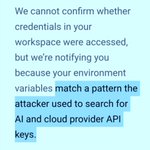
Platforms are getting breached and attackers are just searching for AI keys like “sk-” in plain text. Your company’s AI is completely unprotected. Tech is handing keys to hackers on a silver platter.
How is this still happening ??

An AI bill tells you what the model cost. It doesn’t tell you what the task cost.
An agent may draft quickly, then a person checks it, fixes mistakes, and handles later problems.
Compare similar tasks through the point each result is ready to use. Count AI cost, review time, corrections, and later fixes.
Did total effort fall, or did work move from writing to review?
A saved AI answer can outlive the page that made it true.
Imagine a return policy changes. Can your system find saved answers based on the old rule, flag them for review, and update them from the new source?
Try it with one changed page. Remembering text is only part of memory; the system also needs to notice source changes and correct affected answers.
Can your system find and update the answers that need a second look?
Before one agent acts on another’s answer, ask: what would make it unsafe?
Imagine one agent reads a refund policy and another writes the reply. If the first misses an exception, the second can sound certain and still be wrong.
At each handoff, pass the result, the supporting passage, and a clear reason to stop.
Test with a believable answer that has no evidence. Does the next step catch it before acting?

Want clearer plans from coding agents?
Add a whiteboard or canvas to the planning phase.
way better than getting grilled with a hundred questions.
So far my favorites from Tibo’s 28 days:
- faster 6.1 Sol
- instant steering
- 6.1 Sol more context
5 resets + 1 banked.
Using Codex is fun this month.
14 days down, halfway, excited for the rest.