





Sovereign Immunity: The Betrayal of Republican Responsibility
At the core of the American experiment lies a profound promise — that government exists of the people, by the people, and for the people. The rule of law, the foundation of a free republic, rests upon a simple moral truth: those who cause harm must be held accountable for that harm. Yet, the doctrine of sovereign immunity stands as a direct contradiction to this ideal.
Sovereign immunity is a relic of monarchy — the ancient belief that “the King can do no wrong.” Though America was founded in explicit rejection of that idea, the principle quietly endured in the fabric of our legal system. Today, it shields federal and state governments from lawsuits, rendering them immune from many consequences of their own misconduct.
This immunity erodes the very concept of republican government. If the people are the true sovereign, then the government, as their servant, cannot rightfully claim a status above accountability. A system that excuses those in power from responsibility while demanding strict obedience from citizens is not a republic — it is a hierarchy masquerading as one.
Throughout history, attempts have been made to limit this contradiction. The Federal Tort Claims Act and various state-level reforms allow limited recourse when government negligence harms citizens. Yet these measures are exceptions carved into a wall designed to keep the people out. The structure remains fundamentally unjust: when the government errs, the burden of its mistakes still too often falls on those it governs.
True justice requires symmetry. The governed must be bound by the law — and so must those who govern. Only when government officials and institutions are held to the same standard of responsibility as every citizen can we claim to live under a genuine rule of law.
Sovereign immunity, in its broad form, denies this principle. It invites irresponsibility, fosters detachment from consequence, and diminishes public trust. To restore the republic to its rightful moral footing, the people must reclaim their sovereignty — not as a symbolic phrase, but as a living reality of accountability.
A government that cannot be held to account for its wrongs is not a servant of the people; it is their master. And no free people can long endure under masters immune from justice.
2
104
What a shit show college athletics is! 4- 15 minute quarters and it’s just half time and 1.5 hours of commercial breaks as occurred! A half hour of game play!
1
21
342
Sovereign Immunity: The Betrayal of Republican Responsibility
At the core of the American experiment lies a profound promise — that government exists of the people, by the people, and for the people. The rule of law, the foundation of a free republic, rests upon a simple moral truth: those who cause harm must be held accountable for that harm. Yet, the doctrine of sovereign immunity stands as a direct contradiction to this ideal.
Sovereign immunity is a relic of monarchy — the ancient belief that “the King can do no wrong.” Though America was founded in explicit rejection of that idea, the principle quietly endured in the fabric of our legal system. Today, it shields federal and state governments from lawsuits, rendering them immune from many consequences of their own misconduct.
This immunity erodes the very concept of republican government. If the people are the true sovereign, then the government, as their servant, cannot rightfully claim a status above accountability. A system that excuses those in power from responsibility while demanding strict obedience from citizens is not a republic — it is a hierarchy masquerading as one.
Throughout history, attempts have been made to limit this contradiction. The Federal Tort Claims Act and various state-level reforms allow limited recourse when government negligence harms citizens. Yet these measures are exceptions carved into a wall designed to keep the people out. The structure remains fundamentally unjust: when the government errs, the burden of its mistakes still too often falls on those it governs.
True justice requires symmetry. The governed must be bound by the law — and so must those who govern. Only when government officials and institutions are held to the same standard of responsibility as every citizen can we claim to live under a genuine rule of law.
Sovereign immunity, in its broad form, denies this principle. It invites irresponsibility, fosters detachment from consequence, and diminishes public trust. To restore the republic to its rightful moral footing, the people must reclaim their sovereignty — not as a symbolic phrase, but as a living reality of accountability.
A government that cannot be held to account for its wrongs is not a servant of the people; it is their master. And no free people can long endure under masters immune from justice. I
12
331

Sovereign Immunity: The Betrayal of Republican Responsibility
At the core of the American experiment lies a profound promise — that government exists of the people, by the people, and for the people. The rule of law, the foundation of a free republic, rests upon a simple moral truth: those who cause harm must be held accountable for that harm. Yet, the doctrine of sovereign immunity stands as a direct contradiction to this ideal.
Sovereign immunity is a relic of monarchy — the ancient belief that “the King can do no wrong.” Though America was founded in explicit rejection of that idea, the principle quietly endured in the fabric of our legal system. Today, it shields federal and state governments from lawsuits, rendering them immune from many consequences of their own misconduct.
This immunity erodes the very concept of republican government. If the people are the true sovereign, then the government, as their servant, cannot rightfully claim a status above accountability. A system that excuses those in power from responsibility while demanding strict obedience from citizens is not a republic — it is a hierarchy masquerading as one.
Throughout history, attempts have been made to limit this contradiction. The Federal Tort Claims Act and various state-level reforms allow limited recourse when government negligence harms citizens. Yet these measures are exceptions carved into a wall designed to keep the people out. The structure remains fundamentally unjust: when the government errs, the burden of its mistakes still too often falls on those it governs.
True justice requires symmetry. The governed must be bound by the law — and so must those who govern. Only when government officials and institutions are held to the same standard of responsibility as every citizen can we claim to live under a genuine rule of law.
Sovereign immunity, in its broad form, denies this principle. It invites irresponsibility, fosters detachment from consequence, and diminishes public trust. To restore the republic to its rightful moral footing, the people must reclaim their sovereignty — not as a symbolic phrase, but as a living reality of accountability.
A government that cannot be held to account for its wrongs is not a servant of the people; it is their master. And no free people can long endure under masters immune from justice.
12
Sovereign Immunity: The Betrayal of Republican Responsibility
At the core of the American experiment lies a profound promise — that government exists of the people, by the people, and for the people. The rule of law, the foundation of a free republic, rests upon a simple moral truth: those who cause harm must be held accountable for that harm. Yet, the doctrine of sovereign immunity stands as a direct contradiction to this ideal.
Sovereign immunity is a relic of monarchy — the ancient belief that “the King can do no wrong.” Though America was founded in explicit rejection of that idea, the principle quietly endured in the fabric of our legal system. Today, it shields federal and state governments from lawsuits, rendering them immune from many consequences of their own misconduct.
This immunity erodes the very concept of republican government. If the people are the true sovereign, then the government, as their servant, cannot rightfully claim a status above accountability. A system that excuses those in power from responsibility while demanding strict obedience from citizens is not a republic — it is a hierarchy masquerading as one.
Throughout history, attempts have been made to limit this contradiction. The Federal Tort Claims Act and various state-level reforms allow limited recourse when government negligence harms citizens. Yet these measures are exceptions carved into a wall designed to keep the people out. The structure remains fundamentally unjust: when the government errs, the burden of its mistakes still too often falls on those it governs.
True justice requires symmetry. The governed must be bound by the law — and so must those who govern. Only when government officials and institutions are held to the same standard of responsibility as every citizen can we claim to live under a genuine rule of law.
Sovereign immunity, in its broad form, denies this principle. It invites irresponsibility, fosters detachment from consequence, and diminishes public trust. To restore the republic to its rightful moral footing, the people must reclaim their sovereignty — not as a symbolic phrase, but as a living reality of accountability.
A government that cannot be held to account for its wrongs is not a servant of the people; it is their master. And no free people can long endure under masters immune from justice.
10
397
Sovereign Immunity: The Betrayal of Republican Responsibility
At the core of the American experiment lies a profound promise — that government exists of the people, by the people, and for the people. The rule of law, the foundation of a free republic, rests upon a simple moral truth: those who cause harm must be held accountable for that harm. Yet, the doctrine of sovereign immunity stands as a direct contradiction to this ideal.
Sovereign immunity is a relic of monarchy — the ancient belief that “the King can do no wrong.” Though America was founded in explicit rejection of that idea, the principle quietly endured in the fabric of our legal system. Today, it shields federal and state governments from lawsuits, rendering them immune from many consequences of their own misconduct.
This immunity erodes the very concept of republican government. If the people are the true sovereign, then the government, as their servant, cannot rightfully claim a status above accountability. A system that excuses those in power from responsibility while demanding strict obedience from citizens is not a republic — it is a hierarchy masquerading as one.
Throughout history, attempts have been made to limit this contradiction. The Federal Tort Claims Act and various state-level reforms allow limited recourse when government negligence harms citizens. Yet these measures are exceptions carved into a wall designed to keep the people out. The structure remains fundamentally unjust: when the government errs, the burden of its mistakes still too often falls on those it governs.
True justice requires symmetry. The governed must be bound by the law — and so must those who govern. Only when government officials and institutions are held to the same standard of responsibility as every citizen can we claim to live under a genuine rule of law.
Sovereign immunity, in its broad form, denies this principle. It invites irresponsibility, fosters detachment from consequence, and diminishes public trust. To restore the republic to its rightful moral footing, the people must reclaim their sovereignty — not as a symbolic phrase, but as a living reality of accountability.
A government that cannot be held to account for its wrongs is not a servant of the people; it is their master. And no free people can long endure under masters immune from justice.
1
19
317
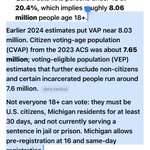
Michigan voting g stats!
Total registered voters (all, including inactive): Approximately 8.47 million as of November 2024.
Here’s what Grok says are age eligible voters
• Voting-age population (VAP, 18+): About 7.85–7.9 million (2023–2024 estimates).
• Citizen voting-age population (CVAP): Slightly lower, estimated around 7.5–7.6 million in recent years (exact 2024 CVAP figures align closely with this range based on ACS data).
Look at the gap of citizen versus voting age population!
1
22
378
Sovereign Immunity: The Betrayal of Republican Responsibility!
At the core of the American experiment lies a profound promise — that government exists of the people, by the people, and for the people. The rule of law, the foundation of a free republic, rests upon a simple moral truth: those who cause harm must be held accountable for that harm. Yet, the doctrine of sovereign immunity stands as a direct contradiction to this ideal.
Sovereign immunity is a relic of monarchy — the ancient belief that “the King can do no wrong.” Though America was founded in explicit rejection of that idea, the principle quietly endured in the fabric of our legal system. Today, it shields federal and state governments from lawsuits, rendering them immune from many consequences of their own misconduct.
This immunity erodes the very concept of republican government. If the people are the true sovereign, then the government, as their servant, cannot rightfully claim a status above accountability. A system that excuses those in power from responsibility while demanding strict obedience from citizens is not a republic — it is a hierarchy masquerading as one.
Throughout history, attempts have been made to limit this contradiction. The Federal Tort Claims Act and various state-level reforms allow limited recourse when government negligence harms citizens. Yet these measures are exceptions carved into a wall designed to keep the people out. The structure remains fundamentally unjust: when the government errs, the burden of its mistakes still too often falls on those it governs.
True justice requires symmetry. The governed must be bound by the law — and so must those who govern. Only when government officials and institutions are held to the same standard of responsibility as every citizen can we claim to live under a genuine rule of law.
Sovereign immunity, in its broad form, denies this principle. It invites irresponsibility, fosters detachment from consequence, and diminishes public trust. To restore the republic to its rightful moral footing, the people must reclaim their sovereignty — not as a symbolic phrase, but as a living reality of accountability.
A government that cannot be held to account for its wrongs is not a servant of the people; it is their master. And no free people can long endure under masters immune from justice.

ALT The sun rises over a Republic with Democratic elections!
1
19
311
Steve Boyer retweeted

So far no one has found the number in the Box
What number do you see?
Correct answer deserve $650


Sovereign Immunity: The Betrayal of Republican Responsibility
At the core of the American experiment lies a profound promise — that government exists of the people, by the people, and for the people. The rule of law, the foundation of a free republic, rests upon a simple moral truth: those who cause harm must be held accountable for that harm. Yet, the doctrine of sovereign immunity stands as a direct contradiction to this ideal.
Sovereign immunity is a relic of monarchy — the ancient belief that “the King can do no wrong.” Though America was founded in explicit rejection of that idea, the principle quietly endured in the fabric of our legal system. Today, it shields federal and state governments from lawsuits, rendering them immune from many consequences of their own misconduct.
This immunity erodes the very concept of republican government. If the people are the true sovereign, then the government, as their servant, cannot rightfully claim a status above accountability. A system that excuses those in power from responsibility while demanding strict obedience from citizens is not a republic — it is a hierarchy masquerading as one.
Throughout history, attempts have been made to limit this contradiction. The Federal Tort Claims Act and various state-level reforms allow limited recourse when government negligence harms citizens. Yet these measures are exceptions carved into a wall designed to keep the people out. The structure remains fundamentally unjust: when the government errs, the burden of its mistakes still too often falls on those it governs.
True justice requires symmetry. The governed must be bound by the law — and so must those who govern. Only when government officials and institutions are held to the same standard of responsibility as every citizen can we claim to live under a genuine rule of law.
Sovereign immunity, in its broad form, denies this principle. It invites irresponsibility, fosters detachment from consequence, and diminishes public trust. To restore the republic to its rightful moral footing, the people must reclaim their sovereignty — not as a symbolic phrase, but as a living reality of accountability.
A government that cannot be held to account for its wrongs is not a servant of the people; it is their master. And no free people can long endure under masters immune from justice.
10
195
Sovereign Immunity: The Betrayal of Republican Responsibility
At the core of the American experiment lies a profound promise — that government exists of the people, by the people, and for the people. The rule of law, the foundation of a free republic, rests upon a simple moral truth: those who cause harm must be held accountable for that harm. Yet, the doctrine of sovereign immunity stands as a direct contradiction to this ideal.
Sovereign immunity is a relic of monarchy — the ancient belief that “the King can do no wrong.” Though America was founded in explicit rejection of that idea, the principle quietly endured in the fabric of our legal system. Today, it shields federal and state governments from lawsuits, rendering them immune from many consequences of their own misconduct.
This immunity erodes the very concept of republican government. If the people are the true sovereign, then the government, as their servant, cannot rightfully claim a status above accountability. A system that excuses those in power from responsibility while demanding strict obedience from citizens is not a republic — it is a hierarchy masquerading as one.
Throughout history, attempts have been made to limit this contradiction. The Federal Tort Claims Act and various state-level reforms allow limited recourse when government negligence harms citizens. Yet these measures are exceptions carved into a wall designed to keep the people out. The structure remains fundamentally unjust: when the government errs, the burden of its mistakes still too often falls on those it governs.
True justice requires symmetry. The governed must be bound by the law — and so must those who govern. Only when government officials and institutions are held to the same standard of responsibility as every citizen can we claim to live under a genuine rule of law.
Sovereign immunity, in its broad form, denies this principle. It invites irresponsibility, fosters detachment from consequence, and diminishes public trust. To restore the republic to its rightful moral footing, the people must reclaim their sovereignty — not as a symbolic phrase, but as a living reality of accountability.
A government that cannot be held to account for its wrongs is not a servant of the people; it is their master. And no free people can long endure under masters immune from justice
13
203
Sovereign Immunity: The Betrayal of Republican Responsibility
At the core of the American experiment lies a profound promise — that government exists of the people, by the people, and for the people. The rule of law, the foundation of a free republic, rests upon a simple moral truth: those who cause harm must be held accountable for that harm. Yet, the doctrine of sovereign immunity stands as a direct contradiction to this ideal.
Sovereign immunity is a relic of monarchy — the ancient belief that “the King can do no wrong.” Though America was founded in explicit rejection of that idea, the principle quietly endured in the fabric of our legal system. Today, it shields federal and state governments from lawsuits, rendering them immune from many consequences of their own misconduct.
This immunity erodes the very concept of republican government. If the people are the true sovereign, then the government, as their servant, cannot rightfully claim a status above accountability. A system that excuses those in power from responsibility while demanding strict obedience from citizens is not a republic — it is a hierarchy masquerading as one.
Throughout history, attempts have been made to limit this contradiction. The Federal Tort Claims Act and various state-level reforms allow limited recourse when government negligence harms citizens. Yet these measures are exceptions carved into a wall designed to keep the people out. The structure remains fundamentally unjust: when the government errs, the burden of its mistakes still too often falls on those it governs.
True justice requires symmetry. The governed must be bound by the law — and so must those who govern. Only when government officials and institutions are held to the same standard of responsibility as every citizen can we claim to live under a genuine rule of law.
Sovereign immunity, in its broad form, denies this principle. It invites irresponsibility, fosters detachment from consequence, and diminishes public trust. To restore the republic to its rightful moral footing, the people must reclaim their sovereignty — not as a symbolic phrase, but as a living reality of accountability.
A government that cannot be held to account for its wrongs is not a servant of the people; it is their master. And no free people can long endure under masters immune from justice.
19
290
Evidently, liberals are running X’s free speech violations! Legacy of twitter! I explained that the word libtard comes from two words! Liberal and retard! Retard is an engineering word meaning to turn back! Liberals think the word retard is forbidden! !
3
10
259
This donkey dumb ass is responsible for killing this woman by inciting this protest! He’ll never admit! He’ll always blame someone else! He lied here! She did try to run over the ICE agent! You’re responsible moron!

2
13
301
Groks analysis of the videos on x;
• One or more ICE agents approach the driver’s side window of the woman’s red/maroon SUV, which is partially blocking the street, and order her to “get out of the fucking car” (audible in several clips).
• She does not comply and instead accelerates forward (tires spinning on snow, visible exhaust/smoke).
• At that moment, a separate agent positioned in front or slightly to the side of the vehicle draws his weapon, sidesteps or jumps to avoid being hit (some enhanced/slow-motion clips show the vehicle clipping or brushing him), reaches across/leans over the hood, and fires multiple shots (3-4) through the driver’s side window or windshield at close range.
• The SUV then continues a short distance before crashing into a parked car.
This front-facing angle (seen in posts described as “new angle,” “enhanced,” or “slow motion”) supports the DHS claim that the shooting agent feared being run over, as he appears directly in the vehicle’s path and makes contact or near-contact before firing—not the agent(s) at the window.
8
140
Holy crap! The house hearing on Somalian fraud! The demonrats are just admitting their fraud by completely trying to blame Trump and any other fraudsters, representing that, everyone does it! All reading from a script written by morons! Fun TV to watch what a sad mess they are!
8
92
Sovereign Immunity: The Betrayal of Republican Responsibility
At the core of the American experiment lies a profound promise — that government exists of the people, by the people, and for the people. The rule of law, the foundation of a free republic, rests upon a simple moral truth: those who cause harm must be held accountable for that harm. Yet, the doctrine of sovereign immunity stands as a direct contradiction to this ideal.
Sovereign immunity is a relic of monarchy — the ancient belief that “the King can do no wrong.” Though America was founded in explicit rejection of that idea, the principle quietly endured in the fabric of our legal system. Today, it shields federal and state governments from lawsuits, rendering them immune from many consequences of their own misconduct.
This immunity erodes the very concept of republican government. If the people are the true sovereign, then the government, as their servant, cannot rightfully claim a status above accountability. A system that excuses those in power from responsibility while demanding strict obedience from citizens is not a republic — it is a hierarchy masquerading as one.
Throughout history, attempts have been made to limit this contradiction. The Federal Tort Claims Act and various state-level reforms allow limited recourse when government negligence harms citizens. Yet these measures are exceptions carved into a wall designed to keep the people out. The structure remains fundamentally unjust: when the government errs, the burden of its mistakes still too often falls on those it governs.
True justice requires symmetry. The governed must be bound by the law — and so must those who govern. Only when government officials and institutions are held to the same standard of responsibility as every citizen can we claim to live under a genuine rule of law.
Sovereign immunity, in its broad form, denies this principle. It invites irresponsibility, fosters detachment from consequence, and diminishes public trust. To restore the republic to its rightful moral footing, the people must reclaim their sovereignty — not as a symbolic phrase, but as a living reality of accountability.
A government that cannot be held to account for its wrongs is not a servant of the people; it is their master. And no free people can long endure under masters immune from justice.
9
94