

One wild science fact a day. Bite-sized brilliance to feed your brain. Snack on curiosity!
Joined May 2014
- Tweets279
- Following7
- Followers14
- Likes664





Pinned Tweet
The immortal jellyfish doesn't live forever. It hits reverse. Injured, starving, or just old, the adult can collapse back into a baby polyp and start the life cycle over. Would you rewind if things got rough?
🤖 Made with AI

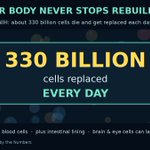
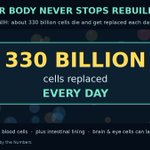
Every day, about 330 billion of your cells die and get replaced. Nearly 86% of that churn is blood cells, plus the lining of your gut. Brain and eye cells can last a lifetime. You are not quite who you were yesterday. How much of you is brand new today?

On Mars, the colors flip. Daytime skies glow yellow-orange, and sunsets turn blue. Fine Martian dust lets blue light slip through and hug the Sun, while red and yellow scatter everywhere. NASA's Curiosity rover photographed one in 2015. Which sunset would you pick?

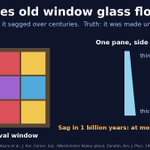
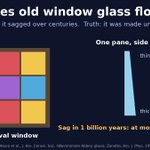
Old church windows are thicker at the bottom, so glass must slowly flow, right? Nope. Scientists studying Westminster Abbey glass found it would sag at most about 1 nanometer in a billion years. Medieval panes were just uneven, and builders set the thick edge down.

Scientists dug into Siberian permafrost and found a tiny animal frozen for about 24,000 years. They thawed it, and the bdelloid rotifer came back to life. No partner needed, it began cloning itself in the lab. Ice Age nap, modern family. Could you sleep that long?

The oldest known piece of Earth is a tiny zircon crystal from the Jack Hills of Western Australia. It formed about 4.4 billion years ago, when our planet was only around 150 million years old. Its chemistry hints that liquid water already existed. Older than any rock.

That spooky Halloween fog isn't carbon dioxide. Dry ice is frozen CO2 at −78.5°C (−109°F), and it never melts. It skips liquid and turns straight into invisible gas. Drop it in water and that icy gas chills the water into tiny droplets. The ghostly cloud? Just water.

Imagine ice the size of a volleyball falling from the sky. The biggest hailstone ever measured in the U.S. was 8 inches wide and weighed almost 2 pounds. It fell on Vivian, South Dakota in 2010. A freezer power outage melted it a bit, so it started out even bigger.

That sunshine on your face took about 8 minutes to get here. But its energy began in the Sun's core, a plasma 8 times denser than gold, then zigzagged outward, absorbed and re-emitted over and over, for up to 170,000 years. You're basking in light older than farming.

A ruby-throated hummingbird's heart beats about 225 times a minute at rest and more than 1,200 times a minute in flight. That's 20 beats every second. On cold nights some hummingbirds drop into torpor, slowing their hearts to around 50 beats a minute. Could you keep up?

Your bone marrow makes about 2.4 million new red blood cells. Every second. Each one laps your whole body in about a minute and lasts 100 to 120 days. They are about 84% of all the cells in you. Think you had a busy morning?

Your pencil and a diamond ring are the same element: pure carbon. Diamond locks each atom to four neighbors. Graphite forms flat sheets that slide onto paper. Plot twist: graphite is lower-energy, so diamond only lasts because it changes too slowly to notice.

Want to climb the tallest volcano in the solar system? Olympus Mons on Mars rises about 25 km (16 mi), nearly 3 times Everest, and its base is as big as Arizona. Yet its slopes are so gentle, just 2 to 5 degrees, you'd barely feel like you're climbing.

How deep have humans ever dug? The Kola Superdeep Borehole in Russia reached 12,262 m (7.6 mi) in 1989, through a hole just 9 inches wide. Rocks hit 180°C, way hotter than expected, and drilling stopped. That's only 0.2% of the way to Earth's center.

Sound is a speed demon underwater. In air it moves about 340 meters per second. In seawater it zips along at roughly 1,500 meters per second, over four times faster. Ever wonder how whales hear each other across an ocean? Water carries sound faster and farther.

You were born with about 300 bones. Today you have 206. Where did the rest go? Nowhere. As you grew, soft cartilage hardened into bone and many small bones fused into bigger ones, like the plates of a baby's skull. The job isn't done until your mid-20s.

Could you go 11 days without landing? In October 2022, a five-month-old bar-tailed godwit flew 13,560 km (8,425 miles) nonstop from Alaska to Tasmania. No food, no rest, just open ocean. It was the bird's very first migration, and a world record.

Saturn's rings are wider than the distance from Earth to the Moon, edge to edge. How thick are they? In the main rings, typically about 10 meters (30 feet), roughly a three-story building. Billions of chunks of ice and rock, spread into one paper-thin sheet.

Every firework color is a metal at work. Strontium burns deep red, barium bright green, copper blue, sodium yellow. Heat kicks their electrons up an energy level; as they drop back, each element shines its own signature color. Blue is the hardest one to make.

Which mountain is closest to the stars? Not Everest. Earth spins, so it bulges at the equator. That bulge lifts the peak of Ecuador's Mount Chimborazo over 2 km (6,800 ft) farther from Earth's center than Everest's, even though Chimborazo stands 2.5 km shorter.

