

🔬 Elementary Science Specialist | 💙 #PWCSProud circa 2012! | 🪐 True @NASA Nerd. | 🧑🏻💻 Loves @Microsoft Excel unironically. | 👍 Opinions are my own.
- Tweets1.8K
- Following834
- Followers430
- Likes6.6K






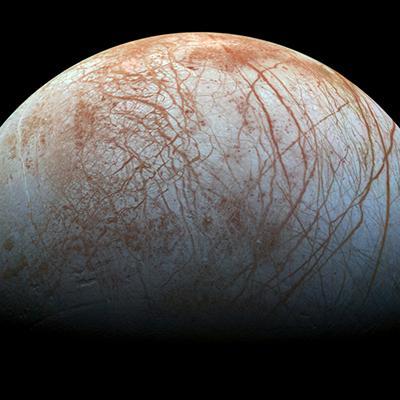
ALT The puzzling, fascinating surface of Jupiter's icy moon Europa looms large in this newly-reprocessed color view, made from images taken by NASA's Galileo spacecraft in the late 1990s. This is the color view of Europa from Galileo that shows the largest portion of the moon's surface at the highest resolution. Credit: NASA/JPL-Caltech/SETI Institute

ALT A promotional image for the 'Europa Kids Art Challenge' featuring a cosmic background filled with deep purples and oranges, resembling a nebula. In the foreground, there is an artistic representation of Jupiter's moon Europa, with a cracked and textured surface. A space probe with solar panels is positioned near the bottom right, suggesting exploration. The text 'Europa Kids Art Challenge' is written in bold, white letters, standing out against the colorful space backdrop. A smaller depiction of Jupiter is partially visible in the top right corner.

ALT A child's drawing showing the interior ocean of Europa populated with a large pink octopus, jellyfish, and a robotic probe in the water. Above the ocean is a cutaway view of Europa's icy crust with erupting geysers. Jupiter and a starry black sky are visible beyond.

ALT A child's drawing showing the interior ocean of Europa populated with black, toothy deep sea creatures. Above the ocean is a cutaway view of Europa's icy crust with erupting geysers. Jupiter and a starry black sky are visible beyond.


ALT A graphic with three large images of two women and a man with labels reading "Diana Trujilo, Flight Director; Eduardo Bidot Lopez, Intern; Penelope Garcia-Falan, Intern." The graphic read "Hispanic Heritage - Celebrate Hispanic Contributions at NASA Thursday, September 19th at 4pm ET." Credit: NASA


ALT The Moon is seen from cameras onboard NASA's Orion spacecraft during the 20th day of the Artemis I mission. This image was taken after Orion executed the Return Trajectory Correction 3 burn to prepare it for the Return Powered Flyby maneuver, bringing it on its second close approach to the lunar surface and continuing the journey back to Earth. The right side of the image is dominated by the gray, cratered image of the Moon. The left side of the image is dominated by the white outer shell of the Orion capsule. The Moon and Orion stand out against the blackness of space. Credit: NASA




ALT Two images mirrored side-by-side showing two nebulae in the shape of two Star Trek Enterprise ships. On the left, the nebulae is a cloud of gas and dust in space, with vibrant colors of green, red, and blue. The image on the right shows the Enterprise ships outlined in white over the nebulae. Credit: NASA/JPL-Caltech




ALT Portrait of Makenzie Lystrup, smiling at the camera. She has medium brown hair, lighter closer to the ends. She is wearing brownish, plastic-rimmed glasses, and a gray shirt and blazer. She has on a white necklace. The background is mostly white, with some out of focus greenery visible behind her right shoulder.




ALT The planet Uranus on a black background. The planet appears light blue with a large, white patch on the right side. On the edge of that patch at the upper left is a bright white spot. Another white spot is located on the left side of the planet at the 9 o’clock position. Around the planet is a system of nested rings. The outermost ring is the brightest while the innermost ring is the faintest. Unlike Saturn’s horizontal rings, the rings of Uranus are vertical and so they appear to surround the planet.

