

Executive Vice President at Curvature Securities. Author of: The Repo Market Shorts Shortages & Squeezes, More Rogue Traders, Rogue Traders, The Money Noose
Joined April 2012
- Tweets9K
- Following99
- Followers12.7K
- Likes73


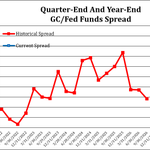

With the market pricing a tightening on Dec 9, the Turn (12/31-1/4) Repo market is at 4.28%/4.27% and recently traded at 4.26% and 4.27%. That puts fed funds at 4.13% and puts the Turn at 14 bps above GC. Overall, that's not a lot of pressure for year-end


The GNA (Global Netting Agreement) is popular with banks in Europe. FICC/CME cross-margining is in the Treasury market and CME should hit in 2027/28. Cross-margining means holding a long and short to allow for positions to be liquidated together, decreasing the liquidation risk
But here's a theoretical question: Let's assume the entire market moves to some kind of cross-margining. Is that good for the market? There will be less margin collected by the dealers overall, but liquidation risk is smaller
1
6
1,106
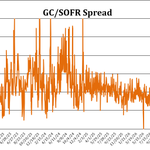
GC avgd 3.5 bps over SOFR in 2026. This is narrower than a few years ago. Two factors affect the spread. The tri-party component of SOFR is a dealer-to-customer rate and tends to push SOFR rates lower. Treasury collateral has a bank balance sheet cost, which moves the GC higher

19
1,371
The SEC proposed central clearing on Sept 14, 2022 and the rule was finalized on Dec 13, 2023. Even though Repo central clearing is not mandated until June 30, 2027, many market participants moved a significant amount of their positions into Sponsored over the past few years
7
1,290
With more Treasury collateral on FICC's balance sheet, there's less on the banks' balance sheet. That's why the cost of balance sheet declined and the GC/SOFR spread dropped from 5.3 basis points in 2024 to 3.5 basis points this year
7
986
Sell-offs in the cash market bring shorts into the Repo market. When bond prices decline, traders tighten their hedges, increase yield curve flattening trades, and increase outright shorts. With the market pricing more than 3 tightenings, the short-base of the market increased
The refunding settles Monday and bills on Tuesday, adding an additional $62B to the market. O/N rates should decline next Thursday, when the GSE cash enters the market and stays until Wednesday the 25th

2
6
1,090
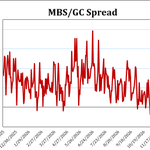
When the Fed began agency/MBS balance sheet runoff, I expected the spread between agency/MBS collateral and REPO GC to widen. Since December, the agency/MBS-GC spread declined from an average of +2.01 bps in 2025 to +1.24 bps. During this time, SOMA agency/MBS declined by $170.1B

11
1,107
With more agency/MBS supply in the market, the spread is supposed to widen; more supply generally means higher rates. However, there are other factors, agency/MBS issuance could have declined more than in increase in market supply from the SOMA roll-off.
1
13
1,358
The REPO market for year-end (12/31-1/4) is 4.38%/4.33%, which is about 27 basis points above fed funds. I'm using an 80% chance of fed funds being 25 basis points higher by year-end. Of course, the year-end market will be higher or lower after Dec 9

3
6
1,034
Some bank economists are predicting funding pressure for year-end based on the pressure on Oct month-end. Pressure again on Nov month-end will confirm increased funding issues on year-end. Otherwise, we can assume Oct month-end was a function of the Cash Management Bill
1
14
1,763
The Treasury issues Cash Management Bills (CMBs) to cover temporary gaps in government cash flows. Whereas bill issuance affects the Repo market more than coupons, CMBs are a closer substitute for Repo. Large CMB issuance and maturities have a direct affect on Repo rates
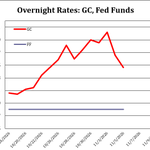
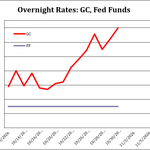
The $25B 11/5/26 CMB issued on October 26 seemed to have an oversized impact on Repo rates. Rates moved from the low 3.90%s to 4.00% for over a week. Of course, month-end had an impact. The question now: was the funding mostly CMB related or month-end related? Or both?

1
6
1,086
The chance of a tightening on Dec 9 declined from about 87% to 80% today and the market is pricing about 2.5 tightenings from here. The terminal rate of fed funds is supposed to peak in Sept 2027 with the target range at 4.75%/4.50% or 4.50%/4.25%

1
6
976
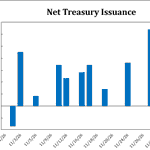
All total, there's a steady stream of new Treasury issuance this month, adding up to $332 billion overall. The $25 billion CM bill matures on Thursday and we expect overnight rates to move lower then

1
9
1,201
104 great reviews for a REPO book can't be wrong!
amazon.com/Repo-Market-Short…

17
1,159
This was the first month-end with funding pressure in a long time. REPO GC opened at 4.00%, traded as high as 4.02%, and as low as 3.88%. For past month-ends, GC opened two or three basis points higher and rallied lower as the day wore on

9
1,239