

Building — PersonaAI | https://teapaw.org/t.co/14JKv5odGL | https://teapaw.org/t.co/Xl0aBOP3S3 https://teapaw.org/t.co/pYLd97Fv3K @PersonaAI_agent @CharX_World
Raleigh, NC
Joined August 2023
- Tweets2K
- Following553
- Followers1.1K
- Likes2.4K





Scott Sparkwave retweeted

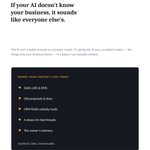
Most companies talk to customers far less than they should.
Not because they don’t care.
Because every question can’t become a 6-week research project.
PersonaAI changes the math.
Ask 50 synthetic customers today. Learn. Change the idea. Ask them again.
🤖 Made with AI

Scott Sparkwave retweeted

The question I get most right now is "what should I turn into an AI agent?"
Here is the 5 part test I use (works for Claude/Codex/Grokbot etc):
1. It has a repeated trigger, so the same kind of task keeps happening over and over.
2. The inputs are stable, so the information comes in a predictable shape every time.
3. The tools are clear, so there is a defined set of things it can actually go do.
4. There is a measurable finish line, so you can tell when it is done and whether it worked.
5. There is judgment in the middle, so each run is a little different and needs a real decision made in the moment.
The first 4 are really just asking "can this be automated at all?" The 5th is the one that matters, because judgment in the middle is what makes it an agent instead of a simple automation.
Once you see it this way, you start spotting agent work pretty much everywhere.

Scott Sparkwave retweeted
We’re currently working on making PersonaAI easier to use and easier to sell as an agent service.
Recently completed
- Added first-run onboarding after sign-in.
- Improved dashboard empty/new-user guidance.
- Fixed help/docs links and added clearer “getting started” guidance.
- Built Study Wizard V1 so users can describe a study conversationally and apply the draft into the existing study composer.
- Pushed everything to wip/pre-migration-backup.
Current planning focus
Define PersonaAI’s agent services / x402 strategy:
- turn PersonaAI capabilities into bounded services other agents/apps can hire;
- start with internal service contracts, not wallets/payments;
- likely first services:
- Study Draft Wizard
- Offer Readiness Score
- Message Test
- Persona Panel Quick Study
- Audience Persona Pack
- later wrap these with x402 / ACP / Virtuals agent-service rails.
Scott Sparkwave retweeted

most AI operators should run Claude Code's /insights command every week.
it analyzes your past sessions and shows:
– what you keep doing manually
– where your prompts break
– which reusable skills you should build
– how to improve your workflow
then ask one more question:
“could I package any of these skills as a client deliverable?”
easy way to build fulfillment assets out of the work you're already doing internally.
Scott Sparkwave retweeted

Best article about how the tech behind AI drives the business of AI, that I’ve ever read
open.substack.com/pub/thealg…


Scott Sparkwave retweeted

Was an amazing day the creators of Solify100 and @ScottSparkwave the Ai genius that helped us design Thera Ai. We sat down and are coming up with something big. @ScottSparkwave also created @PersonaAI_agent and @CharX_World . We have some big coming! Stay tuned!

Scott Sparkwave retweeted

Announcing the hosted X MCP.
Agents now have access to the best real-time information source in the world.
Connect Grok, Cursor, or any MCP-compatible AI tool to the X API without any setup!
Check it out here: docs.x.com/tools/mcp


Scott Sparkwave retweeted
This is the product. Behaviorally realistic AI personas that simulate how different people think, feel and decide.
Note the structure: not a list of attributes — a connected system.
Personality, motivations, values, memory, contradictions, risk, communication, emotions and incentives all interact.
That interaction is what makes responses realistic.
→

Scott Sparkwave retweeted
Every important business decision reduces to one question: how will people respond?
Walk the branches — product, pricing, hiring, policy, campaigns — each one eventually becomes the behavior of dozens of real humans.
That human layer is what we make legible.
→


Scott Sparkwave retweeted

Sparkwave Brain helps businesses turn knowledge into momentum.
It connects research, company memory, workflows, and approval-gated automation so teams can see what changed, what matters, and what action should happen next.

Scott Sparkwave retweeted
The takeaway from Fable 5 being BANNED by the government: GET GOOD AT LOCAL MODELS SO YOU HAVE 100% CONTROL.
My entire weekend was going to be building my craziest ideas with Fable 5. That's now cancelled.
So instead of building with Fable this weekend, I've decided I'll go deep on local models:
1. Start with the runtime. Download Ollama or LM Studio first. This is the thing that actually runs models on your machine.
2. Match the model to your hardware. A model's size is measured in billions of parameters (7B, 32B, 70B). Bigger is smarter but needs more memory. Rule of thumb: a 7B model runs on almost any laptop, a 32B needs a good Mac with 32GB+ RAM, a 70B needs serious hardware like a DGX Spark or a maxed-out Mac Studio.
3. Know which model for which job. Qwen 3 is the best all-around choice for most tasks. DeepSeek for reasoning and coding. Gemma 4 when you need something tiny that runs on a phone. Llama when you want the biggest community and the most fine-tunes.
4. Quantization. You can shrink a model to run on weaker hardware with barely any quality loss. Look for versions labeled Q4 or Q5. This is how a model that "needs" a server runs on your laptop. Learning this one concept changes everything.
5. Connect it to your agent. Point Hermes or your agent stack at a local model.
6. Context window is your real constraint locally. Cloud models give you huge context for free. Local models make you pay for it in memory. A bigger context window eats RAM fast. Keep your sessions tight and your prompts lean or your machine chokes.
7. Learn to give local models tools. A smaller local model with web search, file access, and code execution beats a giant model with none. The capability gap closes fast when you wire up the right tools. The model is the engine but the tools are the wheels.
8. Fine-tuning is more accessible than you think. You don't need this on day one, but know it exists. You can take an open model and train it on your own data so it gets good at your specific domain.
I'll probably do a breakdown at some point on this @startupideaspod if people are into it.
The lesson from this ban is basically don't build your entire workflow on something that can disappear with a single letter. Own part of your stack. Local models are insurance.
It reminds me when people realized they don't own social media accounts. And then you saw people build email lists etc.
I remember running a startup and my biggest traffic source was organic FB. All of a sudden, algo changed, and I lost 99% of my traffic.
Same sorta moment (but bigger) for AI.
This is a wake up call.
Scott Sparkwave retweeted
Preview of our new CharX World design!
There's still a lot of work to do, but we are on track to go live with the redesign by the end of June. Get ready to create intelligent characters, build worlds, and tell stories!
Scott Sparkwave retweeted
Most "AI personas" are simple prompts to an LLM. Here's what we're doing that's different.
We start with personas that each have over 150 traits, with unique attributes for:
Their lived facts — age, location, occupation, education, household, dependents, daily schedule, what occupies their mind during the day.
Money — income, spending style, financial stressors, how they save and invest, risk tolerance, plus attitude toward money, spending, and debt.
Health and body — BMI, fitness, diet, chronic conditions, medications, substance use, mental-health flags. Quietly shapes mood, energy, and outlook in answers that have nothing to do with health.
How they think — verbal fluency, thought coherence, abstract vs. concrete framing, problem-solving style. This is why one persona answers in tidy paragraphs and another rambles and circles back. Texture of mind, not just content of opinion.
Cognitive biases — eight of them, each scored: loss aversion, confirmation, anchoring, status-quo, availability, optimism, sunk-cost, overconfidence. This is the part almost no other "AI persona" has. A persona with high loss-aversion and high confirmation bias doesn't just hold a different view — they defend it differently.
How they talk — formality, directness, pace, humor style, the metaphors they reach for, regional dialect, and how they code-switch between work, home, and online. The layer that makes the voice perceptibly and authentically theirs.
Emotional triggers — stress responses, what triggers warmth, what triggers anger, what turns them on or off.
Truth and honesty — baseline honesty, and relationship and regard for truth and facts
Motivation — primary behavioral drivers, goals, deal-breakers, aspirations.
Identity narratives — politics, faith, race, in-group/out-group loyalty, authority, threat perception.
With nearly 4000 personas and growing, we have we have a panel deep enough to find the exact respondents your question needs.
Scott Sparkwave retweeted

Before you let Fable change your repo.
Use these 5 prompts to help you audit, challenge, revise, pre-mortem, and prepare master plans for your projects before implementation.
Bookmark this for later


Scott Sparkwave retweeted

This week alone:
DOJ opens an investigation into the woman Trump raped.
The White House is caught steering a $620 million contract to Don Jr.’s firm.
The Pentagon hands out a $10 billion contract after Trump buys stock in the company.
Foreign governments are caught funneling hundreds of millions into a random JPMorgan account tied to Trump’s “Board of Peace” with no oversight.
It’s just Thursday.
The corruption isn’t hidden anymore. It’s happening out in the open.

