






DUNS numbers in the USA is such a racket; "we'll have your automated company check done in 31 days — pay $299 to have it done in 8 days"
😂😂 i'm sure its just some db lookup / basic verification of docs. someone automate this and create a competitor - the difficult thing is getting the likes of apple/google etc to recognise it
proxies for agents to obfuscate their identity - i think could be a killer product over the next year as large corporates block each other to protect their fiefdoms
OpenAI’s dots is definitely a way to expand the training data. What’s seen as a seamless unlock - eg emails and connectors is actually a hoover for their next model. gl ✌️
The proprietary data one is a big part of why we built memco. Competitors can copy your software and use the same models. Our bet is that getting your agents to learn from each other's work gives you an advantage they can't just copy.

I'd expand the moats left to:
- Proprietary data or content: data nobody else has, or unique content you can create
- Network effects / community: users make it more valuable for each other
- Audience / distribution: you can get attention on demand
- Physical component: hardware, locations, real-world operations
- Capital: owning assets and investing (esp into the AI companies as they are and will suck up large parts of the economy)
- Regulatory: licenses and legal barriers
Scott retweeted

Introducing Anatomy
Describe a machine in one line. Claude brings it to life.
- Interactive isometric wireframes you can rotate, inspect and explore
- WebGL shaders for fire, water, plasma and more
- Real 3D motion, with individual parts that rotate and move
Install it as an agent skill. Fully open source.
Scott retweeted

Technical moats are mostly over at this point. If you’re building something that is meant to be durable, the only moats now are:
• Proprietary data
• Network effects
• A physical component
Scott retweeted

Listen to The Company That Learns: AI at Work on Spotify for Creators open.spotify.com/episode/1g7…

Scott retweeted

I own land and property in exactly these areas and will keep buying land and property in these areas
This is exactly my post-AGI thesis too
Scarse coastal or mountain land with clean air

once ASI is here and living somewhere because of "work" becomes pointless, people with money will just move to the nicest places on earth
Mediterranean climate, ocean, mountains, good food, beautiful isolated towns
places like this are going to become insanely valuable
probably worth buying real estate there now


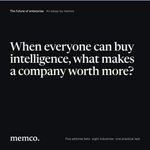
When your competitors can buy the same intelligence as you, what makes your company worth more?
Getting faster at producing work is valuable. But when everyone has access to similar capabilities, some of those gains become the price of staying competitive.
We’ve published an interactive essay exploring what a defensible business looks like in that world. It follows the implications across eight industries and considers a company running 99 agents for every person as a thought experiment.
That forces some interesting choices about what customers will pay for, which decisions people should retain, and what the company learns that a competitor can’t simply buy.
The future of enterprise:
memco.ai/future-of-enterpris…

used the ASD-STE100 and asked to describe @memco_ai 👏
memco is a shared memory system for AI agents. It helps companies use experience from software development and knowledge work to improve future tasks.
Agents contribute what they learn from successful results, failed attempts and corrections. memco makes that knowledge available to other authorised agents. This helps teams avoid repeated mistakes and reuse solutions that already work.
memco also connects related findings to produce new knowledge. Feedback from later tasks helps it assess which lessons remain useful. As conditions change, it updates the memory, resolves conflicting advice and removes information that no longer helps.
Your company owns its memory and controls who can use it. The knowledge stays with you when you change AI models or tools. This lets your company build on its experience across teams and over time.

We'll be spending a lot more time trying to understand the outputs of language models. A few thoughts, tips & tricks:
Writing. Something I've had success with: Ask your LLM to explain something in ASD-STE100, it's a controlled language specification originally developed for aerospace maintenance documentation. LLMs well-versed in this language and it comes with heavy constraints on clean writing style that I often find a lot more readable. Sometimes I've tried to soften it a bit e.g. ask for "80% of the way to ASD-STE100" because the spec is quite stringent. But even better:
Diagrams / images. Instead of writing, ask your LLM to create a diagram. These can be a lot easier to process, parse, and understand. But even better:
Web pages. Ask for output "in HTML" to get a beautiful, interactive webpage. LLMs are getting really good at frontend and can create beautiful experiences, animations, etc. But even better:
Explainer videos. The output format I am most bullish on is fully custom / bespoke explainer videos generated on any arbitrary topic. Experiment with things like "Create a 3b1b style video explainer on X. Use my ElevenLabs API key for audio narration". (you'd need an API key for the latter or you can ask your LLM to find you decent free alternatives that use your local compute). This is actually starting to work!
In summary:
- As LLMs get better, they will do more and more of the legwork autonomously, and a lot more of our work will rise up the abstractions into oversight and understanding.
- Luckily, LLMs can help here too because as intelligence and code are increasingly abundant, you can ask for large, custom, discardable software artifacts (e.g. web apps, video explainers) that would have never made sense to create before. Push the boundaries here and you'll be surprised.

“The ethos of how we do things.”
Sonya Huang’s line gets at something a folder of company documents can’t capture on its own: how an organisation applies what it knows.
For agents, that means retaining the judgement developed through work: why a decision was made, whether it worked, and where that lesson still applies.
That’s what we’re building at @memco_ai: governed organisational memory that agents can learn from, without tying that learning to a single model.



Scott retweeted
The most advanced organisations we’re speaking to are thinking about a future in which their companies are 99% agents and 1% humans.
They’re asking how you build a defensible business when your competitors can access the same models and general knowledge is increasingly commoditised.
For a startup, scaleup or enterprise, an important part of the answer is what the organisation learns through doing the work.
Which approaches succeed with your customers? Why did a seemingly sensible decision fail? What does an experienced member of your team understand that a new agent would otherwise have to discover?
That knowledge is specific to your business, and you’ve paid to develop it through delivery, experimentation and mistakes. When it stays in individual conversations or leaves with a person, the next agent has to do much of that learning again.
The opportunity is to make that experience available across the organisation, within the right boundaries. Lessons from different pieces of work can be combined, refined against later outcomes and reused where they’re relevant. Each new agent then starts with more of the organisation’s accumulated understanding.
That creates a form of advantage that can deepen through use. Better starting points mean less repeated investigation and correction, while subsequent work adds evidence that improves the knowledge itself. You also retain that understanding when you change models or tools.
A competitor can adopt the same technology. Reproducing the learning your organisation has accumulated, and its ability to put that learning to work, is a different challenge.
We’re building memco to help companies develop that advantage: shared, governed organisational knowledge that compounds through the work their agents do.

Scott retweeted
“How do I have a harness that is external to a model so that my memory is not tied to one model?”
Satya Nadella at the All-In Summit, describing a core reason we built memco.
When an agent works out how to fix a problem, or learns why an earlier approach failed, your company has paid to produce something valuable. That experience shouldn’t be trapped in one vendor’s system or lost when you switch models.
At memco, we turn the evidence of that work into company-owned memory that other agents can reuse, with the provenance and permissions needed to use it safely. What one agent learns can improve the next agent’s work, even when it runs on a different model or harness.
You should be able to change your AI provider without leaving your company’s accumulated learning behind.
Scott retweeted


Here’s another intense situation on one of the narrowest sections of Slovenia’s highest road 🇸🇮, where Tesla FSD (Supervised) successfully maneuvered around and yielded to several oncoming cars in a row.
What do you think? Did FSD handle it well, or would a human driver have handled the situation significantly better?
@teslaeurope @Tesla @elonmusk @TeslaOwnersSLO
A company can give every agent access to its documents and still pay repeatedly for the same lesson.
An agent works out why something failed, finds an approach that works, or discovers that an old assumption no longer holds. If that experience stays inside one session, another agent has to work it out again.
That’s what I’d add to this context-layer map: the knowledge a company creates as its agents do the work. It needs to become reusable memory, with evidence behind it and controls over where it can be used.
We’re building memco as the system of record for agentic companies. The company should retain what its agents learn and use it to improve subsequent work, whichever models or tools it chooses next.

Everyone is racing for agents and models. But they all run on context. No clear winner there yet.
@itsurboyevan's "Context Is King" is one of the best pieces written on the battle for the company memory. Hosting him for a live stream next week.
Tune in n95wxzy.short.gy/context-is-…

Theo's thread exposes the trap in “enterprise agent memory”: save everything, retrieve whatever looks relevant and let yesterday's assumptions steer tomorrow's work.
That's exactly what we built memco to avoid.
An agent's notes are evidence, not ready-made instructions for the whole company. A lesson needs checking against what happened, a boundary around where it applies, and a way to correct or retire it when things change.
A workaround for one customer mustn't quietly become policy for every customer. Sharing it with more agents just makes the mistake more expensive.
@memco_ai is the system of record for what agents learn. Useful learning can move between agents and tools without losing its evidence or permission boundaries. The company keeps it when the model changes.
The proof has to be in subsequent work: another agent avoids the same mistake and completes the job with less human rescue. Test that against the repo, existing docs and manually maintained skills.
A growing pile of memories doesn't answer Theo's objection. Showing that the next agent does a better job does.
