

Brandeis Bio/Neuro. We study multiple aspects of sensory biology. Mostly in worms. Lab appears to be powered by vast quantities of junk food. Opinions mine.
Waltham, MA, USA
Joined August 2010
- Tweets4.7K
- Following805
- Followers3.9K
- Likes9.1K




Pinned Tweet
Multiple postdocs out to academic/industry jobs + 2 grant NOAs in = open postdoc position.
Worms are great to work with, sensory biology is an endlessly fascinating topic, and we are a group of good humans. Please email if interested!

Opening for a lab manager/Res Asst! This is a great position if you want more research experience (& perhaps co-author a paper or two!) before heading to grad school. We are a sociable, supportive, inclusive, and dynamic group - come join us.
brandeis.wd5.myworkdayjobs.c…
🎉👏🏽Check out the brand new lab of our star (and much missed) ex-postdoc @nathanCSharris!!! He has a super cool planned research program and is going to be an awesome mentor. Go Nathan!!
This Post is from an account that no longer exists. Learn more
Piali Sengupta retweeted

We thought there wasn't much new to learn about the cell cycle. Turns out we were wrong! Our paper (out today @Nature) identifies a novel alternative cell cycle that regulates differentiation, not cell division. tinyurl.com/4a6yeuke. 1/10

TL;DR: IFT & cilia structure shape responses to stimuli sensed by a single neuron type in different & unexpected ways. Alison untangles this complexity by conditionally manipulating IFT & measuring response dynamics to individual chemicals. Questions/comments welcome! 6/6
What about sensory response adaptation? By acute manipulation of IFT, Alison shows that IFT is needed for diacetyl but not pyrazine adaptation, likely by trafficking the diacetyl but not the pyrazine receptor. 5/6

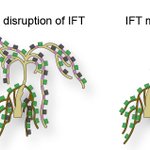
So are cilia useless?! Well no 😅. Although odorant responses persist, there are desensitization & adaptation issues. Without IFT/cilia, odorant receptors mislocalize to branches from the cilia base, while the GRK-2 GPCR kinase stays in cilia, causing desensitization defects. 4/6

Completely unexpectedly, it turns out that w/o IFT, AWA shuttles many (but not all!) cilia-localized signaling molecules including odorant receptors to ectopic branches (arrows) that project from the cilia base. That allows odorant responses to be maintained even w/o cilia. 3/6

Alison used a ts kinesin allele that she generated (thanks to Chlamy ts screens!) to show that
a) IFT is not necessary to maintain cilia of the AWA olfactory neurons, &
b) even w/o cilia, AWA can respond to some food-related odorants. 2/6
🎉New lab preprint! 🔥🔥work by super postdoc @alison_marie1.
C. elegans sensory neurons have gorgeous #cilia at their dendrite ends. We’ve always thought that a) no cilia = no sensory responses, & b) no IFT = no cilia. Punchline is we thought wrong. Read on for more. 1/6

Differential modulation of sensory response dynamics by cilia structure and intraflagellar transport within and across chemosensory neurons biorxiv.org/cgi/content/shor… #bioRxiv
Woo-hoo! Go invertebrates and small (not necessarily 'simple' circuits and of course, go @betenoire1 and Gerry Rubin!

Congratulations to @HHMIJanelia's Gerry Rubin & @RockefellerUniv’s Cori Bargmann (@betenoire1), recipients of the 2024 Gruber Neuroscience Prize for their pioneering work on the circuitry of behavior & development of new tools for neuroscience research.
🔗gruber.yale.edu/prize/2024-g…

Popping back on here to thank my mentors, colleagues and friends @BrandeisScience & elsewhere, my funders, & my very patient family. Most importantly, thank you to all the students & postdocs who chose to science along with me. And of course 🙏🏽 to our beloved worms!

Announcing our new members! The Academy is honoring excellence in an array of disciplines and professions, and inviting these new members to join our work to advance the common good. The first members were elected in 1781. Learn who was elected in 2024: amacad.org/news