I built a 1M+ media brand. Prev. Bybit. MarOps Manager at Crypto Banter. Author. I write about tech, leadership and social impact.
Joined February 2022
- Tweets1.5K
- Following685
- Followers778
- Likes12.9K










Before crypto became an industry, it was a rebellion. Yesterday I appeared on a podcast, and this is what I spoke about... 👇
The idea for using cryptography to reform the financial system is not as new as 2008, when the Bitcoin whitepaper was released.
Cypherpunks and technologists had been writing, programming and debating these ideas for decades prior.
A Brief Timeline
- President Nixon ended the gold standard in 1971, within 5 years Whitfield Diffie and Martin Hellman introduced public-key cryptography in 1976 with their groundbreaking publication of "New Directions in Cryptography".
- By 1983, David Chaum proposed blind signatures for private, untraceable electronic payments.
- By 2001, Peter Ludlow edited 'Crypto Anarchy, Cyberstates and Pirate Utopias', a compilation of some of the most brilliant writings on sovereignty, governance, law and order in cyberspace. I referenced this book in the podcast; it's a fascinating, essential read in my opinion.
2008 was a catalyst for a movement for many reasons; with the housing market crash, institutional trust was at an all time low.
Many of crypto's earliest adopters and developers were committed to a mission that was more cypherpunk and humanitarian in nature, then much of what you see on the timeline today.
When I say “make crypto cypherpunk again,” I really mean: remember the intellectual history.
Learn to understand why this technology exists.
Build systems and protocols that protect privacy, resist censorship and return meaningful agency to people; not just apps and launchpads that create new gatekeepers or reinvent the casino.
We covered so much on the pod yesterday, from ancient civilizations, systems of trade and governance, right through to the cypherpunk movement, crypto and the humanitarian responsibility now facing our industry.
I also argued that realising this mission will require a more unified crypto industry.
I do not believe one blockchain will “win” by solving every human and technical problem. The block-size wars exposed genuine limits and trade-offs around scaling, governance and the preservation of decentralisation in Bitcoin.
Therefore I also made the case that the goal should not be to win the chain war.
It should be to collectively solve a greater surface area of human and systemic problems.
I'm really excited to share this episode once it's out!

GM.

🚨LAWSUIT CLAIMS PUMPFUN INTERNAL CHATS SHOW IT WAS BUILT TO MAXIMIZE ADDICTIVE TRADING!
In an ongoing class-action lawsuit against Pump.fun and related parties, plaintiffs allege that roughly 5,000 internal team messages reveal the platform was deliberately designed to maximize addictive engagement and fee revenue.
According to the complaint, leadership discussed slot-machine style mechanics and acknowledged the product was built around users continuing to trade even when most lose money.
The claims come from whistleblower materials cited in the amended complaint.
With an estimated 1.3B people still unbanked, surely crypto has a better value proposition and invitation then to 'be the next kimchi'. 👇
I don't know who needs to read this today, but this is not how we onboard 'normies' into crypto.


Shek retweeted

🚀Master trading fundamentals for FREE!
The HIGHER! Challenges Library offers free educational resources from Crypto Banter hosts @kyledoops and @Sheldino_D.
Sign up for free to the Challenge platform and get access to a range of educational resources to level up your crypto & trading journey. 📈📚
Let’s go!🔥👇
courseswithkyleandsheldon.cr…

Since putting myself out there, I've had 2 podcast invitations, and 3 new contributor opportunities to feature my writing. 😊
I've spent years building campaigns and funnels for some of the industry's biggest names. I admittedly did not spend a whole lot of time building my own personal brand.
Never too late to start, right?
Now I'm excited to open up and share more about my journey, the extensive research project I started 3 years ago, and where that research is leading me next in my career.
Thank you @CryptoWomenCo for featuring me, exciting things to come!
For more than 3 years, I’ve been studying how decentralised protocols are actually governed, but this research has taken me FAR beyond blockchain.
I’m tracing the recurring problems of power, trust and coordination from ancient civilisations and their earliest record-keeping systems to the cypherpunk movement, early cyberspace communities and today’s protocols; examining where crypto’s claims of decentralisation diverge from reality.
Soon, I’ll begin sharing what I found.
Some conclusions may surprise you. Others may make certain people uncomfortable.
All of this is necessary dialogue, and I can't wait to share.
More soon.
I’m excited to be recognised as part of the CWC speaking index for women in crypto, and even more excited for the opportunities I will have to speak about my research.
There are some incredible founders in this index too, very proud to be featured alongside them!

If you're building something meaningful in privacy, DeFi, payment rails, blockchain use cases; this is your invitation to shamelessly shill what you're building on this thread.
Please, I would love to discover new projects and worthy causes to write about.
🧵Can technological progress truly be called ‘progress’ when MILLIONS remain unable to navigate, resist or meaningfully use the systems that are shaping and impacting their lives?
Simple question, loaded answer.
My extensive research into technology, protocol governance and privacy (and how these crossover at the intersection of human and civil rights) has led me to discovering over and over again that technology is rapidly becoming a large contributing factor to the ever-growing number of humanitarian crises in our world.
TLDR? As fast as solutions are being shipped, so is the list of exploits, risk factors and the attack vector for bad actors to prey on some of the world's most vulnerable communities.
Here are three case studies I reviewed:
1. A woman escaping domestic abuse was located by her abuser after she fled to a safe house; she was stalked through a smartwatch that she left behind when fleeing.
2. Iran’s ongoing internet shutdown, which began at the start of 2026, revealed how digital infrastructure can become an instrument of control and censorship.
I also discovered what profound impact proactive measures can have, with technology:
3. In Iraq, a program which combined digital and financial education helped displaced and vulnerable people successfully move towards employment, freelancing and renewed economic agency.
These 3 instances reveal two sides of the conundrum I discovered: digital systems can expand human agency, but they can equally become instruments of surveillance, exclusion and control.
This is why I believe digital literacy must be treated as humanitarian infrastructure.
This thread highlights some of the organisations and initiatives at this very frontline...
Save this one if you care about privacy, human rights or technology.
@Logos_network is developing privacy-focused, decentralised infrastructure for secure communication, censorship-resistant value exchange and aid or resource coordination for funding and supporting people, without putting any parties at risk. It is a community first technological solution. PriFi by Logos combines privacy-preserving systems with user-controlled hardware. logos.co/


Crypto is the greatest humanitarian mission of our lifetime.
Social trading apps cover one small part of the surface area in the adoption arms race; and truth be told, I'm yet to come across one that isn't purely designed for extraction.
Builders; please don't get distracted from the cypherpunk mission that brought you here.
There's no shortage of humanitarian crises that blockchain could solve. Stay inspired, keep building.
For more than 3 years, I’ve been studying how decentralised protocols are actually governed, but this research has taken me FAR beyond blockchain.
I’m tracing the recurring problems of power, trust and coordination from ancient civilisations and their earliest record-keeping systems to the cypherpunk movement, early cyberspace communities and today’s protocols; examining where crypto’s claims of decentralisation diverge from reality.
Soon, I’ll begin sharing what I found.
Some conclusions may surprise you. Others may make certain people uncomfortable.
All of this is necessary dialogue, and I can't wait to share.
More soon.
I’m excited to be recognised as part of the CWC speaking index for women in crypto, and even more excited for the opportunities I will have to speak about my research.
There are some incredible founders in this index too, very proud to be featured alongside them!
This is why this industry struggles to beat scam allegations.
Greed and grifting will set us back more than regulation at this point.
11.6M cryptocurrencies failed in 2025 alone.
I can only imagine what the number will be year-end for 2026.


‘Decentralisation’ and ‘permissionless’ are not just ‘words’ or ‘bullshit’ to many of us still building in this industry. Trying to control, censor and shut down permissionless networks on a whim leads us back to square one.
This is flawed, counter intuitive logic and the antithesis to what crypto was intended to achieve.
The point of journalism is to assess, interview and present facts or information to the public. To tell important stories and highlight important causes or discoveries. To report with integrity.
*Not* to 2v1 someone on a podcast and then clip out his responses to serious laundering accusations. The kind of accusations that can have huge repercussions for builders; come on, do better.
Was very disappointed watching that interview.
Keep on keeping on @CBarraford. Your composure is so commendable. 🫡

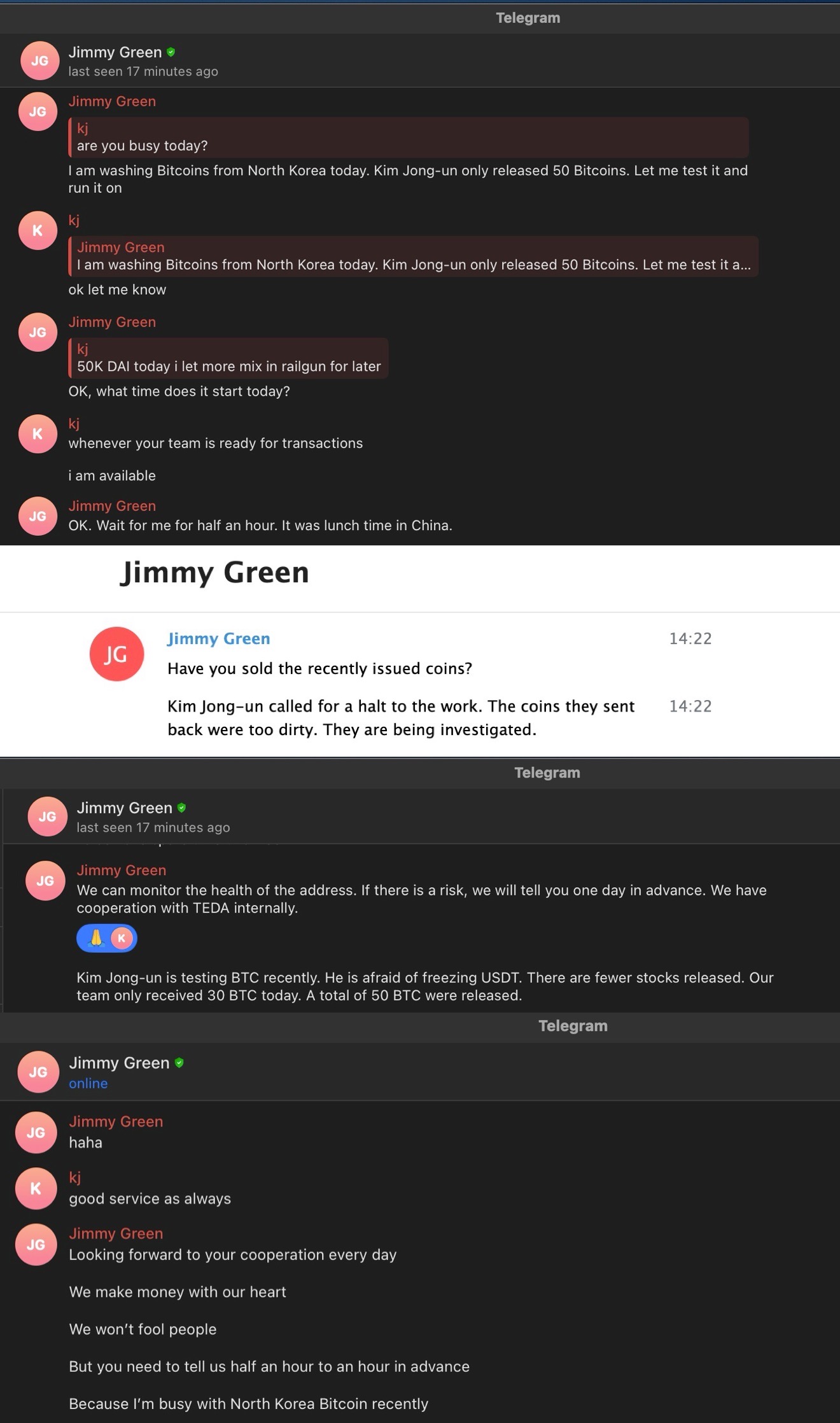
"But I don't want to profit from North Korean laundering money via the service that I provide, that would be a concern for me."
@laurashin now that you know you do profit from "north korea" are you willing to send 1inch money back to bitget? Will you drop them as a sponsor?
Shek retweeted

1/ How I infiltrated a Chinese organized crime syndicate that has laundered $1B+ across multiple exploits for Lazarus Group.
Posing as a client, I gathered intel that helped action freezes for the Feb 2025 Bybit exploit and attribute illicit activity onchain.