

Professor @Stanford | Computational Health Economics & Outcomes | Fair Machine Learning | Causality
- Tweets50
- Following263
- Followers13.5K
- Likes4.2K





ALT Collage of the 2022 NIH Director's Pioneer Awardees.


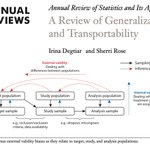
ALT Screen capture of the paper title, authors, journal logo and Figure 1 from the paper: A Review of Generalizability and Transportability, Irina Degtiar and Sherri Rose. Figure 1 is a graphic of internal vs. external validity biases as they relate to target, study, and analysis populations.

ALT Image of text from the chapter with title, authors, and introductory paragraph: Why Machine Learning Cannot Ignore Maximum Likelihood Estimation Mark J. van der Laan University of California, Berkeley Sherri Rose Stanford University 1.1 Introduction The Avalanche of Machine Learning The growth of machine learning as a field has been accelerating with increasing interest and publications across fields, including statistics, but predominantly in computer science. How can we parse this vast literature for developments that exemplify the necessary rigor? How many of these manuscripts incorporate foundational theory to allow for statistical inference? Which advances have the greatest potential for impact in practice? One could posit many answers to these queries. Here, we assert that one essential idea is for machine learning to integrate maximum likelihood for estimation of functional parameters, such as prediction functions and conditional densities.

ALT Test from the chapter's closing: 1.9 Closing There is a tendency for the machine learning literature to focus on piecemeal and small extensions of the ‘flashy’ estimator of the moment. This was recently random forests, but is currently deep learning. However, the statistical theory and empirical process literature has offered strong guidance on the development of data-adaptive estimators for features of the data distribution that provide inference, while fully utilizing the knowledge of a statistical model. In particular, for optimal robust (higher-order) estimation of target estimands, we need to solve specific first- and higher-order canonical gradients of the target estimand.


ALT Conditional Cross-Design Synthesis Estimators for Generalizability in Medicaid: Irina Degtiar, Tim Layton, Jacob Wallace & Sherri Rose While much of the causal inference literature has focused on addressing internal validity biases, both internal and external validity are necessary for unbiased esti- mates in a target population of interest. However, few generalizability approaches exist for estimating causal quantities in a target population when the target population is not well-represented by a randomized study but is reflected when additionally incorporating observational data. To generalize to a target population represented by a union of these data, we propose a class of novel conditional cross-design synthesis estimators that combine randomized and observational data, while addressing their respective biases. The estimators include outcome regression, propensity weighting, and double robust approaches. (Remainder of abstract available at link in tweet.)

ALT Figure (1) Overlap and Nonoverlap Regions in the Target Population. The region of support in the target population’s covariate distribution, R, is the union of the randomized group’s support (R_RCT) and the observational group’s support (R_obs). Partial overlap exists between R_RCT and R_obs: R_overlap corresponds to the region of overlap (i.e., region of common support in the covariate distributions) between data sources; R_obs-only corresponds to the region only represented in the observational data and R_RCT-only corresponds to the region only represented in the randomized data.

ALT Figure (4) Study treatment-specific means (STSMs) and target population treatment-specific means (PTSMs) across Managed Care Plans, with 95% Multiplicity- Adjusted Confidence Intervals. Plans are ordered by randomized data STSM estimates.





ALT Selected quotes from the new article in NEJM on the reporting of p-values.