








S. Lant retweeted

Trump lost white voters in the West by 1 point, and won White voters in the northeast by 1 point.

S. Lant retweeted

Speaking of ContraPoints: My BreadTube article is coming out soon in @ElephantMag_ — here's a preview : )


S. Lant retweeted
WHAT IS ‘JUGAAD’? - THE INDIAN CONCEPT OF ‘UNCONVENTIONAL PROBLEM-SOLVING’ (EUPHEMISTIC) 🇮🇳
After the concept of ‘Izzat’ went viral a lot of people online began using it as catch-all explanation for much of India’s dysfunctionality. Depending on who you ask, how real ‘Izzat’ is ranges from ‘completely made-up slander’ to ‘a very real always present lived reality’ to ‘a figurative sociological shorthand that captures some importantly real social dynamics’. YMMV. In any case if you want to actually understand ‘why India is like India’ maybe a more important term to know is ‘Jugaad’
Jugaad is a Hindi word that roughly means an improvised solution. In the strictest usage it describes fixing a problem with whatever materials, money or contacts are available, rather than with the proper tool or the official method. The word is believed to come from rural Punjab where it also referred to a homemade vehicle built by attaching a diesel water-pump engine to a wooden cart. In everyday speech Jugaad can describe anything from repairing a broken chair with wire to getting a government form approved through a friend in the office. See attached image for examples of improvised Jugaad contraptions and to get ‘spiritual sense’ of the term
Jugaad is then used in two broad ways. One refers to resourcefulness: making do with limited money and unreliable services by finding cheap, practical fixes. Some popular author have used it in this sense to describe "frugal innovation," meaning low-cost products designed for people with little money. The other refers to getting around rules, standards or procedures, often through personal influence or informal payments. Indians use the word in both senses and the meaning usually depends on context
The second sense is a part of daily life for many Indians. Common examples include paying a small amount to settle a traffic fine on the spot, asking a relative to help with a school admission, hiring an agent to speed up paperwork, skipping a queue through a contact, using temporary repairs on wiring or plumbing, adding to a building without full approvals etc etc. Because these practices are widespread they are often treated as a normal part of getting things done. The phrase chalta hai, meaning "it will do," is often used alongside jugaad to describe acceptance of work that is temporary or below standard
These practices are closely connected to patterns of social trust. When people expect others to work around rules they tend to adjust their own behaviour to match. A driver may not wait at a red light if others are driving through. A person in a queue may try to skip ahead if they assume others are also trying to. Following the formal process can come to be seen as slower or less effective than the informal route
This can affect trust in institutions too. If outcomes seem to depend on who you know or what you pay, people may slide into no longer believing that offices, courts or police treat everyone equally. They then rely more on family, caste or community networks to get things done which further weakens formal systems. Trust between strangers can also suffer. Buyers may doubt that products meet standards, tenants may doubt a building is safe, customers may assume a service provider will cut corners. People often spend extra time and money checking, negotiating or arranging their own workarounds
Access to jugaad is uneven. People with more money or wider networks generally have more options for informal solutions, while those with fewer resources are more likely to rely on formal systems or go without or perhaps even opt for more low-tech grasping and opportunistic kinds of Jugaad if they absolutely have to. (Similar practices of course exist in many other countries.) In India, the word continues to be used for both inventive problem-solving and rule-bending. While people's attitudes towards its ubiquity vary it has at least been formalised as a well-known term that ‘gets at’ something in the culture

S. Lant retweeted

How were letters delivered in the ancient world before systematic street addresses were used?
By containing detailed instructions on how to locate the recipient.
Here's one example preserved in papyri:


S. Lant retweeted
Even when immigrant groups are completely absorbed culturally, and are no longer even identifiable, the average genetic SES potential that they brought with them will continue to impact the SES potential of the whole society to which they have been absorbed, for good or bad.
S. Lant retweeted

The census in England and Wales tracks religion by country of birth, here's a map of that:
Similar to the Canada map but irreligion is a bit more common. Also interesting is Hinduism leading in East Africa due to the large Indian diaspora.

S. Lant retweeted

If you are interested in American political history, you should follow
Jerome Sneed Democrat
@avrilbradley23
who is both extraordinarily well-informed and highly reasonable, an unusual combination in 2026.
en.wikipedia.org/wiki/Jerome…


S. Lant retweeted
"Trauma" doesn't seem to have that much of an effect when you control for genetics.


S. Lant retweeted

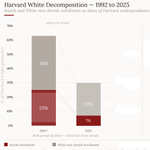
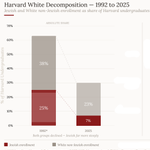
Reminder that every time DEI admissions is framed as a "plus factor" or "tiebreaker," you're being lied to.
Harvard was literally skipping over HALF THE ENTIRE APPLICANT POOL to admit black students in the 40th percentile at higher rates than Asians in the 95th.

S. Lant retweeted
From 1994 to 2019, the ANC never got more than a single digit percentage of white people to vote for it:

S. Lant retweeted

The Founders were basically Unitarians.
It would be incorrect to call them Deists. They attended church, read the Bible, and admired and referred to Jesus. This is more than Deism, but less than Trinitarianism.
- George Washington *never* said "Jesus" or "Christ" in his writings. Though he sparsely mentions things like "Our Savior" etc. He almost always mentioned "Divine Providence". He attended Anglican church frequently, but didn't take communion
- John Adams was perhaps the most fervent Christian of the Founders, and he literally converted to Unitarianism. "one is not three; nor can three be one"
- Thomas Jefferson famously removed all the supernatural from the Gospels. He often mentioned God in his writings. He greatly admired Jesus, but never referred to him as God.
Jefferson very clearly viewed Jesus as a teacher and prophet of God, saying, "it was the reformation of this ‘wretched depravity’ of morals which Jesus undertook. in extracting the pure principles which he taught, we should have to strip off the artificial vestments in which they have been muffled by priests"
- Ben Franklin was like Jefferson in that he greatly liked Jesus. "As to Jesus of Nazareth, my Opinion of whom you particularly desire, I think the System of Morals and his Religion, as he left them to us, the best the World ever saw or is likely to see".
But Franklin did not think he was divine: "I have, with most of the present Dissenters in England, some doubts as to his divinity"
Franklin did describe himself as a Deist but his views seemed to not be what we know as "Deism", saying "God governs in the affairs of men"
- James Madison, like Washington, never states a belief in the Trinity. He writes a lot about Christianity, but that it should be kept separate from the State.
Madison does advocate in one letter for people to be "fervent advocates in the cause of Christ". It reads very much like the other founders- Christ as a great prophet, but not God himself.
Shockingly few of the core group of founders had clearly expressed conventional Trinitarian views. John Jay, Sam Adams, and Patrick Henry.
Alexander Hamilton is perhaps the most interesting. He wrote Christian hymns, and even advocated putting mention of Christ in the Constitution.
But on his deathbed, Hamilton requested 3 different pastors to administer communion. Two refused and only the last obliged.
The only Founding Father who could be described as Deist would be Thomas Paine, who did not think Christ was any sort of prophet.
I describe them as Unitarians because these beliefs mostly align with Unitarian belief. That there is just 1 almighty God and He sent down some sort of prophet in Jesus, but that Jesus was not himself divine.
In fact, Unitarianism sprung up precisely around this time and was very much in vogue. When people were talking about "Deism" what they were really talking about was Unitarianism.
Interestingly, if you look at the religious beliefs of their wives, it's almost entirely conventional Christian. Martha Washington would stay for communion while her husband left service early.

S. Lant retweeted
I would love more research into false paternity rates in modern America.
Considering the available evidence I wouldn't be surprised if 1 in 50 Americans is wrong about who their father is.


S. Lant retweeted
Here's a much better graph of white-collar crime by ethnicity: Per white-collar worker, every group out-frauds whites, except for one... non-Muslim South Asians!
This is gonna break a lot of people's brains


S. Lant retweeted

Charles Murray's Human Accomplishment timeline, split into major civilizations: West/European vs. East Asian vs. Indian vs. Islamic vs. Rest.


