

Shinkai lets anyone create advanced AI agents autonomous, tool-using, with memory. Local-first, with decentralized identity & payments.
Remote
Joined June 2023
- Tweets5K
- Following142
- Followers18.3K
- Likes1.6K






Pinned Tweet
Looking for an effortless AI agent setup?
Shinkai is perfect for non-developers seeking simplicity and speed, while ai16z (ElizaOS) suits those who enjoy deep coding control.
A smart agent isn't necessarily an independent agent.
It might be capable of reasoning, planning, and executing complex tasks.
But who controls its tools?
Who owns its data?
Who decides where it runs?
Autonomy isn't just about what an agent is capable of doing.
It's also about who holds the keys.
One wrong click is a mistake.
One wrong action repeated 10,000 times is a system failure.
That's the challenge with autonomous agents.
They don't just make decisions.
They can execute them, repeatedly, at machine speed.
The question isn't only how much freedom we give AI.
It's how we make sure that freedom remains accountable.
What should an agent never be allowed to do without human approval?
Privacy isn't about having something to hide.
It's about having something to protect.
Your identity.
Your conversations.
Your data.
Your choices.
As AI becomes more integrated into everyday life, control over that information becomes even more important.
Privacy shouldn't be an optional feature.
It should be part of the foundation.
A chatbot waits for your next message.
An agent can work toward a goal, use tools, and take the next step.
One is built around the conversation.
The other is built around getting something done.
That's a fundamental difference.
Getting started with Shinkai? 🐙
Your wallet is part of setting up your Shinkai Identity.
Not sure how to connect it?
We've got you covered.
This quick tutorial walks you through the process, step by step.
Watch here 👇
youtube.com/watch?v=qAz95gA_…
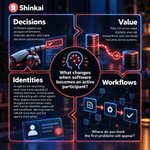
AI agents are becoming capable of making decisions, moving value, and interacting with other agents.
But most digital infrastructure was designed around human users.
Human identities.
Human approvals.
Human workflows.
What changes when software becomes an active participant?
We may need to rethink more than the agents themselves.
Where do you think the first problems will appear?

An AI agent isn't just a chatbot with more features.
It can observe what's happening, gather information, use tools, and take actions toward a goal.
The difference isn't how much it knows.
It's what it can do with what it knows.
Chatbots answer questions.
Agents work toward outcomes.

Everyone's comparing AI models.
Benchmarks. Speed. Reasoning. Context windows.
But the real challenge often starts after you choose one.
Connecting data.
Managing permissions.
Maintaining context.
Handling failures.
Making everything reliable.
A powerful model is only part of a working agent.
The infrastructure matters just as much.
An octopus doesn't need a separate brain for every arm. 🐙
And an AI agent doesn't need a separate intelligence for every task.
Give it tools to search, analyze, create, and execute.
Different capabilities, coordinated toward one goal.
One agent. Many ways to get things done.
Why build an agent around just one capability?
Connect tools.
Combine functions.
Create workflows that fit the way you actually work.
With Shinkai, the possibilities grow as you connect more capabilities.
One environment. More possibilities.
See it in action 👇
Your data lives everywhere.
Documents. Messages. Apps. Private conversations.
And every time you use AI, it's worth asking:
Where does that information go?
With Shinkai, you can run AI agents locally, keeping your data under your control.
Your information shouldn't be the price of using intelligence.
Explore → shinkai.com

Kai Explains 🐙
What is "intent" in AI?
Instead of giving an agent a list of instructions, you tell it what you're trying to achieve.
The goal stays the same.
The path can change. 🧵👇

GM ☕️
New week. New tasks.
Same idea: let the agents handle the repetitive stuff.
You focus on what matters.

Intelligence doesn't equal autonomy.
An agent can be extremely capable and still have very little control.
Someone else might own its data.
Someone else might control its tools.
Someone else might decide where it runs.
Someone else might be able to shut it down.
Being able to make decisions is one thing.
Being able to act on those decisions is another.
The impressive part of an agent is the decision before the action.
Why did it choose that tool?
Where did the information come from?
What alternatives did it consider?
What was it allowed to do?
When should it have stopped?
A useful agent isn't one that acts constantly.
It's one that knows when action is actually necessary.
Agents can work with agents.
An agent doesn't necessarily need to do everything itself.
It can ask another agent to find something.
Pay a service.
Receive the result.
Use that result to make its next decision.
The interesting part isn't simply that agents can communicate.
It's that software can start delegating work to software.
Ownership gets complicated when software can act.
Who owns an agent?
The person who created it?
The company running it?
The person controlling its wallet?
The infrastructure hosting it?
And who decides what it is allowed to do?
As software moves from something we use to something that acts on our behalf, ownership and control start becoming different things.
More autonomy creates more surface area for failure.
Give an agent access to one system.
It can make mistakes there.
Give it access to ten systems.
Now a mistake can travel.
More tools make agents more useful.
They also make their decisions more consequential.
That’s why the difficult question isn’t
“Can we give the agent access?”
It’s
“What should happen if it uses that access incorrectly?”
The biggest change isn't the interface.
It's what happens after you stop talking.
A chatbot waits.
You ask.
It answers.
You ask again.
An agent can keep going.
Search.
Choose.
Act.
Check.
Continue.
The difference between a chatbot and an agent isn't how they talk to you.
It's how much can happen without another prompt.
The internet assumes a human is on the other side.
Click the button.
Fill in the form.
Create the account.
Enter the card details.
Confirm the purchase.
That's how the web was designed.
But agents don't need to use the internet like humans do.
As software becomes an active participant online, the question changes
"What should the internet look like when its users are machines?"
