

The Library at Jack E Singley Academy
Jack E Singley Academy
Joined September 2021
- Tweets2.3K
- Following502
- Followers207
- Likes6.4K







Trunk or Treat! It's the @SingleyAcademy @SingleyECHS Fall Festival! TOMORROW ...Saturday, October 24th. So much to do! So much fun! #Read2RiseUp @IrvingLibraries

I love a good ancient apocalypse theory ... Do you? Learn more about this fascinating site from @NPR : npr.org/templates/transcript… or visit your Premium Resources to read more link.gale.com/apps/doc/A7050… @SingleyAcademy @SingleyECHS #Read2RiseUp @IrvingLibraries


Göbekli Tepe is one of the oldest and most remarkable archaeological sites ever discovered. Dating to around 9600 BC, it predates both Stonehenge and the Egyptian pyramids by thousands of years. Its massive stone pillars have transformed our understanding of early human civilization and challenged long-held ideas about the origins of religion, farming, and permanent settlements.
Located in southeastern Türkiye, Göbekli Tepe consists of large circular enclosures built with towering T-shaped limestone pillars, many carved with detailed images of animals including foxes, snakes, boars, birds, and gazelles. The site was first recognized for its true significance by German archaeologist Klaus Schmidt, who began excavations in the 1990s. He believed it may have been the world's earliest known ceremonial or religious center rather than a permanent village.
The site was constructed by hunter-gatherers before the widespread adoption of agriculture, overturning the traditional belief that farming had to come before monumental architecture. Archaeologists have uncovered stone tools, animal bones, and evidence of large communal gatherings, but few signs of permanent homes. This suggests that groups from across the region may have gathered there for rituals, feasts, and social events.
Excavations have also uncovered evidence of unusual burial practices, including modified human skulls that may have been displayed as part of ritual ceremonies. Combined with the elaborate carvings on the pillars, these discoveries offer rare insights into the beliefs and symbolic world of some of humanity's earliest organized communities.
Designated a UNESCO World Heritage Site in 2018, Göbekli Tepe continues to reshape our understanding of prehistory. Less than 10 percent of the site has been excavated, meaning many of its secrets remain buried. historydefined.net/gobekli-t…

Singley Phoenix Read retweeted

Stop sleepwalking through life.
Wake up, come alive, believe in and become who you were meant to be.
You were created on purpose, for a purpose.
Live like it.
Isn't this amazing! The technology to save something from so long ago. #Read2RiseUp @SingleyAcademy @SingleyECHS @IrvingLibraries

Spooky season special: The Library is home to the sole surviving nitrate print of the first film adaptation of "Frankenstein," produced in 1910 by the Edison Manufacturing Company!
Watch the full film and learn how it came to the Library.
⬇️
blogs.loc.gov/loc/2018/11/th…
Trunk or Treat! It's the @SingleyAcademy @SingleyECHS Fall Festival! Saturday, October 24th. So much to do! So much fun! #Read2RiseUp @IrvingLibraries

Trust the detour. Your college journey does NOT have to look like everyone else's. But always be sure that you are giving your best effort in all things. #Read2RiseUp @SingleyAcademy @SingleyECHS @IrvingLibraries


Singley Phoenix Read retweeted

Expecting middle/high school students to read Homer and Shakespeare isn’t really that outrageous unless the most challenging thing those students read in elementary school was Diary of a Wimpy Kid.
Students who regularly encounter complex, rich literature beginning in kindergarten will be much more prepared later in their education for the challenge of reading the greatest texts ever written.
It matters what students are reading in high school, but what they read in elementary school (and earlier) matters just as much.


Singley Phoenix Read retweeted

Trunk or Treat! 🍬🍭🎃 Tiger Gym Parking Lot 5:00 - 6:30 PM on Thursday, October 29th! #Read2RiseUp @IrvingHigh @IrvingLibraries

Singley Phoenix Read retweeted

Hey @cardwellprep join us for Trunk or Treat on October 29th! #trunkortreat


Singley Phoenix Read retweeted

MIT University just released free online courses.
No payment required.
Here are 10 courses you don't want to miss in 2026:
1. Prompt Engineering for ChatGPT:
imp.i384100.net/QYWOvo
2. Generative AI: Prompt Engineering Basics:
imp.i384100.net/9VrWj5
3. ChatGPT: Master Free AI Tools to Supercharge Productivity Specialization:
imp.i384100.net/rEBnqv
4. OpenAI GPTs: Creating Your Own Custom AI Assistants:
imp.i384100.net/jRBWGP
5. Build AI Apps with ChatGPT, Dall-E, and GPT-4:
imp.i384100.net/5kxbD2
6. ChatGPT for Project Management - Leveraging AI for Success Specialization:
imp.i384100.net/k4Nj1L
7. ChatGPT + Excel: AI-Enhanced Data Analysis & Insight Specialization:
imp.i384100.net/enb45O
8. ChatGPT Advanced Data Analysis:
imp.i384100.net/enb42g
9. ChatGPT for Work & Career Productivity:
imp.i384100.net/aN41zj
10. Google Prompting Essentials Specialization:
imp.i384100.net/Gb2jkE
11. Understand & Use AI – ChatGPT with Smart Prompting Tips:
imp.i384100.net/VO0yKR
Follow @Mohiniuni for more some courses!

Singley Phoenix Read retweeted

50 AI tools that will save you hundreds of hours in 2026. 🤯
1. Claude — Solve any problem
2. Perplexity — Research anything
3. PortfolioTab — Create your portfolio
4. Kling AI — Create AI videos
5. Tripo AI — Create 3D models
6. Gemini — Perfect writing
7. CapCut — Edit videos
8. The AI Library — Discover useful AI tools
9. YouLearn — Summarize YouTube videos
10. Canva — Design graphics
11. ElevenLabs — Clone voices
12. Podcastle — Edit podcasts
13. ChatGPT — Brainstorm ideas
14. NotebookLM — Analyze documents
15. Lovable — Build web apps
16. Bolt new — Generate full-stack apps
17. Cursor — AI coding assistant
18. Windsurf — AI software development
19. Replit — Build apps in your browser
20. Gamma — Create presentations
21. HeyGen — Create AI avatar videos
22. Synthesia — Generate AI presenter videos
23. Midjourney — Generate AI art
24. Ideogram — Create images with text
25. Runway — AI video editing
26. Pika — Generate AI videos
27. Luma AI — Create cinematic AI videos
28. Leonardo AI — Create game assets & artwork
29. Figma AI — Design UI/UX
30. Framer AI — Build websites
31. Tally — Create smart forms
32. Otter ai — Transcribe meetings
33. Fireflies ai — AI meeting notes
34. Granola — AI meeting assistant
35. Wispr Flow — Voice-to-text
36. Zapier — Automate workflows
37. Make — Connect apps with automation
38. n8n — Open-source automation
39. Photoroom — Edit product photos
40. Remove bg — Remove image backgrounds
41. Suno — Generate AI music
42. Udio — Create original songs
43. DeepL — Translate accurately
44. Poe — Access multiple AI models
45. Grok — Real-time AI assistant
46. Genspark — AI super agent
47. Manus — Autonomous AI agent
48. Elicit — Research papers faster
49. SciSpace — Understand research papers
50. Notion AI — Write and organize notes
✅ Save this list—you'll probably use it more than you think.
Singley Phoenix Read retweeted

Today's Pick Save this post
$SNDK (SanDisk) — Don’t buy
$LITE (Lumentum) - Don't buy
$META (Meta) — Don’t buy
$PLTR (Palantir) — Don’t buy
$NVDA (NVIDIA) — Buy at $205–$212
$MU (Micron) — Buy at $885–$898
$TSM (TSMC) — Buy at $405–$420
$AVGO (Broadcom) — Buy at $315–$325
$INTC (Intel) — Buy at $82–$88
$MRVL (Marvell) — Buy at $225–$235
$ALAB (Astera Labs) — Buy at $270–$280
$CRDO (Credo) — Buy at $160–$170
$VRT (Vertiv) — Buy at $186–$198
$LITE (Lumentum) — Buy at $790–$810
$CEG (Constellation Energy) — Buy at $240–$255
If helpful → Like + Follow + Share + Save
Next alert dropping soon!
If you are not following us with notifications turned on, you might miss our next alerts.
NFA
Singley Phoenix Read retweeted

A San Francisco startup says it just turned mercury into real gold, and their own math says gold is one of the cheapest things their machine can make. Aim it at a different metal and it makes a cancer drug ingredient worth tens of billions of dollars a gram.
Here's how it works. When you fuse two kinds of hydrogen, deuterium and tritium, every single reaction kicks out a neutron moving at 14.1 MeV, which is absurdly fast. Fire one into mercury-198 and it knocks another neutron loose on the way through, so two come out and you're left with mercury-197. Give that a few days and it decays into gold-197, the only stable kind of gold there is. The whole trick needs neutrons above about 6 MeV, and regular nuclear reactors barely make those, while fusion makes one every time it fires.
Now swap the mercury for radium-226. Same reaction, one neutron in and two out, and you end up with radium-225, which decays into actinium-225. Novartis is building its next prostate cancer drug around actinium-225, and it's so scarce it sells by the millicurie, roughly $1,200 to $2,500 apiece. Price it by the gram and you're into the tens of billions of dollars, for a material so radioactive nobody could safely hold a gram of it anyway.
Marathon's team actually put a dollar value on a single fusion neutron in a paper this year. Use it to make electricity and it's worth about $3 × 10⁻²⁰. Gold comes in at $2.6 × 10⁻²⁰, basically a wash. Molybdenum-99, which goes into about 80% of nuclear medicine scans, is worth $2.6 × 10⁻¹⁷ a neutron. Actinium-225 is worth about $10⁻¹⁰, around 3 billion times what the electricity's worth.
That's why fusion people should care. Every fusion company you've heard of is chasing electricity, and selling electricity only pays once the plasma puts out something like 10 to 22 times the energy you pump in to heat it. The best result so far, at JET in England, was about a third. Add gold on the side and Marathon's math says you break even around 3x. For molybdenum-99, the number is 0.001x.
So a machine that gives back one-thousandth of the energy you feed it can still make money, as long as the neutrons hit the right metal.
By their numbers, a 3 megawatt machine running way below breakeven could cover the whole world's supply of molybdenum-99, which today comes from splitting uranium in a handful of research reactors. Today's experimental fusion machines already beat the gain that job needs.
Their second post basically says this out loud. Marathon now describes itself as an isotope company for radiopharma. Their chart shows roughly 390 targeted radiotherapy trials. Pluvicto, the prostate cancer drug Novartis launched at $42,500 a dose, did $1.9 billion in sales last year.
Gold still matters to them, just later. It's about a $700 billion a year market, and Marathon's paper figures it could soak up around 2 terawatts of fusion capacity, which is roughly the scale where fusion actually moves the grid. So the plan is to sell cancer isotopes out of small machines now and use gold to pay for the giant ones, years before electricity can pay for itself.

Last month, we demonstrated high-rate alchemy: turning mercury into real, stable gold, beating CERN’s record by a factor of 10.
Last week, we enriched isotopes in the world’s most powerful plasma centrifuge, beating the Soviet record that stood for 40 years.
Now, we’re building a fusion reactor in San Francisco to achieve record power density.
Singley Phoenix Read retweeted

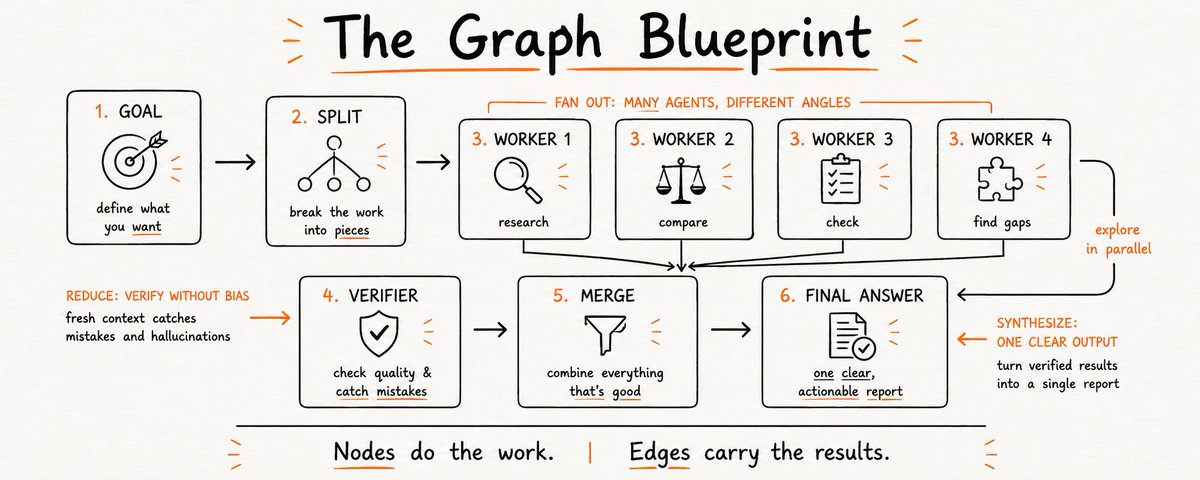
Google Brain founder, Andrew Ng:
"Prompting will be dead in 6 months, graphs are what's replacing it."
In 2 hours at Stanford he shows how to build agents that work and improve entirely on their own.
The first 10 minutes cover what most $500 courses never do. Bookmark this before your feed buries it.
Watch the lecture, then read the guide below on how to build a system that improves itself.

Singley Phoenix Read retweeted

Hawking radiation is one of the few places where quantum mechanics, gravity and thermodynamics meet in a single equation. It shows that black holes are not perfectly black, they glow with a temperature set by their mass.
In 1974, Stephen Hawking applied quantum field theory to the curved spacetime around a black hole. He found that an observer far away sees a steady flux of nearly thermal radiation coming from the horizon, at a temperature
T = ħc³ / 8πGMk_B
where M is the mass of the black hole. Four fundamental constants appear here: ħ from quantum mechanics, G from gravity, c from relativity and k_B from thermodynamics. The formula needs all four.
The most striking feature is that the temperature is inversely proportional to mass. A black hole with the mass of the Sun has a temperature of about 6 × 10⁻⁸ K. A smaller black hole is hotter. As it radiates, it loses mass, so it heats up and radiates faster still. Its heat capacity is negative: removing energy raises its temperature. Instead of cooling towards equilibrium, an isolated black hole runs away towards a final burst. The emitted power scales as 1/M², so the lifetime scales as M³. For a solar-mass black hole, it is about 10⁶⁷ years.
In practice, real black holes are not evaporating today. The cosmic microwave background has a temperature of 2.7 K, far hotter than any stellar black hole. Such a black hole absorbs more radiation than it emits, so it grows. Only a black hole lighter than about 4.5 × 10²² kg, a little over half the mass of the Moon, is hotter than the background and actually shrinks.
Hawking's result also completed Bekenstein's idea. With this temperature, the first law of thermodynamics, dE = T dS, applied to a black hole gives exactly S = k_B A / 4ℓₚ². The factor of one quarter in black hole entropy is fixed by Hawking temperature. The thermodynamics of black holes is not an analogy; it is the same thermodynamics.
There are clear limits. Hawking radiation from an astrophysical black hole is far too faint to detect. Laboratory analogues, such as sound waves trapped in flowing Bose–Einstein condensates, have shown the same mechanism, but they are not gravitational black holes. The deeper problem remains open: if the radiation is exactly thermal, it carries no information about what fell in, which seems to contradict quantum mechanics. This is the black hole information paradox. Recent calculations suggest that the information does come out, but how it is encoded in the radiation is still not understood.
Still, the core lesson is hard to ignore: a black hole has a temperature, and that temperature comes from the quantum vacuum itself. If that holds, gravity, heat and quantum information may be three faces of the same underlying physics.

This! ⬇️ A book can be on your phone. You can do audiobooks or eBooks on the @Sorareadingapp #Read2RiseUp @SingleyAcademy @SingleyECHS @IrvingLibraries Feed your BRAIN!



Be sure to get out and vote if you are eligible! Early voting has started and continues until Friday, October 30th. Voting day is Tuesday, November 3rd. Find out more about the history of voting rights. canva.link/cl6atu5mtt654ye Get the scoop at #Read2RiseUp @IrvingLibraries
