

Institutional-grade on-chain capital markets. Tokenized private market access, structured products, and risk-defined DeFi.
Decentralized
Joined August 2018
- Tweets2.1K
- Following222
- Followers25.8K
- Likes463



Pinned Tweet
Singular Perpetuals now Live! Trade 9 major cryptos with up to 50x leverage. 🌐
✅ Low Liquidation Risk with quality price feeds
✅ Save on trading costs with minimal spreads
✅ Easy swaps via a simple interface
Elevate your trading at singulardex.com . Experience efficiency & security in every trade!
#SingularPerpetuals #BTC #ETH #AVAX #SOL #singulardex
Crypto broke while equities held. $BTC fell 12.93% on the week to $65,093 and $ETH fell 14.12% to $1,825. Total crypto market cap dropped 12.44% to $2.27T. Meanwhile the S&P 500 was up 1.70% and the Nasdaq up 1.45% through Friday’s cash close.
The technical damage matters. $BTC closed below its 200-week moving average at $68.0K for the first time since mid-August, and it has now closed two straight weeks under its 50-week at $75.0K. Next support is the $58K to $62K range where it bottomed over the summer.

2
188
The macro trigger was a hot October CPI. Headline rose 0.4% m/m and core 0.3%, both a tenth above consensus. Polymarket now puts a 25bp December hike at 88%, up from 70% a week earlier, and the 10-year yield closed at 5.15%, a four-week high.
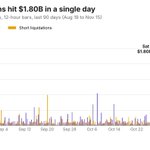
Then leverage did the rest. Longs lost $4.69B of the week’s $5.77B in liquidations, including $1.80B on Saturday alone, the biggest single-day long wipeout since February 5. BVIV spiked to 57.13, well above the 37 to 46 range it has held since July. Futures open interest fell 16.5% to $105.9B, though most of that drop came from lower prices rather than traders closing positions.

1
16
The selling pointed to US institutional channels. Coinbase spot made up 80% of net spot selling at -$634.2M, while perps saw -$8.66B of net taker selling, about 11 times the spot figure. BTC and ETH ETFs lost $1.46B, and IBIT has now seen 11 straight outflow days.
Two more headlines added pressure. MSCI will remove Strategy from its indexes after the November 30 close, which doesn’t force it to sell any BTC. MARA sold 13,597 BTC (about $1.1B) to repay loans. With the Fear & Greed Index at 13, its lowest since June, expect high volatility and choppy price action until the market absorbs this move.

23
Bitcoin just had one of its worst 10-day stretches in history. Over $533 BILLION wiped from the total crypto market in 10 days — only 4 prior 10-day drops were ever worse: May 2021, Oct/Nov 2025, and Feb 2026. In just 10 days, BTC dumped $18,000 straight down with zero bounces, taking out every single long position. The liquidation map now shows $17B in short positions stacked above. And $2.35B has exited Bitcoin ETFs in 2 weeks, with BlackRock’s IBIT leading — 11 straight sessions of redemptions, ~90% of November’s total outflows. Bulls are fully rekt.

3
2
282
One word: Anthropic. Investors are likely selling crypto to fund allocations for Anthropic’s IPO on Nov. 19. We’ve seen this exact playbook before — pre-SpaceX IPO (June 2025), BTC fell 28.3% from its peak. This time? BTC is down 27.47% heading into the listing. Almost identical. But there’s a key difference — Anthropic’s retail allocation is smaller (20% vs SpaceX’s 30%), and the $26B corporate tranche from Nvidia and Google doesn’t compete with retail cash. That means comparatively less selling pressure than what we saw with SpaceX. The Anthropic IPO accelerated the dump — but the Fed’s rate decisions and ongoing tech selloff are keeping risk-off sentiment alive and making recovery harder.

1
1
67
If history rhymes, we could be very close to a bottom. After the SpaceX IPO dump, BTC bottomed around $59K then rallied ~37% from that low — fast and violently. The $17B short stack sitting above current price is a massive liquidation magnet. If BTC starts moving up even slightly, those shorts get squeezed and the move accelerates explosively. The bull case: Anthropic IPO passes, selling pressure fades, shorts get squeezed, BTC rips. The bear case: Fed stays hawkish, tech selloff deepens, and the IPO catalyst alone isn’t enough to reverse sentiment.
41
On 8 November, Vitalik Buterin said ETH should be valued as a store of value, not as a fee-burning token. The reason is simple: this autumn the burn offsets only about 2-3% of new issuance.
Critics called it one more pivot. But twelve years of his own writing show ETH has worn five labels (fuel, security budget, ultrasound money, triple-point asset, store of value) while the argument underneath barely moved. ETH is worth what the chain’s security and usefulness make it worth, and monetary policy should serve security.

1
195
That was the right design, but it broke the burn story. The burn went from 147% of issuance in the year after Shapella to about 2% since Fusaka. You can’t sell a cash-flow token whose cash flow collapsed by design.
Vitalik’s own math shows the “floor” never held either. Most of the burn came from crypto-internal activity, and a floor only works if the revenue comes from outside. Applied to this year’s burn at a 4% discount rate, the model implies about $1.3B against a market cap near $273B.

1
17
The open question is credibility. ETH supply grows about 0.8% a year, similar to Bitcoin after its 2024 halving. But Bitcoin follows a fixed schedule, while ETH issuance rises with staking (now about 36% of supply) and stays open to change.
A store of value needs a monetary policy people can trust for decades. If “partial ossification” is to mean anything, it will have to include the issuance policy itself. That is the thing to watch next.

6
4. A self-custodial DEX can eliminate the need for a centralized operator to hold customers’ deposited assets, but it cannot eliminate smart-contract exploits, malicious approvals, compromised interfaces or vulnerable vault infrastructure.
1
12
5. The FBI announces that North Korea was behind the $6.3 billion hack of Binance, now the largest hack in history. North Korean hackers were previously accused by the FBI of some of the biggest crypto hacks. This includes the $1.5 billion Bybit attack last year and the 2022 theft of $620 million in cryptocurrency. North Korea is now responsible for both the first and second largest crypto hacks in history.
26
What if options trading didn’t need a centralized exchange? 👀
No gatekeepers. Just onchain markets.
SingularDEX Options. Beta loading. ⚡
Describe the future of decentralized options in ONE word.
We’ll go first: Permissionless.
Your turn 👇

153

Tokenized equities grew 483% this year. Total value reached $3.8B in the week of October 5, up from $654M in the week of January 5. Commodities and bonds came on-chain first, but in 2026 equities have taken the spotlight among RWA assets. New issuers drove much of the growth. Ondo still leads at $1B, but its share fell from 56% to 26%. Binance launched bStocks in June and now sits at $905M (24%). Robinhood launched in July and went from $20M to $170M. xStocks grew from $187M to $954M and holds second place at 25%.

2
1
237
The bigger question is whether these assets are actually used on-chain, and the numbers say yes. Weekly transfer volume grew 41.8x between the weeks of Jan 5 and Oct 5, from $420M to $17.5B, against 5.8x for market cap, so each dollar of market cap now moves about seven times as often. Weekly spot DEX volume grew from $45.8M to $2.54B, 55x, and peaked at $7.26B in the week of August 31. Trading has also spread beyond Solana, which carried 99.8% of volume in January. In October, Solana held 31%, Robinhood Chain 26%, BNB Chain 25% and Base 18%.

1
20
Capital is being put to work in DeFi too. Active TVL in tokenized equities grew from $15.5M to $313M, about 20x, or from about 2% to about 8% of market cap, with $33.2M added in the last 30 days. Lending markets hold $51.3M and spot DEX pools hold $77.9M, and the top ten protocols hold 89% of the total. Still, at $3.8B this is just 0.005% of the estimated $75T US equity market, so there is a lot of room left.

9