

Uncensored culture & history
Joined November 2024
- Tweets2.6K
- Following146
- Followers410
- Likes8.2K
Pinned Tweet
The apocalyptic novels of Paul Christensen:
HIDE THE DECLINE
amazon.com/Hide-Decline-Paul…
The period from the September 11 attacks to the Covid-19 lockdowns and beyond, as seen through the eyes of a right-wing filmmaker and an anarchist musician.
THE THRESHER
amazon.com/Thresher-Paul-Chr…
A portrait of the underground music scene of the 1990s, ‘The Thresher’ explores the conflict between individualism, nationalism and globalism, and the role of art in an increasingly sterile and conformist modern world.
THE WOLVES TRILOGY (single volume edition)
amazon.com/Wolves-Trilogy-Pa…
Part satire, part tragedy, Paul Christensen’s tale of an anti-globalist revolt and its aftermath anticipated many political developments of the past decade.
"The best work of dystopian fiction that I have read for many years."
- Black Front Press
‘Christensen’s ability to put his finger on the pulse of everything that is wrong with humanity is a force to be reckoned with.’
- Counter-Currents
‘This is the first book I would lend to anyone who is questioning the system’s narratives. Anyone on the brink of awakening…’
- Juleigh Howard-Hobson, author of ‘I Do Not Belong To The Baader-Meinhof Group & Other Poems’

Christopher Koch’s THE DOUBLEMAN (1985) is a well-structured novel dealing with Tasmania, occultism, and the electric folk scene of the ‘60s.
Its fictional band ‘The Rhymers’ are like a cross between Fairport Convention, The Seekers, and the Manson Family.
The characters are very vivid and you get a strong sense of what they look and talk like.
The weak point of the book is the sinister Darcy Burr, who is clearly modelled on Koch’s perception of Charles Manson (one of his disciples is even called Pipsqueak…an obvious reference to Lynette ’Squeaky’ Fromme).
But it is never clear what Burr’s real motives are.
Is he interested in ‘piercing the veil’ of the sensory world, like his master Clive Broderick?
Or is he merely desperate for the shallow pleasures of celebrity, to the point where he will water his music down to please record company execs?
Part of this confusion is due to Koch’s evident distrust of esotericism, which he seems to regard as little more than a search for personal power.

Werner Herzog’s WHERE THE GREEN ANTS DREAM (1984) was almost completely ignored in Australia, where it is set.
Herzog presents a fight between tribal Aborigines and a mining company in a very even-handed way, showing both sides of the conflict.
It’s not very flattering to Aborigines (at one point a mine worker complains that he can’t drive his truck because ‘them bloody boongers’ve been sniffing the transmission fluid again!’), yet it shows sympathy for their traditions.
One pompous reviewer referred to ‘Herzog’s increasingly offensive noble savage theme’, which isn’t even accurate as his main concern is the harsh yet dreamlike nature of the Australian landscape, which seems above and beyond the concerns of either race.

How accurate was William Gibson’s famous cyberpunk novel NEUROMANCER (1984) in its prognostics?
A lot of the hardware predictions were awry, for instance a cyberspace entered via cranial jacks, and the complete absence of mobile phones.
Japanese dominance of the planet didn’t eventuate as many thought it would in the ‘80s.
But he foresaw the erosion of the middle class, and the rise of tech corporations with power rivalling that of nation-states, which seems more significant than the things he got wrong.

In 1984, followers of Indian guru Bhagwan Shree Rajneesh contaminated food at ten restaurants in an Oregon town with salmonella bacteria.
Their aim was to incapacitate enough voters so their own candidates could win control of the county planning commission and their commune could expand, spreading its doctrine of free love and food poisoning.
The incident is regarded as the first bioterrorist attack in US history.
The poisoning was believed to be accidental until Rajneesh ratted on his own henchmen during an internal power struggle (of the kind that most communes experience).

Zola Budd had already smashed the women’s 5000m record while running barefoot.
South Africa was barred from the 1984 Olympics, but being eligible for UK citizenship she got onto the British team.
Despite being non-political she faced a storm of hatred from anti-apartheid protestors.
An athlete called Mary Decker (who Budd idolised) jostled her as she ran, but ended up falling over herself.
The crowd held Budd responsible and booed her relentlessly for the rest of the race.
Budd slowed down on the last lap, later saying that this was done deliberately because she didn’t want to face the boos at a hostile medal ceremony.
The US media cast her as a villain who had ruined Mary Decker’s gold-medal dream, and death threats accompanied her return to Britain where she had to be escorted through Heathrow under armed guard.

When Indira Gandhi was assassinated by her Sikh bodyguards in 1984, somewhere between 8000 and 17,000 Sikhs were killed by Hindus in reprisal.
It’s interesting to to contrast this with the incident in 2026 when a young British man was murdered by a Sikh in his hometown, and somewhere between 0 and 0 Sikhs were killed in reprisal.
This is what is known as ‘British politeness’.

SONGS OF THE WOLF (1984) was recorded after Tony Wakeford was kicked out of Death In June for being too ‘right-wing.’
The song ‘Progress’ ruthlessly mocks the idea of enforced egalitarianism.
‘Hundred Flags’ is a plea for regional identity and cultural heritage as a defence against both Soviet socialism and US capitalism.
‘Roses’, the standout track, is an anti-war song melding violence and beauty, with its haunting evocation of ‘crosses that have no one underneath.’
After this recording Wakeford worked as a drug dealer, before founding Sol Invictus in 1987.

The NSK (Neue Slowenische Kunst) was founded in 1984 by the band Laibach and other artists.
The German name (very controversial in Communist-run Yugoslavia) was intended ‘to surface uncomfortable historical and national questions’.
Their manifesto held that all art is subject to political manipulation, ‘except that which speaks the language of the same manipulation.’
This ensured that Laibach’s actual views, if any, have always been near impossible to glean.
There was also an emphasis on timelessness (Zeitlosigkeit), which is very un-Communist.
In the ‘90s NSK was declared a non-territorial ‘state’, issuing passports and operating embassies.

THE HUNGER (1983) is one of the best vampire movies, because it captures the sordid horror of this kind of parasitism, without the romantic notions prevalent in other films of this kind.
An ancient sorceress achieves immortality through blood drinking (Catherine Deneuve is well cast in this role, as she looks a bit like a vampire anyway).
She promises her lovers eternal life, but in fact they start to decay after a couple of centuries, remaining conscious but trapped in a kind of living death.
She keeps all of these previous lovers in a collection of coffins in the attic.
That is, until one of her victims is forced to use her own techniques against her.
The lighting and sets in this film are like one long ‘80s goth or synthpop video clip.
The soundtrack itself is good, ranging from Bauhaus to Allegri’s haunting 17th century masterpiece ‘Miserere.’

In 1983, 38 Provisional IRA prisoners escaped from the Maze in Northern Ireland, supposedly one of Europe’s most escape-proof prisons.
This was achieved by means of handguns and knives being smuggled in to them, which they used to take over a prison block.
After trying unsuccessfully to storm the gate with a truck, they fled on foot, scaling the outer fence.
Half were caught the same day, but nineteen remained at large and many of these escaped to the Republic of Ireland, in a major propaganda victory.
Two of them haven’t been traced to this day.

HELLICONIA SPRING (1982) was the first in Brian Aldiss’s Helliconia trilogy, about a world where seasons last for centuries (George R.R. Martin would recycle this idea less effectively in ‘A Song of Ice and Fire’).
Man shares the planet Helliconia with a shaggy minotaur-like species called phagors, who grow stronger in the winter centuries, often enslaving humans.
Summers, conversely, are dominated by man, who is better adapted to warmer weather.
A virus that manifests as ‘bone fever’ in spring and ‘fat death’ in autumn changes people morphologically to prepare them for the coming season.
Compounding the drama, humans from Earth are observing Helliconia from orbit, and their temptation to interfere will have ramifications for both civilisations.
The main theme of the trilogy is enantiodromia (the process of things turning into their opposites): religion becoming heresy and vice versa; freedom and slavery interchanging.
‘Helliconia Spring’ is the most atmospheric of the three volumes.

In July 1982, pilots near Long Beach Airport reported seeing a man in a flying chair at 16,000 feet, wielding a gun.
This was ‘Lawn Chair Larry’, travelling on a lawnchair held aloft by 45 helium balloons, and the pellet gun was his primary means of controlling descent, by shooting out the balloons.
He also packed a CB radio and some sandwiches.
His catchphrase: ‘A man can’t just sit around…’
He was fined several thousand dollars, and died by his own hand a decade later, perhaps unable to recapture the exhilaration of his famous flight.

It’s interesting to compare John Carpenter’s Antarctic horror film THE THING (1982) with ALIEN (1979).
While the latter is more ‘realistic’, i.e. biologically plausible, its H.R. Giger-designed monsters are too anthropomorphic to be scary, especially with their ludicrous hissing sounds.
The shape-shifting creature in ‘The Thing’, conversely, sounds too far-fetched to be plausible on paper, but as experienced by the film viewer is far more disturbing.
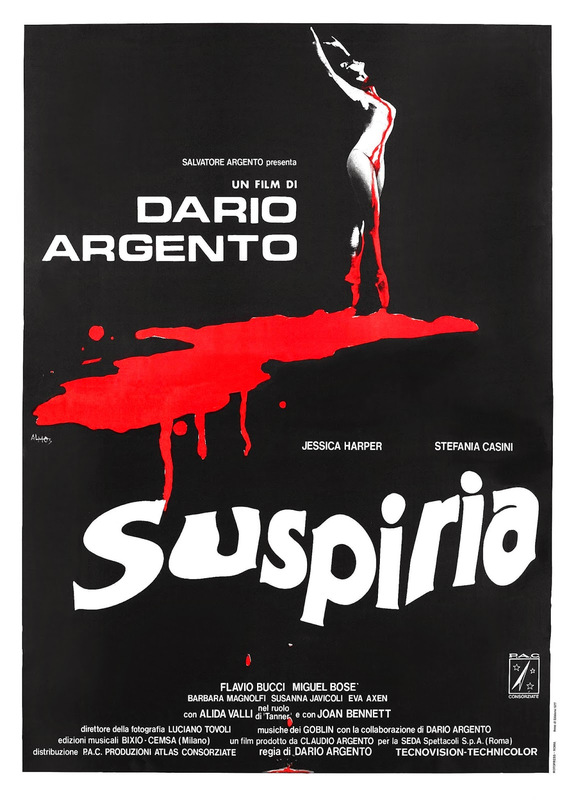
Which proves that ‘realism’ adds nothing to horror movies (as if Argento’s absurd-yet-disquieting ‘Suspiria’ wasn’t argument enough).


As far as I know, Dario Argento wasn’t an influence on David Lynch, but the depiction of pure malefic evil in his 1977 film SUSPIRIA (not to mention the velvet drapes), appear to indicate some unspoken link.
This tale of a Swabian dance academy controlled by a blackened undead witch is one of the atmospheric horror movies ever made, thanks in no small part to the disturbing soundtrack by Goblin.
The Technicolor filtering, so unnaturalistic, contributes to the feeling of putrescence and corruption, with camera angles that make it seem that the building itself is watching.
Nothing about this film is realistic, the plot is almost non-existent, and yet it is somehow completely convincing.
The 'Illuminati' card game (1982) was based loosely on Robert Anton Wilson's Illuminatus Trilogy, with each player controlling a different faction (Bavarian Illuminati, Discordians, Cthulhuists etc.)
An updated 1990s version included Hillary Clinton’s ‘vast right-wing conspiracy’, and it is this version which contains many of the cards accused of predictive programming.
‘Terrorist Nuke’ and ‘Pentagon’ appear to predict September 11, while other cards foreshadow Donald Trump’s rise.
Probably this is the work of the cosmos itself, which is known to have a dark sense of humour.

‘National Democrat’ (1981/2) was the first publication to introduce the work of thinkers such as Julius Evola, Alain de Benoist and Guillaume Faye to an English-speaking audience.
It followed the French New Right in supporting particularism against all forms of universalism.
Founded by ex-National Front organiser Michael Walker, it argued that the nationalist right had failed to achieve its goals partly because it had neglected cultural and intellectual issues.
It ran for three issues before changing its name to ’The Scorpion’.

A.B. Facey began work as a farm hand in the Western Australian wheatbelt at age 8, later working as a drover, railway worker and professional boxer.
In 1915 he served at Gallipoli, where two of his brothers died.
He only learnt to read and write in his twenties.
Despite his life being incredibly harsh by today’s standards, Facey regarded it as ‘fortunate’, and became a celebrity on the publication of his autobiography A FORTUNATE LIFE in 1981.
Laconic and free of bitterness, it became one of the bestselling books in Australian history.

Ken Russell’s ALTERED STATES (1980) is essentially a film about the limits of science as a method of knowledge.
How can different states of consciousness be ‘measured’ when you can only partake in them subjectively?
It is from this realisation, uneasy for ‘progressives’ to process, that the film builds its atmosphere of surrealistic horror.
The main scientific materialist in the film has a thick southern drawl, which in rootless cosmopolitan films is often used to represent someone ‘backwards’ or regressive, so Russell is subverting that trope and implying that it is materialists themselves who are regressive.
The hallucinatory special effects in this film are unique, engendering an atmosphere all of their own.

The Mandelbrot set was first visualised in 1980.
The shape that emerged has a finite area and an infinite perimeter, leading some to call it ‘the thumbprint of God’, as it mirrors the structure of real natural boundaries such as coastlines.
It also seems to me, somehow, to incorporate the masculine and feminine principles.
