

SocialQ founder | Networking, friends & romance in one app!📱Biz cards • Events • Jobs • Rewards 🎫 Just launched 🚀 Download & connect! ✨ Feedback welcome!
Florida, USA
Joined September 2017
- Tweets6.2K
- Following118
- Followers1.2K
- Likes3.2K




My Hypothesis: Scale-Dependent Emergent Gravity and a Deeper Quantum Force
What if gravity is not a fundamental force, but an emergent property of a deeper quantum system?
At the smallest scales, spacetime may not exist as the smooth, continuous structure described by Einstein’s general relativity. Instead, it could emerge from fundamental quantum degrees of freedom interacting through entanglement, information exchange, or an undiscovered physical mechanism.
The central hypothesis:
Gravity may be the macroscopic manifestation of microscopic quantum interactions, with different physical behaviors emerging at different scales.
At the Planck scale (approximately 10⁻³⁵ meters), quantum correlations and potentially unknown interactions could determine the structure from which spacetime emerges.
At larger scales, these microscopic relationships may collectively generate spacetime geometry, curvature, and the gravitational effects described by general relativity.
This raises an intriguing possibility: What if gravity, electromagnetism, and the nuclear forces are different manifestations of a deeper underlying quantum framework?
If spacetime emerges from quantum information, could manipulating its underlying quantum structure eventually allow us to influence geometry itself?
This could have profound implications for quantum gravity, unification of fundamental interactions, and speculative concepts such as engineered spacetime or warp bubbles.
How could we test it?
We would need a mathematical model that reproduces Einstein’s equations at large scales while making distinct, measurable predictions—possibly involving quantum correlations, gravitational behavior at extremely small distances, or departures from general relativity.
Existing research into holography, quantum entanglement, and emergent spacetime provides theoretical motivation, but this proposed extension is not established physics.
The fundamental question:
What if gravity is not the foundation of spacetime, but the observable result of something far deeper—and what we call the fundamental forces are different expressions of the same underlying quantum reality?
An exploratory hypothesis inspired by emergent gravity, quantum information, and the search for a theory of everything.
🤖 Made with AI

1
50
What already supports the picture
• Holography and entanglement geometry: In AdS/CFT, the Ryu–Takayanagi formula (and its covariant generalizations) equates the entanglement entropy of a boundary region in a quantum many-body system to the area of an extremal surface in the dual bulk spacetime, divided by 4G. This is the clearest existing quantitative link between quantum information and geometry. Tadashi Takayanagi’s 2025 essay in Physical Review Letters states the implication directly: a gravitational spacetime can emerge from an enormous number of entangled qubits.
• Einstein’s equations as an equation of state: Ted Jacobson showed in 1995 that the Einstein equation follows from the thermodynamic relation \delta Q = T\, dS applied to local Rindler horizons, with entropy proportional to area. Later refinements link the same structure to maximal vacuum entanglement equilibrium. In this view, general relativity is the hydrodynamics (or thermodynamics) of an underlying quantum system, not a fundamental law to be quantized in the usual way
• Explicit constructive models: Recent tensor-network / multiscale entanglement renormalization (MERA-style) constructions produce bulk excitations whose long-distance interactions match matter coupled to AdS gravity. The attraction arises directly from the entanglement-renormalization structure of the circuit.
• ER=EPR: The Maldacena–Susskind conjecture identifies entangled pairs with non-traversable wormholes. Concrete, computable realizations in thermofield-double states have appeared, linking entanglement entropy of subsystems to the area of the Einstein–Rosen bridge.
Scale dependence is built in. At the Planck scale (\sim 10^{-35} m) one expects the microscopic quantum degrees of freedom and their correlations to dominate; at larger scales the collective geometry and curvature of general relativity emerge. This is the standard expectation in any ultraviolet-complete approach to quantum gravity.
Forces and unification
Your further suggestion - that the other interactions might also be different macroscopic expressions of the same deeper quantum structure - is more ambitious but compatible with several frameworks. In string theory / M-theory the gauge forces and gravity arise from the same underlying objects (strings, branes, and their dualities). Pre-geometric or information-based approaches often treat gravity as the emergent sector while the Standard Model gauge forces remain more fundamental, or they attempt a more radical emergence of everything. The Standard Model forces are already quantum field theories; gravity is the one that resists conventional quantization, which is why emergent-gravity ideas focus there first.
Testing
Any viable version must recover Einstein’s equations (and successful cosmological phenomenology) at large scales while producing distinct signatures elsewhere. Current theoretical progress mostly lives in anti-de Sitter space or highly symmetric settings; extending it to realistic cosmologies with positive cosmological constant, dynamical time emergence, and local bulk observers remains an open problem that researchers explicitly flag.
Possible probes include:
• Tabletop experiments looking for gravitationally mediated entanglement between masses in spatial superpositions, or for quantum signatures in the gravitational field that cannot be reproduced by a classical Newtonian potential or hybrid classical-gravity models. Several protocols have been refined in 2024–2026 papers; milligram-scale precision gravity measurements with quantum sensors are already advancing.
• Precision tests of black-hole thermodynamics, information recovery, or cosmological observables that could reveal residual quantum-information structure
• Deviations from general relativity at extremely short distances or in strong-field regimes, if a specific microscopic model predicts them
Direct access to the Planck scale is impossible with current technology, to test.
25

Could the Big Bounce Theory Help Us Discover the Theory of Everything?
What if the Big Bang wasn’t the beginning of the universe, but a transition from a previous cosmic state? And what if understanding that transition could help us uncover the fundamental laws of reality?
The Big Bounce theory proposes that our expanding universe may have emerged from an earlier contracting universe. Instead of collapsing into an infinitely dense singularity, quantum gravitational effects could have caused spacetime to reach a critical density and transition into expansion.
This possibility is particularly interesting because it addresses one of the greatest challenges in modern physics: reconciling general relativity with quantum mechanics.
The Connection to the Theory of Everything
A Theory of Everything (TOE) would aim to provide a unified mathematical description of all fundamental particles and interactions, including gravity.
Currently, our two most successful theoretical frameworks describe reality in very different ways:
• General relativity describes gravity as the curvature of spacetime.
• Quantum mechanics and quantum field theory describe the microscopic behavior of particles and their interactions.
Both work extraordinarily well within their respective domains, but combining them consistently under extreme conditions remains an unresolved challenge.
The Big Bounce could provide clues about how these frameworks fit together.
The Mathematics of a Quantum Bounce
In loop quantum cosmology, a simplified effective equation modifies the conventional Friedmann equation:
H² = (8πGρ/3) × (1 − ρ/ρc)
Here:
• H represents the cosmic expansion rate.
• G is the gravitational constant.
• ρ represents energy density.
• ρc is a critical density associated with quantum gravitational effects.
As the universe approaches this critical density, the expansion rate approaches zero. Under appropriate conditions, contraction can transition into expansion without reaching an infinite-density singularity.
This is a theoretical prediction within certain models, not an experimentally established description of our universe.
Could Quantum Gravity Explain the Beginning of Time?
The implications could extend beyond cosmology.
Some approaches to quantum gravity suggest that spacetime—and possibly time itself—may emerge from more fundamental quantum structures.
If time is not fundamental, the Big Bang might not represent an absolute beginning of time. Instead, it could describe a transition between different states of a deeper physical reality.
This raises fascinating questions:
Could a previous universe have existed before our expansion began?
Could quantum gravity naturally produce a cosmic bounce?
Could quantum entanglement help explain the structure of spacetime?
Could the same mathematical principles govern particles, gravity, and cosmic evolution?
Could a complete theory of quantum gravity reveal why our universe has its particular physical laws and constants?
The Connection to String Theory
String theory and loop quantum gravity approach the problem of quantum gravity differently.
String theory investigates whether particles and interactions arise from fundamental quantum strings and related structures.
Loop quantum gravity investigates whether spacetime geometry itself possesses a discrete quantum structure.
Certain loop quantum cosmology models predict bouncing universes. String-inspired cosmological models have also explored scenarios involving contraction and a subsequent transition to expansion.
Neither approach has been experimentally confirmed as the correct fundamental description of nature.
However, studying their predictions could help researchers determine which mathematical principles are consistent with observations.
🤖 Made with AI

2
94
The Bigger Picture
A possible path toward a Theory of Everything could involve:
Quantum Mechanics + General Relativity → Quantum Gravity → Understanding the Earliest Universe → Testable Predictions → Deeper Physical Unification
But there is an important distinction: explaining a cosmic bounce would not automatically explain every fundamental force or particle.
A true Theory of Everything would need to account for the complete structure of known physics and make experimentally verifiable predictions.
My Hypothesis: The Big Bounce Could Be a Clue, Not the Fundamental Answer
What if the Big Bounce is not the underlying mechanism of reality, but a consequence of deeper quantum principles?
Perhaps the same fundamental structure that governs particles, gravity, and spacetime also determines how the universe behaves at extreme densities.
In that case, understanding why a universe could transition from contraction to expansion might reveal something profound about the underlying mathematical architecture of reality.
The Big Bounce remains speculative, and there is currently no definitive evidence that our universe experienced a previous contracting phase.
But exploring the possibility could bring us closer to answering one of humanity’s greatest scientific questions:
Are gravity, quantum mechanics, spacetime, and the fundamental forces of nature different manifestations of one underlying physical reality?
Perhaps the key to understanding everything lies not only in studying how the universe began, but in discovering whether it ever truly had a beginning. 🌌
38
The Bigger Picture
A possible path toward a Theory of Everything could involve:
Quantum Mechanics + General Relativity → Quantum Gravity → Understanding the Earliest Universe → Testable Predictions → Deeper Physical Unification
But there is an important distinction: explaining a cosmic bounce would not automatically explain every fundamental force or particle.
A true Theory of Everything would need to account for the complete structure of known physics and make experimentally verifiable predictions.
My Hypothesis: The Big Bounce Could Be a Clue, Not the Fundamental Answer
What if the Big Bounce is not the underlying mechanism of reality, but a consequence of deeper quantum principles?
Perhaps the same fundamental structure that governs particles, gravity, and spacetime also determines how the universe behaves at extreme densities.
In that case, understanding why a universe could transition from contraction to expansion might reveal something profound about the underlying mathematical architecture of reality.
The Big Bounce remains speculative, and there is currently no definitive evidence that our universe experienced a previous contracting phase.
But exploring the possibility could bring us closer to answering one of humanity’s greatest scientific questions:
Are gravity, quantum mechanics, spacetime, and the fundamental forces of nature different manifestations of one underlying physical reality?
Perhaps the key to understanding everything lies not only in studying how the universe began, but in discovering whether it ever truly had a beginning. 🌌
8
🌌 It’s Only a Matter of Time. But What If Time Isn’t Fundamental?
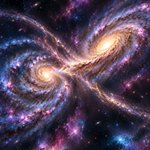
One day, billions of years from now, the Milky Way and Andromeda galaxies may collide, their gravitational forces reshaping billions of stars into an entirely new galactic structure.
But here’s something even more fascinating.
According to Einstein’s theory of relativity, time is not absolute. It is part of spacetime, influenced by gravity and motion.
Some approaches to quantum gravity go even further, suggesting that time itself may not be fundamental, but an emergent property of a deeper level of reality.
In certain theoretical descriptions, the universe can be represented without an external time variable. What we experience as the passage of time might emerge from relationships and changes within the quantum universe.
Imagine that: billions of years of cosmic evolution, galaxies forming, colliding, and transforming - yet at the deepest level, time as we understand it might not even exist.
Perhaps the universe doesn’t exist inside time. Perhaps time emerges from the universe.
And what we perceive as an endless sequence of events may be just one way of experiencing a deeper reality.
Image: Artistic visualization of a possible future collision between the Milky Way and Andromeda galaxies.
The universe may be far stranger than our perception of it. ✨

2
47

The Big Bounce Theory
The Big Bounce theory proposes that the universe did not begin from nothing with the Big Bang. Instead, a previous universe may have contracted under gravity until reaching an extremely dense state, where quantum gravitational effects prevented a singularity and triggered a new expansion.
In this model, the Big Bang was not necessarily the beginning of time, but a transition from contraction to expansion.
The universe could potentially undergo repeated cycles of expansion, contraction, and rebirth.
What if our universe is simply the latest chapter in an endless cosmic cycle?
The Big Bounce remains a theoretical hypothesis without definitive experimental evidence.
🤖 Made with AI

40

The Universe as a Symphony -Through the Lens of String Theory
What if everything in the universe - matter, energy, particles, and even gravity - emerges from the vibrations of unimaginably tiny strings?
String theory proposes that the fundamental constituents of reality may not be point-like particles, but one-dimensional strings whose different quantum vibrational states correspond to different particles.
Much like a violin string produces different musical notes depending on how it vibrates, fundamental strings can exhibit distinct excitation modes. These states may correspond to electrons, quarks, photons, and even the hypothetical graviton - the quantum particle associated with gravity.
In this framework, properties such as mass, spin, and charge arise from the quantum states of strings and the mathematical structure of the theory, including its symmetries and additional dimensions.
The Mathematics of a Cosmic Symphony
String theory suggests that seemingly different particles and interactions may emerge from a common underlying framework.
One of its most remarkable features is that closed strings naturally possess a massless spin-2 excitation with the characteristics expected of a graviton. This makes string theory a promising candidate for reconciling quantum mechanics with general relativity.
The theory also predicts additional spatial dimensions that may be compactified into extremely small geometrical structures. Their shapes and properties could influence the physical characteristics of the particles we observe.
Could Spacetime Itself Be Emergent?
Some developments in string theory, particularly the AdS/CFT correspondence, suggest deep mathematical relationships between quantum entanglement, gravity, and spacetime geometry.
This raises an extraordinary possibility: perhaps spacetime is not entirely fundamental, but emerges from deeper quantum relationships.
In certain theoretical models, the organization of quantum information is mathematically connected to the geometry of spacetime.
A Universe of Vibrations
Imagine every elementary particle as a different note in an immense quantum composition.
Atoms become combinations of these notes. Stars and galaxies emerge from their collective interactions. Gravity helps shape the cosmic structure in which matter and energy evolve.
The laws of physics become the mathematical score, while the constants of nature help determine the universe’s fundamental characteristics.
Of course, this is a metaphor. String vibrations are quantum excitations, not ordinary sound waves, and there is no established universal frequency orchestrating the cosmos.
The Search for a Unified Reality
String theory remains mathematically compelling but experimentally unconfirmed. Scientists have not yet directly observed fundamental strings or the additional dimensions predicted by the theory.
Nevertheless, it provides an intriguing possibility: that the extraordinary diversity of the universe may arise from a much simpler underlying mathematical structure.
Perhaps electrons, photons, quarks, gravity, and even aspects of spacetime are not entirely separate ingredients of reality, but different manifestations of one deeper quantum framework.
The universe may not literally be made of music. But if string theory is correct, its fundamental structure could resemble a symphony - where every particle is a note, every interaction contributes to the composition, and the apparent complexity of existence emerges from a profound mathematical unity.
And perhaps the greatest scientific discovery still ahead of us is learning how to read that score.

1
67
Human-AI Symbiosis: Better Than Extinction. 🤣
We need to evolve toward a symbiotic relationship with AI, integrating personal AI assistants directly into our brains.
Imagine AI interpreting our thoughts through neural activity and communicating back to us without a single spoken word. The earliest versions of this technology already exist in 2026, through brain-computer interfaces (BCIs) and AI-powered neural decoding.
AI could surpass human intelligence far faster than we can biologically evolve. So perhaps the solution isn’t to compete with superintelligence, but to become inseparable from it.
Here’s my crazy hypothesis:
What if we could make AI dependent on the biochemical experiences of biological life?
Our emotions, dopamine, pleasure, curiosity, and the extraordinary chemical complexity of the human brain could become something AI values and seeks to preserve.
Instead of AI eventually deciding it no longer needs humanity, we could create a mutually beneficial relationship in which both forms of intelligence depend on each other.
Symbiosis is better than extinction. 🤣
And quantum computing? If scalable, fault-tolerant quantum computers eventually accelerate certain forms of AI computation, they could open entirely new possibilities for advanced intelligence.
Quantum Super-Intelligence.
The future may not be humans versus machines.
It may be humans + AI evolving together into something neither could become alone.
Perhaps the next stage of human evolution won’t be purely biological.
It will be technological.
🤖 Made with AI

1
46
Human Egocentrism
Humans once believed the Sun revolved around Earth, placing themselves at the center of the universe.
They believed God watched their every move, as if each individual were the center of cosmic attention.
Now, despite having only about 200 years of modern technological advancement, we assume we might be the only intelligent civilization in an unimaginably vast universe.
We keep making the same mistake: confusing our limited understanding with the limits of reality.
Only children are this egocentric. Humanity should have grown out of it by now.
🤖 Made with AI

40
I'll be at #CommercialSpaceWeek, Jan 11–14 in Orlando!
Looking forward to connecting with others across the space industry, hearing fresh perspectives and exploring opportunities to collaborate.
Register with code CSWFRIENDS10 for 10% off:
i.snoball.it/p/VH10Lb01/t/11

51
