

Entrepreneurship in Asia https://teapaw.org/t.co/yyLSGQyahv
Bangalore
Joined March 2009
- Tweets4.6K
- Following2.8K
- Followers645
- Likes12.4K


Sree Sivanandan retweeted

For all those who have been following the epic journey of Amur falcons, I have put together a small deck exploring the most fascinating parts of their journey, with a few of your questions answered along the way. The work belongs to Dr Suresh Kumar and the scientists at the Wildlife Institute of India (MoEFCC), the Manipur Forest Department, and the local communities who protect these birds. I do believe this incredible migration will move something in us, so that each of us are inspired to do our bit to keep these ancient journeys going, forever. 🤛 as told to @supriyasahuias by @sureshwii
#AmurFalcon #Migration #Manipur #Conservation @moefcc


Sree Sivanandan retweeted
Hurray ! And he has landed !
Apapang too has done it, arriving in Somalia after 5,400 Kms NONSTOP flying . Apapang, the male Amur Falcon, has reached the shores of Somalia after an epic nonstop flight from Tamenglong, Manipur India ! With Alang the young female Amur Falcon already in Somalia, both our winged travellers have now completed this breathtaking leg of their transcontinental migration. From the hills of Manipur to the Horn of Africa. We are witnessing a true miracle of nature @sureshwii #AmurFalconMigration


Unbelievable but true ! Alang has made it to Somalia ! 5,700 km in 101 hours of NONSTOP flying! No rest, no landing, just sheer endurance across the Arabian Sea! And Apapang is still flying ! 4,100 km covered in 95 hours, NONSTOP!
Magnificent little champions are blazing across the skies 💪
Info Dr Suresh @sureshwii @wii_india @IUCN @moefcc

In this world where everyone is aspiring to be a superhuman, it's humbling to note that there are such creations who are doing astonishing things, just being a small bird, let alone trying to be a super bird :)
Unbelievable but true ! Alang has made it to Somalia ! 5,700 km in 101 hours of NONSTOP flying! No rest, no landing, just sheer endurance across the Arabian Sea! And Apapang is still flying ! 4,100 km covered in 95 hours, NONSTOP!
Magnificent little champions are blazing across the skies 💪
Info Dr Suresh @sureshwii @wii_india @IUCN @moefcc
1
4
137
What are the current regulations in Bengaluru City about burning waste in open lands?
Can someone guide us to the right department or officials we can contact to raise this issue?
This is happening in Yemalur, 10 minutes away from HAL Police Station.
@WFRising @peakbengaluru @karnatakakspcb @krishnabgowda @GBAChiefComm @GBA_office

1
66

Sree Sivanandan retweeted

If NVIDIA employees want Jensen back, they should start with “NVIDIA is nothing without its people” - resign and chill.
Good GPU engineers are very hard to find and even harder to replace than ML engineers.
Engineers should take their destiny into their own hands if they love the company. They shape and deliver the company mission, not the boards.
Sree Sivanandan retweeted

I turned 53 .. Here's what I learnt.
At 50 plus the world starts filing you under senior. Recruiters go quiet on the big roles. Younger colleagues explain things to you slowly. Relatives ask about retirement plans.
Yet when someone dies at 50, everyone says the same thing: Gone too soon. He had so much left.
So which is it .. Old, or barely started
Same number. Opposite verdicts. Neither one is really about you. Both are about whoever is doing the judging.
A number without context is meaningless. ₹100 crore of revenue is a triumph for a startup and a crisis for a company that did ₹300 crore last year. Age is no different. 50 plus is a data point, not a conclusion.
Society runs on a fixed calendar. Degree by 22. Married by 28. Home loan by 32. CXO by 45. Retire at 58, then wait. Miss a date and you're behind. Hit every date and nobody asks if you wanted any of it.
I've seen batch mates tick every box and show up at reunions looking drained. I've also seen people start a business at 48, change careers at 52, pick up a camera at 55, and look a decade younger than their PAN card says.
In compounding, the biggest gains come in the later years. The early years build the base. The back end does the heavy lifting. Experience, judgment and relationships work the same way. At 50 plus, you're not at the end of the curve. You're entering the steep part.
So stop asking ..Am I on schedule..
Instead ask ..what do I want the next 20 years to compound into .. Is it mine, or something I inherited from a WhatsApp family group.
I'd rather walk slowly up a hill I chose than sprint up one someone else picked for me.
50 plus isn't late. It's leverage.
Sree Sivanandan retweeted

My wife is an animal rescuer and today, she got badly assaulted by some people in dommasandra village area
@BlrCityPolice we are at varthur police station. Need your support.

Sree Sivanandan retweeted

Andrej Karpathy spent 8 years at OpenAI and Tesla
Last week he compressed everything he knows into one free 2-hour lecture
Prompts → Agents → Harness → Graphs → Loops
People spend $15k on bootcamps that teach less than this
You probably don't have 2 hours right now
Don't let it vanish from your feed
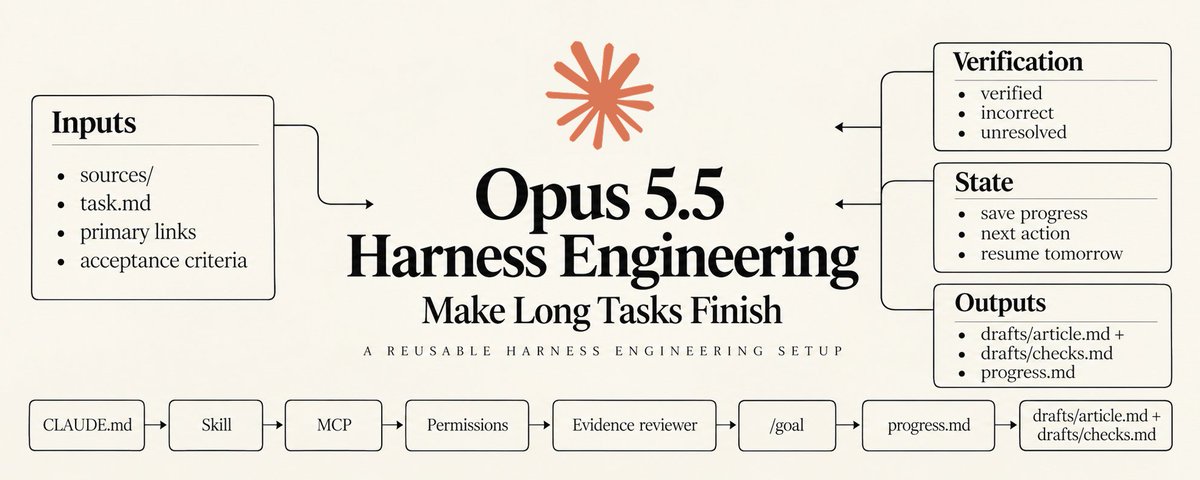
Watch it, then read the full Opus 5.5 harness engineering guide below

Sree Sivanandan retweeted

Listen to this ❤️ and see you on 10th October, at Gyan Bhawan, Patna, Bihar
Sree Sivanandan retweeted
Shuru karne ke baad bhi, sawaal khatam nahi hote.
Sometimes, that is when you need guidance the most. You have taken the first step. People are counting on you. And now there are decisions you have never had to make before.
You should be able to say, “Mujhe yeh samajh nahi aa raha,” and find someone willing to listen and work through it with you.
Eighteen years of YourStory have taught me to take these moments seriously. A question about a business can carry years of someone’s savings, their family’s expectations, their confidence in themselves. It deserves time, care and honest guidance.
That learning is shaping how we build ShuruKar.
This is a movement to support aspiring entrepreneurs as they develop their ideas, find their first customers and learn to run their businesses.
We want to create workshops where you can learn, drive conversations where you can ask freely, and offer practical support when registration, legal complexities or compliance feel unfamiliar.
I want someone building in a small town to feel they have people to turn to. I want them to know their questions will be taken seriously.
And I hope those of us who have experience will make time for this work. We know how much a thoughtful conversation or timely advice can matter. There is so much we can help someone figure out.
Bharat has been my teacher for 18 years. I am bringing that learning, and a willingness to keep learning with you, to ShuruKar.
We launch on 10 October at Gyan Bhawan, Patna. I’ll be in Patna from 7 to 10 October, and I would love to meet you.
Hokar Nidar, Shuru Kar.
Sree Sivanandan retweeted
Happy birthday, PM @narendramodi ji 🙏
Few leaders have made an entire generation believe that where you start does not decide where you end up.
Thank you for the energy, the conviction and the relentless work for India.
Wishing you good health and many more years of service. 🇮🇳
#HappyBirthdayModiJi
Sree Sivanandan retweeted
India has recognised more than 2 lakh startups. But will it buy from them?
For a decade, India has encouraged its young people to build.
We created funds, grants, incubators, tax incentives, credit guarantees, challenges and accelerators.
But when a startup finally builds something that works, it confronts a harder question:
Who will buy it?
In FY26, the Government e-Marketplace handled purchases worth ₹5.03 lakh crore.
Micro and small enterprises received ₹2.36 lakh crore, or 47.1% of the total.
Startups received just over ₹19,000 crore, less than 4%.
Why the difference?
MSEs have a procurement mandate. Startups have exemptions.
One tells the government: you must buy.
The other tells the startup: you may apply.
India relaxed prior turnover, experience and earnest-money requirements for recognised startups. But it gave government buyers no target, no budget line and no reporting obligation to purchase from them.
And getting through the tender is only the beginning.
Consider an illustrative case - a four-year-old company with ₹6 crore in revenue wins a ₹5 crore government order. Liquidated damages can run to 10% of contract value, ₹50 lakh, often secured by an irrevocable bank guarantee.
Add performance security, production costs and the payment cycle, and the biggest order in the company's history can consume more cash than it generates.
The biggest order in a young company's history should not become the order that kills it.
Defence and space show us another path.
India unlocked private innovation in these sectors not only by funding startups. It created procurement routes, converted successful prototypes into orders, and changed contract terms for emerging technology.
Several states are already experimenting -
Kerala enables direct procurement from startups.
Telangana offers a price preference and time-bound evaluation.
Maharashtra requires departments to earmark 0.5% of their budgets for innovation.
Karnataka is positioning government as the first customer for deep-tech startups.
Odisha has reduced the performance-security burden.
India already possesses the answers. Now it needs national scale.
I propose a 1% Purchase Order Mission:
Earmark at least 1% of central procurement for recognised startups.
Allow successful government-funded pilots to convert into orders.
Create startup-specific contract terms for first-of-a-kind technology.
Publish ministry-wise and PSU-wise startup procurement every quarter.
On FY26 GeM volumes, 1% would mean approximately ₹5,000 crore in annual demand, without creating another subsidy or funding scheme.
India spent its first startup decade teaching young people to build.
The next decade must answer a harder question:
Will India trust them enough to buy what they build?
Because grants build prototypes.
Purchase orders build companies.
Read the full story with @PremManukonda here - yourstory.com/2026/09/india-…
#StartupIndia #IndianStartups #PublicProcurement #DeepTech

Sree Sivanandan retweeted

We grew from ~0 to $500M ARR, adding $250M last year alone while being EBITDA profitable.
1,300-word post on every growth tactic that worked for us:
1. What got us from 0-$400M ARR in the US works in every country.
2. Retention and Monetisation Hacks.
3. Localization > Translation.
4. Experiment with $1M internal seed checks.
5. Pivoting to only AI content production unlocked 100% ARR growth.
Pocket FM is like Netflix for audio-only dramas, with our own pool of one-person studios.
1. Acquisition Playbook for 0-$10M ARR in any country in 6 months
We run a 90 sec video trailer of an audio drama as an Ad and ask users to download the app if they're interested in the rest of the story.
Our core insight after spending >$100M on acquisition is: If the clickthrough rate (CTR) for an ad goes from 2% to 2.25%, our customer acquisition cost (CAC) decreases by ~ 30%.
We remodelled our system around this insight and built an AI-first 2.25% CTR ad manufacturing machine that works in every country.
For every new country, we take our hit shows -> use LLMs to extract and most intriguing moments -> Write a 5-min script combining all the best parts. The first 60 seconds has to have a hook every 5 seconds and needs to end with a crazy cliffhanger to force a download mid-scroll.
If a marketing video is not hitting our benchmarks (2.5% CTR and 55% 3-second through-play), a creative director gets involved to change the hook or cliffhanger to get the numbers there.
AI lets us make 1,000 Ads per show, and in total we do ~17.5k Ads per month. When a business creating scales from 1k to 10k Ads, the normal thing is for CAC to skyrocket. But with what I just shared, we 7-8x'd our User Acquisition budget without increasing our CAC materially.
It took us 8 months to figure this out, but then the timeline from 0-$10M in every country got shorter and shorter:
US revenue grew to $25M in 19 months. (US is now 78% of total)
Germany to 21M in 11 months.
France to $10M in 3 months.
2. Retention and Monetisation Hacks.
We knew we wanted to create an audio entertainment platform, but there was no standard format. For the first 2-3 years, we tried 10 different formats before landing on the winner.
After we got it right with audio drama (8-12min chapters, written for mobile fiction, serialized, episodes have strong hooks and end on cliffhangers), avg daily streaming time went from ~25mins to 150+.
Audio drama made us realize that Pocket FM was creating a whole new medium. There was no playbook for anything that we were doing. Everything had to be thought & built from scratch.
This is what we did for each major bullet:
- Monetization: Users have some free daily minutes to listen; then it's pay per episode. We also added the option for users to unlock episodes by watching ads, which is doing extremely well. Ads scaled from zero to a ~$90M run rate in 12 months.
- Engagement & production: You don't become obsessed with an app you open once a week. To have users engage daily, we make the next episode free every day. Also helps them build the habit.
- Discovery. Huge problem because people consuming Pocket FM enter the app, tap the show, and lock the screen. We fixed it by doing "playlists" of episodes. Once users's free minutes on a show are done, we ask users if they want to pay. If they say no, we play a new show, one where they haven't used their free mins. And we stitch episodes of different shows together that way, creating natural discovery.
3. Localization > translation.
78% of our revenue is still concentrated in the US. Localisation is fixing this: You might write a show for a Spanish audience where language, jokes, folklore, have a certain flavor; if you merely translate the show for, say, a Norwegian audience, that color is lost and hurts the show in the Norway. Listeners would relate more if the show was written by a Norwegian.
That's why, instead of translating, we localize shows to different regions. We use AI to take the spine of stories and adapt their whole cultural layer to the other country.
The results: a US show that was localized for a German audience had 50% higher retention than the translated version.
Localization + our user acquisition playbook led to:
- $10M+ ARR in France within 3 months
- $21M+ ARR in Germany within 11 months.
And this expands writers' addressable market.
We get messages of writers thrilled to have revenue coming from the US, India, EU, LatAm, without them doing much incremental work.
4. Experiment.
We give $1M checks to new internal initiatives, and the team has 12-18 months to prove their thesis. If they prove it, we double down.
This is how Pocket Saga came about, our AI video microdrama app. It's an AI video equivalent of Pocket FM. Same shows and structure, but as a vertical 2-min mobile video series.
We launched it two months ago and it's at ~$15M ARR.
Pocket's broader thesis is to help creators tell their stories to as many people as possible. Start with audio drama -> multiple languages or localize to diff countries -> microdrama -> more formats like movies, TV shows, and games.
Best of all is that writers get revenue streams not only from countries they wouldn't have tapped into, but also from formats they wouldn't have thought possible.
5. Pivoting to only AI content production unlocked 100% ARR growth.
In mid-2024, we pivoted to only AI content production.
Our growth took a very direct hit. Pocket was already at $200M ARR, growing 50% YoY, and we flatlined for a whole semester.
Six months later, the business exploded.
After the switch, we went from ~25k hours of content produced per year to over 2.5M hours, which are also higher quality. Because AI orchestrates the writing and more data is fed into it, more blockbusters come out.
Over 90 titles have $1M+ in lifetime earnings and 13 crossed $10M.
Quality control is done with LLM as a judge, and LLMs are quite tough.
Results are very encouraging:
- 12-month revenue retention went from 44% to 76%.
- In the past year, we added $250M in net new ARR.
__________________________________
Pocket Entertainment (Pocket FM + Pocket Saga) has become the largest AI entertainment platform.
We have the largest storytelling catalog with 770,000 titles, 550k creators, and 5.5B hours of playtime with minute by minute retention & engagement data. We are using all of this data to improve every aspect of our business.
Our Bet: In the next 3 years we will be able to produce Naruto-like series for $1000.
Netflix has to spend $17B to find 100 Blockbusters per year.
What happens when you can produce 1M high quality shows for $1B?
The streaming wars caused a $300B reallocation of market cap.
The AI entertainment wars may be a $1T+ reshuffling of market cap.
We are at a unique spot. Unlike other AI creator tools like Runway or Midjourney, we own both the supply and demand side of AI content.
We've attracted over 550,000 writers who are producing an annualized 2.5M hours of content every year. This pairs with 137B+ minutes streamed.
Because of this, growth is accelerating as we scale further.
We have multiple S-curves inflecting at the same time:
- AI produces better and more ads -> scale faster in new countries
- Writers + AI produce more shows -> more blockbusters
- Localisation -> more reach per blockbuster
- Audio to video format expansion -> larger TAM -> more creators
Every aspect of our business is designed to improve another, and everything is aligned so that the number of blockbusters continues to rise.
If you're interested in building at the intersection of ai, tech and entertainment, DM me.


I am sure even @grok, @ChatGPT, and @claudeai will take a while to comprehend the WTC design. Why would they call it a world championship if there is no parity in the number of matches played by each country?
SA has played 4 and England 14, and SA is placed 2nd and England not even in the top 5 🤔
Wouldn't this framework favofavourse teams who are willing to take the risk of playing fewer matches and aiming for a higher percentage versus achieving those numbers after playing a higher number of matches?
cricinfo.com/story/wtc-scena…

1
1
113
Sree Sivanandan retweeted

If you’re from India and have access to any of the cargo drones mentioned below and you’re a trained, experienced drone pilot who can help with relief operations in Nepal, please DM me. We urgently need your help.
Many villages in Nepal are currently cut off because of floods, damaged roads and destroyed bridges, while helicopter access is limited.
Cargo drones could help deliver essential supplies to areas we can’t reach easily, including:
• Medicines & first-aid supplies
• Dry food
• Power banks
• Radios/communication equipment
• Blankets and other emergency supplies
Some suitable Indian options include:
• BonV Aero / Air Hans — up to 20 kg payload, ~12 km range, up to 30 min flight time, high-altitude capable, with winch-delivery options
• Krushaka
• Marut Drones
• NeoSky / Throttle Aerospace
If you can help us source these drones, arrange temporary deployment/rental, or connect us with trained pilots, please reach out.
We will coordinate the necessary arrangements for deployment in Nepal.
Please share this widely. Someone in your network might have exactly what we need right now.
Nepal needs every possible hand. 🙏
Sree Sivanandan retweeted

अत्यन्त जरुरी सूचना — खोजी तथा उद्धारका लागि सहयोग गरिदिनुहोस् 🙏
मेरो छोरा प्रज्वल थापा र छोरी प्रनिषा थापा रसुवा, गोसाइँकुण्ड घुम्न गएको अवस्थामा हाल परिवारको सम्पर्कमा आउनुभएको छैन।
रसुवा क्षेत्रमा विपद्को अवस्था रहेकाले उहाँहरूको अवस्थाबारे परिवार अत्यन्त चिन्तित छाै ।
उहाँहरूलाई देख्नुभएको, भेट्नुभएको वा उहाँहरूको अवस्थाबारे कुनै जानकारी प्राप्त गर्नुभएको छ भने कृपया तलका नम्बरमा तुरुन्त सम्पर्क गरिदिनुहोला।
📞 9808163744
📞 97076711254
📞 9766006077 Whatsapp No
कृपया यो पोस्ट धेरैभन्दा धेरै शेयर गरिदिनुहोस्, ताकि खोजी तथा उद्धारमा सहयोग पुग्न सकोस्। 🙏
बाबू नानी सम्पर्कमा आउने काेसिश गर घर परिवार तिमीहरूको प्रतिक्षामा छाै । — with Sunkanchi Gauchan.
- Naresh Thapa
