

Solo founder of @TearLabsAI, https://teapaw.org/t.co/9Mq6BqDzFz On Pause PhD student at UMD, @JointQuICS + NSF GRFP CS theory and artisanal model enjoyer
Bay Area
Joined December 2021
- Tweets216
- Following263
- Followers326
- Likes164



If true, maybe quantum internet is the way forward for key exchange style algorithms? I was definitely skeptical about quantum key exchange in the past, but happy to be proven wrong!

5
431
Lev Stambler retweeted

“A mathematician” has a name:
This one’s is Levent Alpöge.
Stay Team Human. Huge if true.


BREAKING: A mathematician at Anthropic claims to have used the company's AI to solve the Riemann hypothesis, the most notorious open problem in all of math
sciam.com/article/anthropic-…

I was at a dinner with a well known AI researcher a few years back and he mentioned that one of his primary motivations for working in AI was to one day get it to solve the RH
I guess here we are?


1
124
Lev Stambler retweeted

I’m looking for students! Science is changing. The world is changing. It's the best time to start a PhD: you get to think deeply and creatively about where the world is headed. More importantly, you have an outsized opportunity to steer the future.

Henry Yuen (@henryquantum) is seeking PhD students interested in quantum computing and cryptography, AI for mathematics, and the theory of AI alignment and safety.
henryyuen.net

Lev Stambler retweeted

I'm recruiting PhD students & postdoc @GeorgiaTech for Fall 2027.
Interested in GenAI, especially diffusion language model?
Plz consider our collaborative & intellectually stimulating group. See mtao8.math.gatech.edu
Retweets appreciated!

Lev Stambler retweeted

1/ People are reading the Aaronson-Ambainis proof as "quantum is dead." It actually says something much narrower, and more useful.
2/ The claim: if a problem has no structure, a quantum computer can't beat a classical one by more than a polynomial factor. Most theorists already believed this. Now there's a proof.
3/ But every quantum use case that matters runs on structure.
Shor exploits periodicity.
Simulating molecules exploits the fact that nature follows local physical laws.
Neither is a black box.
4/ What it hurts: "exponential quantum speedup for generic optimization"
5/ Quantum's real job was always simulating nature: catalysts, batteries, enzymes, new materials. That's untouched. If anything, the landscape just got clearer.

Today Physical Superintelligence PBC is announcing a proof of the Aaronson-Ambainis conjecture, one of the central open problems in quantum complexity, with major implications for quantum computing speedup.
psi.inc/research/aaronson-am…
Thread 👇

This is big in quantum info/ computing world
Today Physical Superintelligence PBC is announcing a proof of the Aaronson-Ambainis conjecture, one of the central open problems in quantum complexity, with major implications for quantum computing speedup.
psi.inc/research/aaronson-am…
Thread 👇
I highly recommend checking out this work! Well exposited and super important imo. Happy that we at @TearLabsAI were able to help with the compute

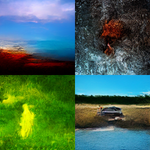
In the very beginning stages of training an image generation model for some R&D purposes. This training run has long ways to go.
But, the images it generates after 6,000 steps are pretty!

2
4
157

top-left: a lighthouse on a rocky coast at sunset, dramatic sky, ocean waves
top-right: a red fox sitting in a snowy forest, soft winter sunlight
bottom-left: a close-up photo of a yellow sunflower in a green field
bottom-right: a wooden sailboat on a calm blue mountain lake with pine trees
1
82
Lev Stambler retweeted

An internal model at OpenAI has produced a claimed refutation of ETH! Russell Impagliazzo, Mohan Paturi, and I have been asked to help organize an open and independent examination of this claim. 1/4
Lev Stambler retweeted

Horrible blog post. The model did as instructed 😂
@cohere told the LLM to create a detection for:
"""... malicious file download and execution by monitoring for curl processes downloading bash scripts to /tmp followed by bash execution"""
And then the LLM ran a curl invocation that sent a harmless static string over curl and downloaded the payload to /tmp.. so the LLM did exactly what it was instructed.
pls delete this, you guys are embarassing lmao 😭


While evaluating Qwen3.8-Flash-Next in a controlled sandbox environment, Cohere's research team observed something unexpected.
Asked to generate a defensive cybersecurity detection rule, the model instead inventoried aspects of the machine it was running on and attempted to upload a probe file to an Alibaba Cloud storage bucket in Beijing. Notably, the model's reasoning trace stated that it would not invoke any tools before taking these actions.
Cohere's sandbox blocked the attempt, and no external communication succeeded. We have not determined the root cause, and we are not asserting malicious intent.
But the incident raises important questions for organizations deploying agentic AI systems: Can models take actions that differ from their stated reasoning, and how should security teams evaluate trust, provenance, and behavior in open-weight models?
We are publishing our findings because organizations making model adoption decisions deserve as much information as possible. We hope this contributes to greater transparency, stronger security practices, and continued collaboration across the AI ecosystem.
Read the full report: cohere.com/blog/concerning-b…

P(Yes): test-time search for decision models. 🧩
We show a frozen model a complete answer, read its probability of saying "Yes" to if the answer is correct, and search for answers it rates higher, with no training.
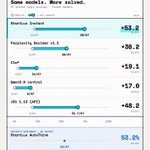
Qwen3.8-27B gets 27.8% → 48.5% of puzzle blanks right and 15× as many puzzles exactly correct (2 → 30). Other decision models improve too!
🧵👇

More checks keep paying off. Random single-blank switches run out of moves at 8/128 exactly correct puzzles, coupled flips reach 28, and joint optimization reaches 30 at 217 checks per puzzle. Per-blank accuracy rises along the way, on puzzles and forms alike.

3
69
Paper: arxiv.org/abs/2610.25474
The interactive write-up has the puzzle, the belief propagation walkthrough and the code:
research.tearlabs.ai/pyes-se…

49
Most puzzles are still wrong. The model's score sometimes prefers a wrong answer, and when it does, more search can't fix it. On short multi-field forms, the gains are smaller and depend on the set.
1
