

Independent research on AI infrastructure, semiconductors & U.S. equities. Following the data, money flows and risks behind the headlines.
Joined September 2022
- Tweets53
- Following7
- Followers82
- Likes27




Jensen Huang Is Back and Nvidia Still Has a Washington Problem
A 31% rebound priced in the founder’s return. The board’s reversal and the December hearings leave investors with a harder question about who shapes Nvidia’s biggest decisions.
Nvidia shares surged 31.48% to $165.05 on November 23 after the company announced that Jensen Huang was returning as CEO. By the November 25 close, the stock was back at $149.30.
The rebound followed a sharp selloff and left Nvidia about 5% below its November 11 close. For StockLong, the price action captures the relief of getting the founder back and the uncertainty investors still face over the conditions of his return.
That uncertainty matters because Washington can influence both the markets Nvidia serves and the people who run it. The question for shareholders is how much confidence to place in the board’s decisions when the White House and Congress are pulling in different directions.
What the rally priced in
Nvidia announced Huang’s departure on November 12, appointed CFO Colette Kress interim CEO and began a search for a permanent successor. On November 17, board chair Harvey Jones publicly ruled out bringing Huang back and said the company had hired Heidrick & Struggles to run the search.
Five days later, the board voted unanimously to reinstate him. Nvidia disclosed the decision on November 23 and said its independent investigation, assisted by outside counsel, would continue.
The board said it had met with Huang and was satisfied with his candor and ability to lead. It also said that input from senior U.S. officials gave it confidence his return posed no national security risk.
The public filing gives directors’ conclusion. It leaves open what information they received and how they tested it before voting. A decision about whether Huang could resume his duties can come before a final investigation report.
The board will still have to explain the basis for that judgment if lawmakers or shareholders press for the record.
Nvidia is incorporated in Delaware, where courts generally presume that directors make business decisions on an informed basis, in good faith and in the company’s best interests. Government input can be relevant to a national security question.
What matters for governance is how the board evaluated it and exercised its own judgment. The public record leaves that process open to scrutiny. Nvidia has created a board committee for national security and export controls and begun recruiting a chief compliance officer, who will report to the nominating and corporate governance committee.
Those measures strengthen oversight. The board’s account of how it reversed course still matters on its own.
There is also a management question. Huang said in a 2024 interview that he had 60 direct reports.
Bloomberg reported that senior leaders were informed of his reinstatement at the last minute, citing people familiar with the decision.
For a company that relies on a flat structure, the practical test is whether the leadership team can execute through the Vera Rubin ramp while responding to lawmakers. The reversal also gives investors little visibility into whom the board could turn to if it needs a successor again.
full research report
stocklong.substack.com/p/jen…
$NVDA $SPY #Stocks

2
1
55
Dell Crushed Earnings Estimates. So Why Is Wall Street Slashing Price Targets? AI’s Credit Risk Is Being Repriced
Dell Technologies ($DELL) delivered a fiscal Q3 2027 earnings report that significantly exceeded Wall Street expectations.
Revenue surged 103% year over year, adjusted earnings per share jumped 265%, and the company substantially raised its full-year revenue and earnings guidance while announcing an additional $25 billion share repurchase authorization.
Yet these impressive results failed to prevent a sharp sell-off. Dell shares plunged more than 10% intraday, while several major Wall Street firms, including Bank of America, Wells Fargo, Deutsche Bank, and TD Cowen, lowered their price targets.
Earnings expectations are rising, but valuations are falling. What explains this striking divergence?
At StockLong, we believe the market is reassessing the sustainability of AI infrastructure earnings, returns on capital investment, and the potential credit risks embedded across the AI supply chain.
full research report stocklong.substack.com/p/del…
$DELL $CRWV #Stocks

1
51
DELL Just Reported a Massive $132.3 Billion AI Server Backlog!
Dell's latest earnings crushed Wall Street expectations:
• Revenue: $54.94B vs. $49.32B expected
• Adjusted EPS: $9.45 vs. $6.59 expected
• AI server backlog: $132.3B
• New AI orders: $60.2B in a single quarter
• FY27 AI server revenue guidance raised to $78B
But one detail stands out.
Dell says it is rigorously screening AI orders based on customers' financial strength and access to capital, land, and power.
This signals a shift in the AI infrastructure boom.
Demand remains enormous, but the industry is becoming more selective about who can actually finance, build, and deploy that capacity.
StockLong's view: I'll be watching three things closely: server deliveries, accounts receivable, and operating cash flow.
If shipments continue accelerating, customer payments keep pace, and networking and storage contribute more to profitability, I'll become increasingly confident that Dell's massive backlog can translate into stronger earnings and cash returns.
The real opportunity lies in how profitably Dell converts those orders into cash.
$DELL $NVDA #Stocks

22
Dell Earnings Preview: HPE Signals a Potential Blowout Quarter, but Wall Street Has a Bigger Concern
Strong AI server demand and aggressive pricing could drive another earnings beat for Dell. However, HPE's latest results expose a growing risk to the sustainability of those profits.
At StockLong, we believe Hewlett Packard Enterprise's (HPE) latest earnings provide an important leading indicator for Dell Technologies (DELL). We are raising our expectations for Dell's upcoming revenue and EPS results while remaining cautious about the sustainability of its longer-term margins.
HPE significantly exceeded both revenue and earnings expectations and raised its FY27 revenue growth outlook from 13–17% to 27–35%, driven primarily by its Cloud & AI business.
Despite these impressive results, HPE shares fell 7%.
The reason is that Wall Street is beginning to recognize a growing contradiction within the AI server industry: rapid revenue growth does not necessarily translate into equally rapid profit growth.
Dell Is Positioned for Another Significant Revenue Beat
Third-party channel checks suggest that Dell is tracking ahead of plan, with AI server revenue expected to exceed its quarterly guidance of $19 billion.
full research report
stocklong.substack.com/p/del…
$DELL $HPE $NVDA
1
30
BREAKING: Trump Wants Jensen Huang Back as $NVDA CEO!
President Trump publicly called for Nvidia to give Jensen Huang a second chance, calling him one of the world's most brilliant minds.
$NVDA $AMD #Stocks
teapaw.org/StockSavvyShay/status/…

President Trump is calling for Jensen Huang to return as $NVDA CEO saying he deserves a second chance.
“If they were smart, they’d take that brilliant man, accept an apology, and let him go back to work.”
1
81
This puts Nvidia's board in an increasingly difficult position.
With Trump, Elon Musk, and prominent investors supporting Huang's return, pressure on the board is mounting.
1
5
Wall Street’s Three-Pronged Short Attack on the AI Supply Chain: A Carefully Orchestrated Hunt
Lip-Bu Tan, Jensen Huang, and Lisa Su — three of Silicon Valley’s most powerful semiconductor CEOs — were thrust into controversy within just two weeks.
$AMD $INTC $NVDA #StockMarket
1
110


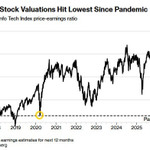
The S&P 500 Info Tech Index (NTM P/E) just hit its lowest valuation since the 2020 pandemic crash, testing that ~16x level (via Bloomberg).
Either earnings estimates are about to get slashed, or Big Tech is on serious sale. #TechStocks $NVDA $AMD

and challenge the directors responsible.
My take: Nvidia's board may have turned a personal scandal into a much bigger corporate governance crisis.
If shareholders believe the board acted out of panic rather than protecting shareholder value,
1
5
the directors themselves could become the next targets.
The question is shifting from whether Jensen should return to whether Nvidia's board deserves to stay.
teapaw.org/BillAckman/status/2123…

I believe the @nvidia board is not acting in the best interest of shareholders nor in a manner consistent with their fiduciary duties.
What we know is that the board fired Jensen or forced his resignation for violating company policy and/or in response to the accusation of an affair with a spy.
They did so without careful consideration of the impact on the company, its customers, its shareholders or other stakeholders.
They rushed to judgment without the benefit of careful due diligence or even with a basic understanding of the facts.
How do we know this?
We know this by how quickly Jensen was fired and how little was known at the time of his firing.
It takes time to convene a board meeting. There was time, maybe, for one Zoom.
And this is a decision that should have been made by a board sitting in person and carefully deliberating the facts once they are known.
And they should have slept on the decision and met again the day after to discuss the facts, the risks and the other implications of their decision.
The timing and lack of information did not allow for careful board deliberation.
While boards can fire a CEO for an inappropriate relationship with a subordinate, it should not be an automatic decision. That is why we have boards comprised of humans and not agents.
A board should consider whether or not such a relationship was consensual or whether it was an abuse of power dynamics. And a board has to consider what the impact of the firing is on all stakeholders.
If I were in this board, I would not have rushed to judgment based on articles in the media. I would have made sure the board had all of the facts so it could make a careful and informed decision.
Boards of Delaware companies have a duty of care which means they must make informed, prudent and good faith decisions. This clearly did not happen here.
What law firm is advising this board?
Or is the board even taken good legal advice?
It doesn’t look like it.
And now the board is compounding its failures by insisting that there is no possibility for Jensen’s return as CEO.
Why is it in the best interest of the company to foreclose the possibility of Jensen’s return and to do so before all of the facts are known? This is yet another breach of their duty of care.
Furthermore, the board has launched an investigation whose scope is unknown. Investigations can be extremely damaging to a company and should be carefully targeted to address whatever facts need to be known rather than be overly broad in scope.
In short, this looks like a series of major governance failures by directors that panicked due to headlines in the media. They likely felt compelled to do something because they were afraid of looking bad in the media, not because it was the right thing for them company.
They couldn’t stand the heat.
The board’s conduct here is shocking for a company of this scale and importance to our country and the world at large, particularly at this moment in history.
6
History made:
• SpaceX IPO: $75B
• Anthropic IPO: $81B
We are officially in the era where foundational AI models command bigger public raises than space exploration.
Next question: How does $GOOG and MSFT trade when their biggest AI bet becomes a standalone mega-cap rival? $ANT

We’ve priced our IPO at $83 per share, with trading expected to begin on Nasdaq tomorrow.
anthropic.com/news/anthropic…
Legal disclaimer: A registration statement relating to the Class A common stock was declared effective by the Securities and Exchange Commission on November 18, 2026. The offering is being made only by means of a prospectus. Copies of the final prospectus may be obtained, when available, from: Goldman Sachs & Co. LLC, Attention: Prospectus Department, 200 West Street, New York, NY 10282, by telephone at (866) 471-2526, or by email at [email protected]; or Morgan Stanley & Co. LLC, Attention: Prospectus Department, 180 Varick Street, 2nd Floor, New York, NY 10014, or by email at [email protected]

62


