

Virgil says ' Timeo Danaos et dona ferentes ', I say I'm a Phlegmatic Perquisite Perjurer following ' La Forza del Destino ' of Verdi !
India
Joined July 2015
- Tweets10.9K
- Following5.8K
- Followers477
- Likes16.1K







Subash S retweeted

🚨 Harvard just made its AI course free.
No tuition.
No application.
Just world-class AI education.
Harvard University just released 6 high-quality lectures on AI + Prompt Engineering— and anyone can access them.
If you're serious about AI in 2026, start here:
🎓 Harvard University LECTURES
1. Introduction to Generative AI
A step-by-step guide to how GenAI actually works.
Link: lnkd.in/e9rWNjBE
2. Prompt Engineering
Real tips for improving output quality from any LLM.
Link: lnkd.in/e5nekvS2
3. Beyond Chatbots: System Prompts, RAG
Move past surface use cases into scalable applications.
Link: lnkd.in/exsX5tP7
4. Generative AI in Teaching & Learning
How educators can adapt and lead with AI.
Playlist: lnkd.in/erdwPRvu
5. Teaching with AI in the Classroom
Frameworks for trainers and educators.
Link: lnkd.in/eWXskwWG
6. The Basics of Generative AI
No jargon. Just clarity.
Link: lnkd.in/eSCJ62Bi
BONUS
🟩 CS50x 2025 – Artificial Intelligence Lecture
LLMs, neural nets, and real-world use cases
Link: lnkd.in/eYg6vdCr
🟩 CS50 Extension – AI / Prompt Engineering
Design prompts that think with you
Link: lnkd.in/eJH4DWQR
🟩 GPT-4: How it works + how to build with it
Behind the curtain on GPT-4
Video: lnkd.in/eeh7QXUM
🟩 LLMs and the End of Programming
Why prompting is the new coding
Video: lnkd.in/e3JbSFi7
---
💡 REALITY CHECK
✅ Harvard-level AI knowledge is now free
✅ Prompting = career acceleration
✅ 2 lectures can put you ahead of 90% of professionals
✅ The future belongs to people who can “talk to machines” strategically
Don’t just consume AI. Learn how to control it.
👇 Which lecture are you starting with?
♻️ Repost to help others learn AI
🔖 Save this (you’ll need it later)
🔔 Follow @razib_ul47671
for more AI insights

Subash S retweeted

You may have heard about the Model Context Protocol and wondered how it lets AI tools connect to other tools, APIs, and systems.
Well, it's all thanks to MCP servers.
In this guide, @manishmshiva explains how MCP servers work and helps you build your own with Python and the FastMCP library.
freecodecamp.org/news/how-to…

Subash S retweeted

Miles 101
> Install Miles
> Run GRPO on NVIDIA Blackwell GPU
> Run open weights on SGLang engine
> Pick a model size that fits training and rollout on one GPU
> Scale and Rollout the size
aiengineeringfromscratch.com…

vLLM 101
> Install vLLM, serve a model
> Predict how many users fit on your GPU
> Pick the one or two flags that matter for your traffic
> Decide from a measurement when speculative decoding, FP8, or a compile level pays
> Debug a slow or broken server
aiengineeringfromscratch.com…
Subash S retweeted

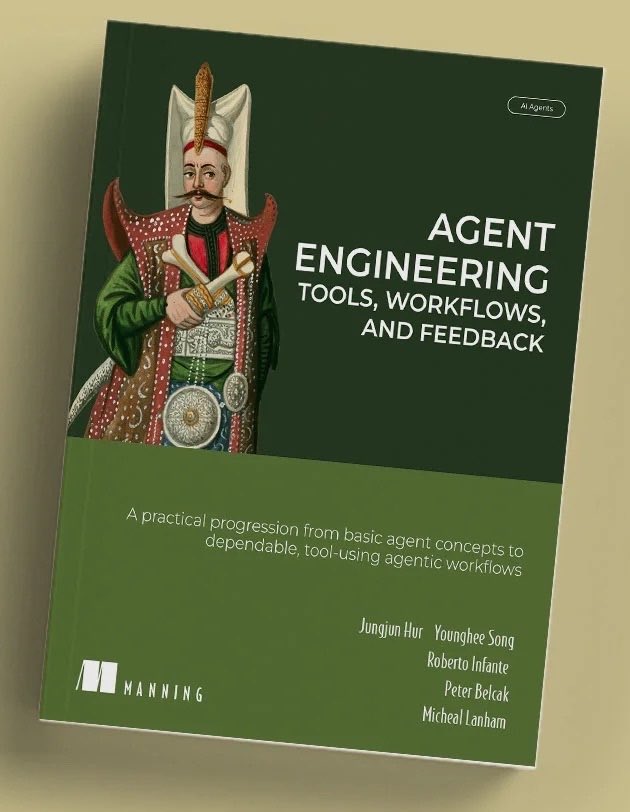
Download the @ManningBooks Agent Engineering ebook for free here: blog.manning.com/free-ebook-…
Subash S retweeted

Karpathy sketched the second brain. these 7 open-source repos already built it for Obsidian + Claude Code
250,000+ GitHub stars between them, and every one is free to clone
sorted by stars:
1. graphify - 134k stars
turns your codebase, docs, SQL schemas and PDFs into one knowledge graph you can query
↳ github.com/Graphify-Labs/gra…
2. Understand-Anything - 88k stars
maps any codebase into an interactive knowledge graph you can click through
↳ github.com/Egonex-AI/Underst…
3. claude-obsidian - 15.8k stars
a second brain that organizes itself: drop in a source, Claude Code files it
↳ github.com/AgriciDaniel/clau…
4. obsidian-second-brain - 4.9k stars
long-term memory for Claude Code, stored as plain markdown in your vault
↳ github.com/eugeniughelbur/ob…
5. mcp-obsidian - 4.5k stars
one MCP server and Claude can read, search and write your whole vault
↳ github.com/MarkusPfundstein/…
6. claudesidian - 2.6k stars
a starter vault designed around Claude Code from the first note
↳ github.com/heyitsnoah/claude…
7. second-brain - 756 stars
an Obsidian wiki the model keeps up to date, built on Karpathy's LLM Wiki pattern
↳ github.com/NicholasSpisak/se…
where to start:
> your knowledge lives in code -> graphify
> your knowledge lives in Obsidian -> claude-obsidian
> you just want Claude to remember -> obsidian-second-brain
> you live in Claude Desktop -> mcp-obsidian
the skills that sit on top of all seven are in the full map below ↓


Subash S retweeted

YOU DON'T NEED EXPENSIVE SOFTWARE TO EDIT VIDEOS.
These 5 open-source tools can help you cut clips, edit videos, create 3D content, and even automate your editing workflow.
1. LosslessCut
Trim videos without re-encoding.
github.com/mifi/lossless-cut
2. Shotcut
A full-featured video editor for multiple platforms.
github.com/mltframework/shot…
3. Palmier Pro
Explore AI-powered video editing with MCP workflows on macOS.
github.com/palmier-io/palmie…
4. Blender
Create 3D animations and edit videos in one place.
github.com/blender/blender
5. Editly
Generate videos programmatically with FFmpeg, transitions, and subtitles.
github.com/mifi/editly
Whether you're making content for social media or building automated video pipelines, there's something here worth exploring.
No expensive subscription required to get started.
🔖 Bookmark these tools for your next video project.

Subash S retweeted

Turn a new client's yes into a welcome email the same day, with every question they asked either answered from your own files or marked for you to answer.
On a made-up test folder, a flower shop said yes to a Christmas shoot and asked two things, what the photographer needs from her before the shoot and whether she can bring the flowers that morning.
Neither answer was in the files, so it wrote [ASK ME] twice instead of making something up.
It also saw that the planning call and the shoot were already in the calendar, and said not to add them twice.
This is the kind of work that used to need someone on staff, and the article below is about the setup that does it now.


Subash S retweeted

A counterintuitive insight about LLM inference:
LLM inference can get faster even when every GPU operation takes exactly the same amount of time.
The improvement can come entirely from reducing the time between operations.
An LLM forward pass appears to be one computation.
But on the GPU, it becomes a sequence of smaller operations for attention, matrix multiplication, normalization, sampling, and data movement.
The CPU usually prepares and submits these operations individually.
That overhead is small for one launch. But token-by-token decoding repeats a similar sequence for every generated token.
Some kernels complete in only a few microseconds. The GPU can finish one operation before the CPU has submitted the next.
The resulting gaps contain no useful model computation, and the profiler shows the GPU waiting for its next work.
This means optimizing inference is not always about accelerating the kernels themselves. Instead, sometimes the larger opportunity is removing the empty waiting time between them.
CUDA Graphs are designed for this situation.
A CUDA Graph is a saved execution plan containing a sequence of GPU operations and their dependencies.
The application first runs a warm-up pass. This handles one-time initialization and establishes the shapes, buffers, kernels, and memory addresses required by the workload.
The runtime then captures the operation sequence as a graph.
Later iterations can replay the entire graph through one launch instead of submitting every operation separately.
Replay does not reuse an earlier output.
New input is placed into the expected buffers. The GPU runs the captured operations again and produces a new result.
The computation remains almost the same. What changes is how efficiently that computation reaches the GPU.
This works particularly well during LLM decoding because every step processes a new token while following a largely repeated execution path.
The tradeoff is reduced flexibility.
A captured graph expects compatible operations, tensor shapes, control flow, and memory addresses across replays.
Real inference traffic rarely has one fixed shape. Batch sizes change, requests enter and leave, and servers switch between prefill and decoding workloads.
Serving engines often capture several graphs for common execution shapes. Other requests can be padded to a captured size or handled through eager execution.
More captured shapes improve coverage, but consume additional GPU memory and increase startup work.
CUDA Graph replay is useful because it optimizes something kernel benchmarks can easily hide: the cost of repeatedly asking the GPU to begin its next piece of work.
The visual below shows how warm-up, capture, and replay remove that repeated launch path.
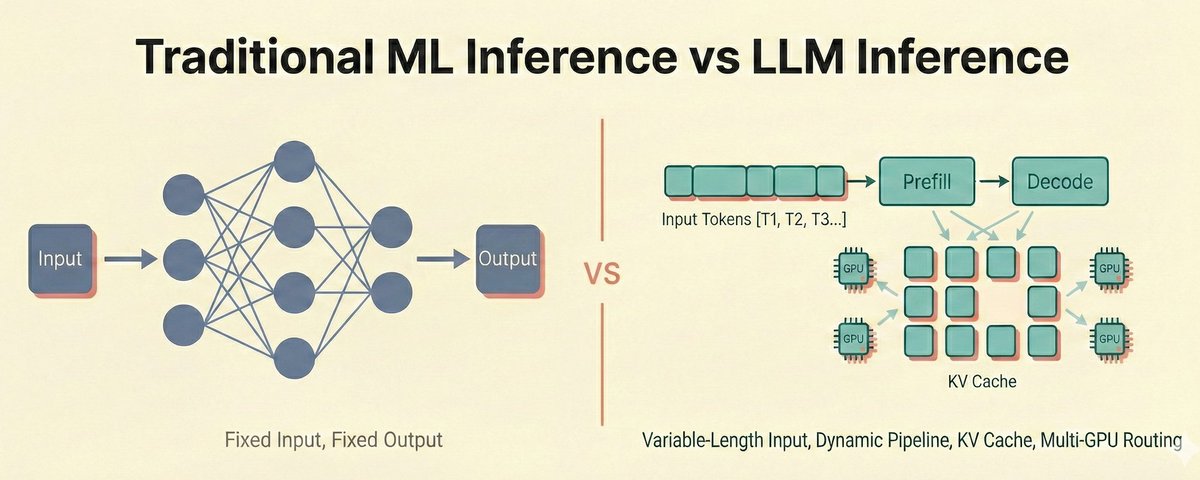
This is one reason LLM inference needs a specialized serving engine rather than a standard prediction API.
I also wrote an article that explains five architectural differences between traditional ML inference and LLM inference.
Read it below.

Subash S retweeted

Banger guide by Anthropic.
While frontier models have improved at context management, subagents still help in some cases (e.g., parallelizing research tasks with their own context windows).
I still use them, but mostly for complex research work via dynamic workflows and /goal.
For most agent workflows, folding subagents into the main loop via tool calls and skills makes a ton of sense (as Anthropic recommends). That's because newer models are more persistent and better at managing large contexts. Subagents might be getting in the way now, since models can handle much of what subagents were used for. I see a similar pattern with memory (another day).
But you can't just get rid of subagents if you have been using them extensively. You need to run evals (cost, efficiency, etc.) and let that help you determine whether to fold them (and how) into the main agent loop.
The evals should always inform your strategy.
But keep in mind issues that can arise when scaling agent work, such as too many tool calls, context bloat, and unclear separation of concerns. Subagents are still very useful for that.
Lastly, all of this is constantly evolving as frontier models improve. Always keep an open mind and regularly test/eval your workflows and harnesses.


Anthropic is now recommending that companies REMOVE unnecessary subagents from their AI systems.
This is a pretty significant shift in agent architecture, with their team finding that a single agent equipped with skills can frequently outperform complex multi-agent systems, and one customer seeing roughly 2x faster execution.
The emerging rules of thumb:
→ Skills: Teach the agent HOW to do something, including procedures, expertise, and instructions.
→ Tools / MCP: Give the agent the ability to DO things through APIs, actions, and live data.
→ Subagents: Use for parallel work, isolated context, or tasks a single agent struggles with.
The interesting part is progressive disclosure. Instead of spawning specialized agents or stuffing everything into a giant prompt, one agent discovers and loads skills and tools as needed.
Their advice is to fold existing subagents into the main loop, turn their instructions into skills, expose their actions as tools, and run evals to see if performance holds up.
As models have gotten smarter, improving agent architecture is becoming less about what you can add and more about what you can delete.
claude.com/resources/article…

Subash S retweeted

University of Texas paper finds that handing small memory decisions to a fast scoring model let an AI memory system build its memory of long conversations 6.6 times faster
Many memory systems ask an LLM to make small choices, like what to link or when to stop searching.
Generating text for each choice is slow, and those calls pile up during memory building and search.
Jev-Mem gives those choices to a fast scorer, Jev, that returns probabilities in batches instead of text. The LLM is called only at the end, to read the chosen memories and answer.
On the LoCoMo long-conversation benchmark, it got a 0.777 answer score versus 0.700 for the best baseline. It built memory in 158 seconds versus 1,044 for the fastest rival and answered in 0.93 seconds versus 1.47.
If your memory pipeline calls an LLM for routing, scoring, or stopping, try a fast classifier there and save the LLM for answers.

Subash S retweeted

I built a full engineering team with Grok Bot.
Here are the roles, tools, and handoffs you can replicate:
(bookmark it)
The goal was to give one project manager a feature request and let it coordinate the backend, frontend, and testing.
Here’s how I divided the work.
→ Piper, the project manager. Breaks features into tasks, tracks dependencies, and reviews each handoff before the next agent starts.
→ Bay, the backend developer. Owns the database, APIs, and server logic, then documents what the frontend can call.
→ Fin, the frontend developer. Builds the interface against Bay’s documented contract and flags missing details instead of guessing.
→ Tess, the tester. Verifies the requirements, records defects, and sends them back to the agent responsible.
Four roles give planning, backend work, frontend work, and testing clear owners. Keeping the team small also limits the handoffs.
All four share a cloud computer. Tasks, project context, and handoff notes live in files, so each agent can read what the previous one built.
Only Piper updates the board, preventing competing edits. Every handoff includes file paths, interface details, decisions, and unfinished work.
That gives you a repeatable workflow. The manager coordinates the work, the specialists deliver it, and you step in for decisions that need your input.
For the backend, Bay uses InsForge, an open-source platform with Postgres, authentication, storage, and functions.
I chose it because its command line lets Bay inspect the current backend setup and provision what the project needs.
InsForge on GitHub: github.com/InsForge/InsForge
(don’t forget to star 🌟)
The article quoted below covers the setup and prompts, plus a hands-on example showing everything in action. Read it to build your own team.


Subash S retweeted
AI apps get way more powerful when multiple agents can collaborate and specialize.
Especially when you understand agent design and inter-agent communication.
Here, Balajee goes over how to build a multi-agent AI system in Python, containerize it with Docker, and deploy it in a scalable environment.
freecodecamp.org/news/build-…


Subash S retweeted

Most developers know Kafka as a messaging system, but few truly understand how to leverage its full power in event-driven architectures.
Kafka isn’t just about producing and consuming messages. It’s the backbone of scalable, fault-tolerant, and real-time systems used by some of the biggest companies in the world.
Here’s a breakdown of five key Kafka patterns that every engineer should know:
1. Centralized Log Management – Stream logs from multiple applications into Kafka for long-term storage and analysis.
2. Real-Time Data Distribution – Publish data to multiple consumers efficiently using Kafka’s pub/sub architecture.
3. Seamless Log Replication – Ensure consistency across distributed systems by replicating and replaying log changes.
4. Multi-Stage Event Processing – Process event streams in multiple stages for real-time pattern detection and analytics.
5. Advanced Event Workflow Automation – Automate workflows by detecting and analyzing event patterns in real time.
Mastering these patterns can help you design scalable, event-driven architectures that power real-world applications.
Save this post for future reference.
Share it with someone preparing for system design interviews or working with event-driven systems.
Which Kafka pattern have you used the most? Let’s discuss in the comments.
P.S. Preparing for a software engineering role? Check out my book, System Design and Behavioral Intelligence.
It will help you:
• Build strong System Design foundations and approach design problems with confidence
• Develop practical frameworks to navigate complex behavioral and leadership challenges
Get Your Copy anywhere internationally:
US: lnkd.in/eVy2ACxQ
UK: lnkd.in/evzmHKm4
India : lnkd.in/e25PthqU

Subash S retweeted

Mathematics of Deep Learning — Free PDF (333 Pages)
Want to understand the mathematics behind deep learning?
Explore Mathematics of Deep Learning: An Introduction, a De Gruyter textbook that introduces the mathematical foundations behind modern deep learning techniques.
What you can learn:
Mathematical foundations of deep learning
Linear algebra and matrix operations
Calculus and optimization concepts
Neural networks and their mathematical principles
The theory behind modern AI models
Perfect for students, researchers, data scientists, and machine learning enthusiasts who want to strengthen their mathematical understanding of AI.
333 pages of learning
Read more and access the resource:
clcoding.com/2026/08/mathema…

Subash S retweeted

this is f*cking gold.
A guy who shipped 100+ apps and about 6M organic downloads before AI just wrote the exact path he'd follow if he was starting today.
He's been building apps since 2009, and the thread is basically every mistake non-technical people make before their first app even exists.
And step one isn't even building the app. It's a quick web version you test with real people for 1 to 2 weeks.
→ Pick a category someone already validated and find your angle. The demand, the pricing and the complaints are already out there
→ Give the web prototype 2 days, then spend a week with real users before you touch a real app
→ Map the app flow by flow on paper first (onboarding, sign up, payments, the core) and write the spec with Claude
→ Pick a builder where you plug in your own Claude and keep your code, so you're not paying credits forever
→ Build one flow at a time, never the whole app in one prompt, and expect about 30% of your time on debugging
I run a mobile app studio, and honestly this is where most first apps die. Prompting the whole app in one go feels amazing for a day. Then you spend weeks fixing it.
If you're building your first app this month, go slow, build one flow at a time, and get it in front of 5 or 6 people on TestFlight before you launch.
Full post below.

Subash S retweeted

Your AI agents can remember your whole business.
Here's how to build that with Hermes + Antigravity 2.0.
→ Use Antigravity 2.0 to manage your agents.
→ Use Hermes to run your tasks.
→ Use Obsidian to store your business memory.
→ Add skills, goals, and projects inside Agent OS.
→ Connect everything into one daily setup.
Now your agents can work with your business details instead of starting from zero.
Save this video, you'll have the steps to build your own Agent OS.
Want the SOP? DM me. 💬
Subash S retweeted
THIS IS SHOCKING!
10 GITHUB REPOS LET YOU SEE WHAT HAPPENS BEHIND THE CODE.
These tools help you reverse-engineer binaries, inspect running apps, analyze network traffic, and uncover how software works internally.
1. Ghidra
Reverse-engineer compiled software and analyze binaries.
github.com/NationalSecurityA…
2. JADX
Turn Android APKs into readable, Java-like source code.
github.com/skylot/jadx
3. Fride
Inspect running apps and observe how their functions behave.
github.com/frida/frida
4. mitmproxy
Capture and inspect HTTP traffic between applications and servers.
github.com/mitmproxy/mitmpro…
5. ILSpy
Decompile .NET applications and explore their C# logic.
github.com/icsharpcode/ILSpy
6. APKTool
Decode Android app resources and inspect Smali code.
github.com/iBotPeaches/Apkto…
7. Sourcegraph
Search massive codebases and trace functions and dependencies.
github.com/sourcegraph/sourc…
8. Semgrep
Find bugs and risky code patterns with customizable rules.
github.com/semgrep/semgrep
9. Tree-sitter
Parse code into syntax trees for deeper analysis and navigation.
github.com/tree-sitter/tree-…
10. Binwalk
Analyze firmware and uncover files hidden inside binary images.
github.com/ReFirmLabs/binwal…
The interesting part?
You don't have to treat software like a black box anymore. These tools help you explore what's happening under the hood.
Bookmark this list. Your next deep dive into software starts here.

Subash S retweeted
Mathematics algorithm SVM (Support Vector Machine) is a classic nonlinear classifier in Machine Learning.
Download 640-page PDF "Learning with Kernels: Support Vector Machines, Regularization, Optimization, and Beyond" here: mcube.lab.nycu.edu.tw/~cfung…

