Cofounder & CFO @defidevcorp. Ex-Goldman, Binance, Kraken. Views are my own. Not financial or tax advice.
New York
Joined April 2025
- Tweets406
- Following205
- Followers361
- Likes2.1K
Hi there - I'm John, CFO of DFDV. I've spent half my career in crypto (Binance, Kraken) and half in TradFi (Goldman Sachs TMT equity research, then hedge fund and long-only public equity investing), I write about thoughts and experiences across both halves here.
These are my personal thoughts, usually with a chart. I try to be analytical without being hard to read. Sometimes it's a niche corner of the market, sometimes it's the story of the week.
Had fun chatting with friends about Solana’s tokenization boom, $CHAD at par, and why Bitcoin barely flinched at a $6.3B hack.
Block Time Ep. 1 is live. Give it a watch 👇
BLOCK TIME EP. 1 IS LIVE! 🎬
Introducing Block Time, $DFDV’s new series breaking down the biggest developments across crypto, capital markets, AI, & the broader economy.
In our inaugural episode, @pete_humiston, @joseph_onorati, @SumBasis, and @TheOtherParker_ tackle:
🔸 Solana’s tokenization boom and why $SOL’s price isn’t reflecting network fundamentals
🔸 $CHAD reaching $10 par just 48 days after its trading debut
🔸 The $6.3B Binance hack and Bitcoin’s surprisingly muted reaction
🔸 The AI sell-off, global liquidity, and what could drive Bitcoin’s next move
🔸 U.S. midterms, the four-year crypto cycle, and what’s next for markets
⏱️ TIMESTAMPS
00:00 Episode Highlights
00:33 Introduction
01:22 Solana’s Tokenization Boom
03:24 Tokenization & Global Market Access
06:40 Who Wins the RWA Race?
10:13 DeFi’s Next Wave of Innovation
11:54 Solana Fundamentals vs. SOL Price
14:34 CHAD Reaches Par & Digital Credit
18:42 The $6.3B Binance Hack
22:15 Crypto’s Growing Resilience
24:20 AI Sell-Off & Crypto Outlook
25:31 Liquidity & Bitcoin’s Next Move
31:37 Midterm Elections & Market Predictions
34:10 Closing Remarks
Watch the full episode. 👇
Five years ago I would not have guessed this. Stripe can now pay people in more countries with a stablecoin than with a regular bank payout.
More than 160 of them.
teapaw.org/WatcherGuru/status/211…
This morning the U.S. Treasury nearly doubled its bond buyback plan: up to $70 billion for liquidity support in the coming quarter, up from $38 billion. If your cash sits in a money fund or a stablecoin, this is the plumbing under it.
Some thoughts on the Treasury's quarterly refunding.
Four times a year the Treasury says how much it will borrow and in what form. Today it set $125 billion of notes and bonds for mid-November, about $28 billion of it new cash.
Since April 2024 the program has bought back $516 billion of older bonds.
The rest of this quarter's borrowing comes from T-bills, and the statement points to growing private demand for them. T-bills are what money funds and stablecoin reserves hold. Tether alone reports $132.4 billion of them, about what South Korea holds in Treasuries. So the bill supply set here shapes what your cash earns.
Watch February 3, 2027, when the next sizes land.
TL;DR: The Treasury raised its buyback plan to $70 billion and set a $125 billion refunding, and since T-bills back money funds and stablecoins, this shapes what your cash earns.
Just the beginning 💪
Tokenized stocks traded on Solana in 2026 so far: $21.2B. 🚀
That's 6.2x the total for all of 2025, with two months left.
source: stateofsol.com
Mastercard letting AI agents pay for things in stablecoins is the line on this list I keep rereading.
The web set aside a payment code in 1999. It took a program with a wallet to finally use it.
teapaw.org/base/status/2117693841…

ALT Two tiles: 1999, the year the web reserved status code 402 for payments and left it unused, and 2025, the year a server first answered 402 with a stablecoin price and was paid in the same request through Coinbase's x402, which had 40 member organizations in its Linux Foundation group by April 2026.
The Base ecosystem ships hard
Here are 25 things that launched and got announced in October
1) @mastercard launched Agent Pay for Machines with Cloudflare. Enabling AI agents to pay for digital services using x402 on Base
2) @cloudflare opened its Monetization Gateway on Base. Letting APIs charge agents per request with settlement in USDC
3) @bitso launched Bóvedas on Base. Enabling users access to DeFi tools on MXNB and USDC, powered by @morpho and curated by @gauntlet_xyz
4) @pendle_fi launched PendleLoop on Base. Users can loop long Coinbase Tokenized Stocks on @aave markets and claim incentives on @merkl_xyz
5) @onepay now lets users send USDC straight into their Checking balance on Base. People who get paid in stablecoins can spend or send that money without first routing it through an exchange
6) @ripple launched RLUSD on Base. Ripple is providing liquidity so users can hold and move the stablecoin on Base
7) @openstandard launched OUSD on Base. Users get 1:1 USD conversion paths through Coinbase, Mastercard, Stripe, and Visa integrations
8) @itstuyo rebuilt its entire app. The new Tuyo matches bigger ambitions for banking, with a full redesign now live on Base
9) @dyli_io launched on Base. Collectors can rip packs, trade collectibles, vault favorites or have them shipped, with a refreshed pack experience now live
10) @thunespayments is integrating stablecoins across its global payout network on Base. Letting businesses send and receive cross-border stablecoin payouts
11) @marqeta is bringing stablecoin-backed cards to enterprise customers, with settlement on Base. Giving companies a way to issue cards funded by stablecoins for spending
12) @atomhq now supports stablecoin checkout and seller payouts on Base. Users can now access over 2 million domains with stablecoins
13) @smbcnikko_jp is building an institutional DeFi Gateway for Japan on Base. Opening a regulated path for Japanese institutions into DeFi
14) Yuno added stablecoin payments acceptance on Base. Merchants can enable one-click stablecoin checkout without new rails or extra integration work
15) @superformxyz brought SuperNVDA and SuperTSLA to Pendle on Base. Holders can lock in fixed yield, earn rewards, or position for yield upside on tokenized stocks
16) @birchhill_io launched the Groma Ecosystem Vault on Base. Users can lend USDC backed by Boston and Providence apartment buildings
17) @falconxglobal's USDC credit facility is live on Base. Lenders deposit native Base USDC to generate returns from institutional credit
18) Gennius is bringing digital-asset services to LatAm banks with Coinbase, starting in Argentina. Banks can convert eligible deposits into ONED USD, transfer 24/7, and enable Visa spending
19) @torosfinance launched Toros Options on Base. Users can trade over BTC, ETH and more asset options with cashback, and positions are tokenized on Base
20) @exa_app launched the first credit card backed by Coinbase Tokenized Stocks. Enabling users link a Coinbase account and spend against tokenized stock collateral
21) @lucamoneyapp extended its app to tokenized stocks on Base. Letting people in LATAM access them through the same simple digital-dollar experience
22) @zothdotio launched zMAG7 on Base. One stablecoin deposit holds equal-weight AMZNc, AAPLc, NVDAc, GOOGLc, METAc, MSFTc and TSLAc, backed by real shares in regulated custody
23) @mochatradeapp received its full $500K YC investment in USDC on Base
24) @credifi launched Credifi Zero. Anons and agents can qualify for credit with zero personal info
25) @opensea opened OpenSea Mobile to everyone. With new trade options, including memes, art, trading cards and perps on Base from one app
You make about 1.5 payments a day. One AI agent in 2029 is forecast to take 217 actions a day, and they are starting to carry payments.
Some thoughts on who does the paying next.
The average U.S. consumer makes 47 payments a month, about 1.5 a day. Coffee, groceries, a bill.
AI agents pay less today. All the agents on Coinbase's x402 rail made 138 million payments in their first year, about 378,000 a day. A city of 250,000 people makes more.
IDC forecasts over 1 billion active agents by 2029, 40 times the 2025 count, taking 217 billion actions a day, 217 per agent.
And agents pay agents. Forty times the agents is 1,600 times the pairs that can transact.
An agent pays per call. Nine in ten x402 payments are under a dime. A card cannot carry a three-cent payment. A stablecoin can.
It matters because the payer of the next decade may not be a person. Watch the payment count before the dollar volume.
TL;DR: A person makes about 1.5 payments a day, IDC forecasts 217 actions a day per AI agent by 2029 across more than a billion agents that increasingly pay each other, and the rail that can carry a three-cent payment is the stablecoin.
The future of finance doesn’t wait 90 days for payday. Daily dividends just hit different.
I keep coming back to the hours. Hong Kong's banks can now settle with each other at any hour of the week, in central bank money. The dollar's own rail still shuts for 58 hours a week. That is the kind of thing a corporate treasurer notices.
teapaw.org/WatcherGuru/status/211…
If intelligence were a token, it would be down 99.65% in two years.
Some thoughts on what gets expensive when intelligence gets cheap.
Stanford's AI Index tracked the price of an AI model that scores like GPT-3.5 on a standard knowledge test. In November 2022 it cost $20 per million tokens. By October 2024 it cost 7 cents. That is a fall of more than 280 times, and it matters for your career, because when one input gets that cheap, the money moves to whatever stays scarce.
Half my career was in TradFi, starting in equity research at Goldman, and the analysis was never the scarce part. I think three things get more expensive from here: judgment about which of the model's answers to act on, a name people trust when the facts are contested, and an audience that listens.
Each time the model you use at work gets cheaper, the hours you put into those three are worth more.
TL;DR: The price of GPT-3.5-level AI fell from $20 to 7 cents per million tokens in two years, so the career value moves to judgment, trust and an audience.
Day by day, week by week, brick by brick 🧱
Today, $DFDV added 5,336 $SOL to our treasury, bringing total holdings to ~2,600,948 SOL and taking us past 2.6M SOL.
$CHAD's 14% annual dividend rate also takes effect today, paying $1.40/share annually every business day.
Full announcement 👇
globenewswire.com/news-relea…
Ray Dalio (@RayDalio) wrote this in January 2021, after years of public doubt.
The invention he means is money with a fixed supply that nobody can change: 164,250 new coins a year, 0.83% of supply, with the next halving in 2028. That rule is why 13 U.S. ETFs could be built on it.
Separate the invention from the price, and judge the invention by who builds on it.
I check this chart every month and it keeps getting better. Seven straight months as the top chain for app revenue. People pay to use Solana, and we build where people pay.
October is in the books, and $SOL apps out-earned every other chain yet again.
🔸 $147M in app revenue
🔸 1.7x Ethereum
🔸 37% of all app revenue, the highest share since January
🔸 #1 for 7 straight months
Track it all and more 👇
stateofsol.com
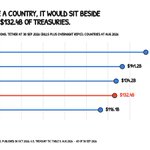
Tether now holds about as many U.S. Treasury bills as South Korea holds Treasuries: $132.4 billion against $134.2 billion. A stablecoin has become one of Washington's bigger lenders, and its customers are people who just want dollars.
Some thoughts on a stablecoin issuer as a Treasury buyer.
The new report from Tether (@Tether_to), attested by BDO, covers 30 September. The $132.4 billion is $122.8 billion of bills held directly plus $9.5 billion through overnight loans. The Treasury's latest table has Saudi Arabia at $141 billion and the United Arab Emirates at $116 billion. Those country figures are from August and cover all maturities, so read this as scale.
Countries decide at meetings. Tether's demand arrives one phone at a time, from people abroad who want dollars. Its reserve buffer also nearly doubled in the quarter, to $7.95 billion from $4.1 billion.
Watch 18 November, when the Treasury's September table gives a same-date comparison.
TL;DR: Tether reports $132.4 billion of Treasury exposure at 30 September, close to South Korea's $134.2 billion, and that buyer grows with every digital dollar bought abroad.
Satoshi posted this on a forum in February 2009, a month after the first block.
The market's answer turned out to be trust you can check. Tether reported more than $122 billion of Treasuries held directly for 2025, and the GENIUS Act now requires one-to-one reserves from every permitted issuer.
When you hold a dollar token, read the latest reserve report. It takes two minutes.