

The Chinese Learning App That Makes You Speak Download now: https://xitter.cf/t.co/ozYYZ1iDM9
Shanghai
Joined September 2018
- Tweets1.4K
- Following447
- Followers6.4K
- Likes1.4K


In Chinese, Mastercard is 万事达卡 (Wàn Shì Dá Kǎ)
The name 万事达 (Wàn Shì Dá) is actually a brilliant translation.
万 (Wàn): Ten thousand / All
事 (Shì): Things / Matters
达 (Dá): Reach / Accomplish
So 万事达 literally means "Everything is achievable" or "Ten thousand things reach." It sounds like a magical card that lets you do anything. The Chinese name is much more poetic and lucky-sounding than the English name!
And 卡 (Kǎ) simply means Card!
So, while "Mastercard" in English sounds like a "Boss Card," in Chinese, it sounds like a "Lucky Card that gets everything done." Both are pretty cool, right?

Instead of falling in love, spend that time learning Chinese.
Send this to someone who should learn Chinese.

If you can tell these 2 characters apart at a glance, you're a pro Chinese learner.
未 (wèi), not yet, vs 末 (mò), end.
Six levels, easy to hard:
1. 大 (dà) vs 太 (tài)
2. 日 (rì) vs 目 (mù)
3. 买 (mǎi) vs 卖 (mài)
4. 土 (tǔ) vs 士 (shì)
5. 己 (jǐ) vs 已 (yǐ)
6. 未 (wèi) vs 末 (mò)
Which level did you stop at?

Answers:
1. 卖 (mài), sell. Sell 卖 (mài) wears a 十 (shí) on its head. Buy 买 (mǎi) does not.
2. 受 (shòu), to receive. 爱 (ài) has 友 (yǒu), friend, at the bottom. 受 (shòu) has 又 (yòu), again.
3. 夏 (xià), summer. 夏 (xià) starts with a flat line on top. 复 (fù) starts with a slanted stroke.
4. 士 (shì), scholar, soldier. Earth 土 (tǔ) has the longer line at the bottom. 士 (shì) has it on top.
5. 己 (jǐ), self. 己 (jǐ) is open at the top. 已 (yǐ) is half closed.
6. 未 (wèi), not yet. 未 (wèi) has the shorter line on top. 末 (mò) has the longer line on top.
How many did you get right?
Many Chinese parents rarely say “I love you.” They say these 6 things instead.
好好吃饭 (hǎohǎo chīfàn) = eat a proper meal, said at the end of almost every phone call home
多穿点 (duō chuān diǎn) = wear more, said when the weather turns, right before you walk out the door
注意身体 (zhùyì shēntǐ) = pay attention to your health, said when you are busy, sick or working too hard
早点回家 (zǎo diǎn huí jiā) = come home early, said as you head out, with dinner already waiting
早点睡 (zǎo diǎn shuì) = go to bed early, said when they know you are up late working or studying
好好照顾自己 (hǎohǎo zhàogù zìjǐ) = take good care of yourself, said at goodbyes, when you move away or leave on a trip
What does your family say instead of “I love you”?

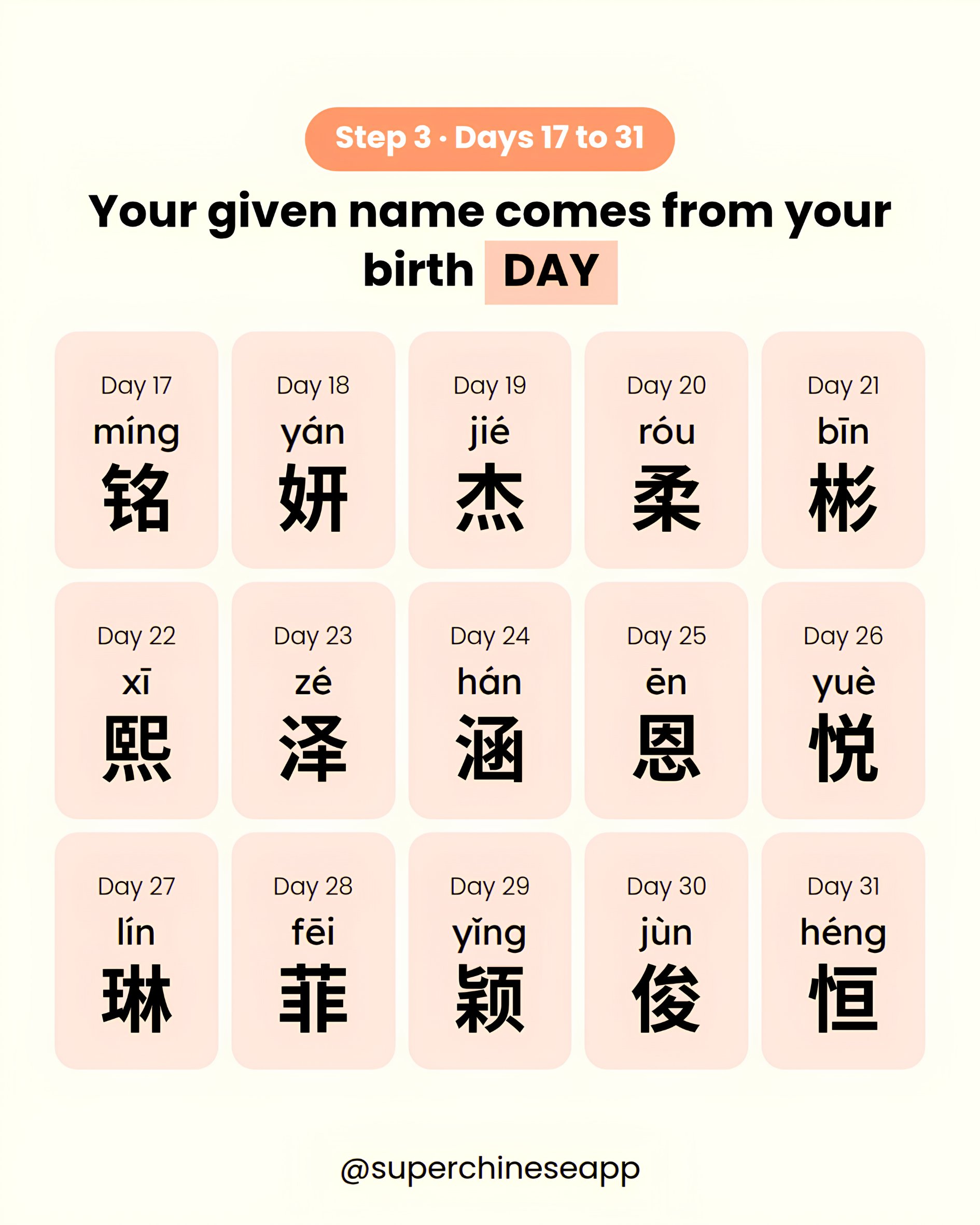
What would your Chinese name be if it came from your birthday?
1. Surname = last digit of birth year (or pick your lucky number)
2. Middle character = birth month
3. Given name = birth day
Example: born on 24 February 2001 = 王 (Wáng) + 梓 (Zǐ) + 涵 (Hán) = 王梓涵 (Wáng Zǐ Hán).
Tables in the images.
Comment your Chinese name below.
Just for fun! For a name you will keep, ask a Chinese friend to choose one for you.


4 things you should never give Chinese people as a gift. The first one is a clock.
送钟 (sòng zhōng), give a clock = 送终 (sòng zhōng), attending a funeral.
Same problem:
伞 (sǎn), umbrella = 散 (sàn), to separate
分梨 (fēn lí), share a pear = 分离 (fēn lí), to separate
四 (sì), four = 死 (sǐ), death
Which one would you have given by mistake?

Do you say 我不能听懂 (wǒ bù néng tīng dǒng)? It actually means "I'm not allowed to understand it." Native speakers say 我听不懂 (wǒ tīng bu dǒng): "I can't understand it."
The trick is to put 不 between the verb and its result. Five more:
我不能睡觉 → 我睡不着 (I can't fall asleep)
我不能吃完 → 我吃不完 (I can't finish it)
我不能买 → 我买不起 (I can't afford it)
我不能记得 → 我记不住 (I can't remember it)
我不能看清楚 → 我看不清 (I can't see it clearly)
Which one have you said the beginner way?

There's no single English word for 心疼 (xīn téng), feeling pain in your heart for someone you love.
Five more, all picked from your comments on part 1:
敷衍 (fū yǎn): doing something just to get it over with.
羡慕 (xiàn mù): wishing you had what someone else has, without resentment.
热闹 (rè nao): the warm buzz of a place full of people.
孝顺 (xiào shùn): respecting and caring for your parents.
乖 (guāi): well-behaved, listens, and easy to love.
Which one would you add to English?

The Chinese you learn in class vs the Chinese people actually say.
It's not either/or. Class Chinese is used every day too. Here are a few more ways people say the same things:
什么 → 啥 (What)
为什么 → 为啥 (Why)
怎么 → 咋 (How)
你怎么了? → 你咋啦? (What's up with you?)
等一下 → 稍等 (One moment, please)
对不起 → 抱歉 (Sorry (more formal))
我想要一杯咖啡 → 来杯咖啡 (A coffee, please)
我同意 → 有道理 (That makes sense)
Which one have you heard the most?

You've been saying hello wrong in China. Here are 5 greetings people actually use.
吃了吗 (chī le ma): Have you eaten?
去哪儿 (qù nǎr): Where are you going?
早 (zǎo): Early.
在干嘛 (zài gàn má): What are you doing?
嗨 / 哈喽 (hāi / hā lóu): Hi / Hello.
In your language, do you greet people with a question too? Tell us yours.

One Chinese character, two sounds.
行 is háng in 银行 (bank) and xíng in 旅行 (travel).
长 is cháng in 长城 (Great Wall) and zhǎng in 长大 (grow up).
还 is hái in 还是 (or, still) and huán in 还钱 (pay back).
乐 is lè in 快乐 (happy) and yuè in 音乐 (music).
重 is zhòng in 重要 (important) and chóng in 重新 (start over).
好 is hǎo in 好吃 (tasty) and hào in 爱好 (hobby).
Which one tripped you up?

English has no single word for food that makes you eat more rice.
Chinese does: 下饭 (xià fàn).
麻辣 (má là) is numbing and spicy.
香 (xiāng) is smells and tastes good.
过瘾 (guò yǐn) is deeply satisfying.
清淡 (qīng dàn) is light, and a compliment.
What's your 下饭 dish?

One wrong tone and your mom becomes a horse.
妈 (mā) is mom. 马 (mǎ) is horse.
买 (mǎi) is buy. 卖 (mài) is sell.
水饺 (shuǐ jiǎo) is dumplings. 睡觉 (shuì jiào) is sleep.
汤 (tāng) is soup. 糖 (táng) is sugar.
请问 (qǐng wèn) is "may I ask." 请吻 (qǐng wěn) is "please kiss."
Which one have you made?

English: aunt, uncle. That's two words.
Chinese: ten. You need to know the side of the family, and who is older.
- 伯伯 (bó bo) and 伯母 (bó mǔ): your father's older brother, and his wife.
- 叔叔 (shū shu) and 婶婶 (shěn shen): your father's younger brother, and his wife.
- 姑父 (gū fu) and 姑姑 (gū gu): your father's sister, and her husband.
- 舅舅 (jiù jiu) and 舅妈 (jiù ma): your mother's brother, and his wife.
- 姨父 (yí fu) and 姨妈 (yí mā): your mother's sister, and her husband.
How many do you have?

Every Chinese learner in China has heard these.
你中文说得真好!(nǐ zhōngwén shuō de zhēn hǎo)
"Your Chinese is so good!"
You: I only said hello.
你会用筷子啊!(nǐ huì yòng kuàizi a)
"Wow, you can use chopsticks!"
You: I have used them for years.
我们说英语吧。(wǒmen shuō Yīngyǔ ba)
"Let's just speak English."
You: but I wanted to practice.
Which one have you heard the most?

In China, a phone number can cost more than a car. One ending in five 8s sold for about US$325,000.
The number 4 can ruin your day. And 520 means "I love you."
It is all about how they sound:
8 (bā) sounds like 发 (fā), "get rich."
4 (sì) sounds like 死 (sǐ), "death." Many buildings skip the 4th floor.
6 (liù) sounds like 溜 (liū), "smooth."
9 (jiǔ) sounds like 久 (jiǔ), "long-lasting."
520 (wǔ èr líng) sounds like 我爱你 (wǒ ài nǐ), "I love you."
What's your lucky number?

Same sound, different word: 在 and 再 are both zài.
在 = at, or in the middle of doing something.
再 = again, or one more.
Quick test. Pick 在 or 再:
1. 请___说一遍。 (qǐng ___ shuō yí biàn.)
2. 他___北京工作。 (tā ___ Běijīng gōngzuò.)
3. 我们下次___聊。 (wǒmen xià cì ___ liáo.)
Reply with your answers.

In English you say "you can do it!" In Chinese you say 加油 (jiā yóu): "add oil."
Four more:
不客气 (bú kè qi): "don't act like a guest." Your reply when someone says thanks.
干杯 (gān bēi): "dry the cup." Cheers, and people mean it.
多喝热水 (duō hē rè shuǐ): "drink more hot water." Cure for everything.
麻烦你了 (má fan nǐ le): "I've troubled you." Thank you for the favor.
Which one have you heard?
