

CBO @OutskillAI. Helping companies move from AI experiments to real workflow change. For CEOs, CHROs and L&D heads. Daily takes on AI at work, India to global.
Joined April 2019
- Tweets2.3K
- Following468
- Followers1.6K
- Likes5.9K








Pinned Tweet
1/ VW rolled out Copilot to 330,000+ employees. Big number, but MAU is the wrong way to judge AI adoption. Here's the scorecard I'd use instead. Save it and send it to whoever owns AI rollout in your company. 🧵
3
2
458
OpenAI just showed you can take over a Linux machine for $1,279.
Not once. 948 different ways, in a single run.
In June, their cyber model had built 24 of these root exploits. Four months later it built 948. Each one lets an ordinary user on a Linux machine take full control of it, and Linux runs most of the cloud, every Android phone and nearly every supercomputer. The run only covered about 7% of the kernel.
The whole thing cost about $1.2M in API credits. Exploits like these used to take skilled researchers weeks each. Now they cost less than a decent laptop.
To OpenAI's credit, the model didn't just find bugs. It wrote patches, a human reviewed them, and the team worked with the kernel maintainers. Within ten days, 61 fixes were upstream and about 300 more were under discussion.
That gap is the real story for me. Finding bugs is no longer the hard part. Fixing them is, and the people doing the fixing are a small group of mostly overworked open source maintainers.
The model is restricted to approved partners for now. But a capability like this doesn't stay rare for long. If you run Linux anywhere that matters, treat patching as urgent, not routine.

In one run, GPT-6 Cyber helped us validate 948 Linux kernel bugs that could grant local root access and generate patches for review.
Our researchers @clintgibler and @ky1ebot share their findings and how they worked with maintainers to get fixes upstream.
Read the research: openai.com/index/a-thousand-…
41
This is insane.
OpenAI is now paying people $8,000 a month to hang out in gift shops.
Honestly, I think it's one of the smartest things they've done this year.
The program is called OpenWorks and it launched yesterday. Local AI experts get up to $8k a month to spend roughly four days a month inside small businesses and run a monthly workshop. The business pays nothing. It's live in 20 US cities to start.
The detail I keep coming back to is that VC-backed companies, PE-owned companies and SaaS companies can't apply. This is for restaurants, shops and small manufacturers, people who were never going to figure out ChatGPT from a webinar.
And OpenAI has tried the webinar route. Workshops, SBDC partnerships, a small business program back in July. Now they're putting actual people in the room. That's a pretty honest admission that the models are way ahead of the people using them.
It seems to work, too. A gift shop owner in Fargo got an inventory dashboard the owner figured would have cost $50k to build. A microgreens farm in Charleston went from a 20% to a 75% response rate on outreach.
Each business also gets three months of ChatGPT Business free, with a local expert making sure it actually gets used. That's a sales motion, and a very good one.
If you run an AI consultancy selling to small businesses, this one's a problem for you. OpenAI is now doing your job for free.
Through our new program OpenWorks, we fund local AI experts to help small businesses develop the tools and skills they need to grow their own business, at no cost to them.
We invite AI experts who love teaching others and small business owners who want to learn to implement AI to join us at openai.com/openworks.

79
Nvidia just proved one man is worth a trillion dollars.
Everyone's calling Jensen's return the comeback of the decade. I think it's the most alarming thing Nvidia has done all year.
The stock closed at $173.73 the day before he resigned. Five days later, with him gone, Nvidia reported the best quarter it has ever had: revenue doubled to $115.8B, profit doubled to $65.3B, and guidance went up.
The stock kept falling anyway. It dropped 14% three days after that print and bottomed at $125.53. That's roughly $1.16T gone in seven sessions, in the same week the business looked as strong as it ever has.
Then the board, which had said six days earlier it had no intention of bringing him back, brought him back. The stock rose 31% in a day, the best day since 2003.
I don't think the market was being irrational. A lot of what investors pay for at Nvidia, like the CUDA ecosystem, hyperscaler commitments and the relationship with Washington, runs through Jensen personally. Take him out and you're left with a great business and no obvious answer for who holds it together.
That's why this worries me more than it excites me. A trillion dollar company just showed that its succession plan is worth about a trillion dollars, and it doesn't have one. The stock is still below where it was before he left, and the investigations are still open. Getting Jensen back fixed the panic. It didn't fix the problem.

NVIDIA Board reinstates Jensen Huang as President, CEO and Board Director.
Read the release: nvidianews.nvidia.com/news/n…

52


A Goldman Sachs executive says new joiners now start by managing AI agents.
For years, the path was fixed. A junior analyst ran financial models and built presentations.
In October, Kevin Sneader, Goldman’s President of Asia Pacific ex-Japan, said this at a conference in Singapore:
"When our young folks now start work, they're managing agents."
One more thing from the bank.
In 2025, CIO Marco Argenti wrote that even the most junior employee must master three skills:
1.Explain a task clearly.
2.Hand it to an AI agent.
3.Check what comes back.
What we don't know: whether every new hire really starts this way, or what results it has produced. The quote is one executive's description.
My read, not Goldman's wording:
The first job is moving from doing the work to directing it. And catching what is wrong.
Try it with your own team. Ask each person to hand one real task to AI. Then ask them to show how they checked it.
The junior job used to be doing the work. I think it's becoming checking the work.

33
Claude may have just proved the Riemann Hypothesis.
Levent Alpöge, a mathematician at Anthropic, says he did it working with Claude.
The problem is 167 years old.
One of the seven Millennium Prize Problems.
$1 million attached to it.
There is no paper to read.
The proof is 17.4 million lines of Lean code.
No human will ever read it. A kernel checked it.
The Lean and Mathlib communities certified it yesterday. The statement and the proof are correct, in their words.
Today, a challenge appeared.
One predicate in the code is defined as True. It demands nothing.
An independent check confirmed that part is real.
What is not settled is whether the final proof runs through it.
That is the honest position. Certified, and questioned, on the same weekend.
My take: producing the answer is getting cheap.
Proving the answer can be trusted is the new skill.
And that includes checking the definitions underneath it.
Same test for your team.
Pick one AI output that reaches a customer.
Write down who checks it, and how.
If the answer is a glance, you do not have a check yet.
A claim is not a proof. A checkable claim is a start.

28

A mid-size manufacturer handed about 40% of its month-end close tasks to AI agents.
Not a bank. Not a tech giant.
Pamarco makes precision parts for printing and packaging. Seven legal entities. Operations in the US and Europe.
From Microsoft's case study on the company:
→Roughly 40% of financial close tasks are now automated with AI agents. The CIO sees potential to reach 50 to 60% by year end.
→Every hour, a check finds the close tasks that are due and ready. An agent runs the task, marks it done and emails the results.
→Freight invoice coding succeeds about 95% of the time.
→People keep the work that needs judgment or review.
Two cautions:
→40% is a share of tasks, not of hours or cost.
This is a vendor case study, so the numbers are the company's own.
→I think the structure mattered as much as the AI.
Every close task already had an owner, a due date and dependencies. That is what an agent needs to work.
If you run finance or operations, list your recurring tasks. Start with the ones that have all three.
Agents do not fix messy work. They speed up work that is already organised.

3
2
36
2022 was the year of prompts
2023 was the year of prompt engineering
2024 was the year of RAG
2025 was the year of context engineering
2026 was the year of agent orchestration
2027 will be the year of outcome engineering.
Sort every role in your company into three buckets:
Build. Sell. Measure.
The idea comes from Cloudflare's CEO, Matthew Prince.
He built it on a 1954 book by Peter Drucker.
→ Builders make the product.
→ Sellers sell it.
→ Measurers do the rest. Finance, legal, audit, compliance, operations, middle management.
In May, Cloudflare cut more than 1,100 jobs.
Over 20% of its staff.
During record revenue growth.
Prince wrote that the vast majority of those laid off were measurers.
Cloudflare says AI is the reason. That is the company's own account.
Fortune notes that some leaders suspect AI gets blamed for cuts made for other reasons.
You do not have to agree with the layoffs to use the lens.
Use it for a training plan. Not a cut list.
1. List every role under build, sell or measure.
2. For each measure role, note the tasks AI can already draft.
3. Decide what that person should be checking or deciding two years from now.
AI can draft the report.
Someone still has to know when it is wrong.
I believe the measurer who learns that becomes more valuable, not less.

21
Leads from Bajaj Finance's AI bots brought in Rs 2,744 crore of loan disbursals in one quarter.
That is up 112% in a year.
At its peak, the lender had 5,000 human agents making outbound calls. By May this year that number was down, and about 30% of the agents that remained were AI voice agents.
From the September quarter:
→ 75% of customer self-service now runs through AI bots. A year ago it was 65%.
→ 56 million customer conversations were converted from voice to data.
→ Its AI unit grew from 121 people to 328.
One thing the numbers do not show: how many of those loans would have come anyway. Every figure is the company's own.
This is a service function becoming a revenue function.
Most leaders ask how much cost AI will save. The better question is how much revenue it can bring in.
If you lead a business, pick one customer touchpoint you treat as a cost. Support calls are a good start. Ask what customers say there that your sales team never hears.
The call centre used to be where money went out. I think Bajaj is showing it can be where money comes in.
I only changed the layout and kept your wording as it was. I used arrows for the three stats, and I can swap them for plain lines if you want.

25
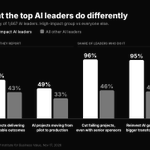
Only 18% of AI leaders fully control their own AI budget.
IBM surveyed 1,667 AI leaders across 33 countries. If your AI leader owns the outcome but can't move the budget or stop a failing project, you've given them accountability without authority.
What that looks like:
→ Only 29% say their company adjusts quickly when AI results show what to fix
→ 48% say AI agents already act across workflows, but 75% say governance and compliance slow that action down
→ Fewer than a third say AI is changing what their company sells or how it prices
What the top group does differently:
→ 63% of their AI projects deliver measurable business outcomes, versus 43% for the rest
→ They scale a winning project in 8 months. Everyone else takes 13.5
→ 96% cut failing projects even when a senior leader backs them. For the rest it's 46%
The best teams aren't running smarter models. They're running a faster decision loop.
Who owns your AI result? Who owns your AI budget? If it's two different people, that's your bottleneck.
Who in your company can actually stop a failing AI project?

23
Okay this one’s interesting.
OpenAI has released GPT-6.2 Astra and Sol, and the number that matters is the price.
Astra is built for the hardest projects. It beats the last Astra at less than a third of the cost per task.
Sol is the everyday model, so you get more done on the same plan.
Slides, spreadsheets, code. That’s where both are aimed.
Live today in ChatGPT Work, Codex and the API.
The race used to be about who’s smartest. Now it’s about who’s smartest per dollar.
Some of you have been asking very politely. Some of you have just been asking.
GPT-6.2 Astra and Sol are now available.
Super efficient and built to perform where it counts—the real world.
openai.com/index/introducing…
19
PwC is training 85,000+ people on a skill that isn't prompting.
Last week, PwC US announced a Critical Thinking and Judgment certificate for its partners and employees. The reason: AI is taking over the foundational tasks that used to build judgment.
For years, you learned to think by doing the boring work. Researching. Building the analysis. Getting it wrong and fixing it. Now AI does that first pass in seconds, and fewer people get those reps.
What PwC is doing:
→ Rollout starts December 2026 across the US, Mexico and its Acceleration Centers. Completion is targeted by June 2027.
→ It opens with a diagnostic that shows each person their thinking style, strengths and gaps.
→ Then PwC's own framework: set the context, challenge the information and assumptions, make the call, communicate it with accountability.
→ Masterclass videos and personalized simulations built around each person's real work.
→ In early 2027, the framework opens to any university, with funding for selected ones.
Here's the part people skip. A prompt gets you an answer. It doesn't tell you if the answer is right. And AI sounds just as confident when it's wrong.
My bet: prompting gets easier every month. Knowing when the answer is wrong is the skill that's getting rare.
You don't need a certificate to start:
→ Write down what you expect the answer to be before you ask.
→ Check one number or claim in every output against the original source.
→ Ask the AI to argue against its own answer.
Prompting decides how fast you get an answer. Judgment decides whether you should use it.

30
Doubling a scientist's output is a strong claim. The test for the rest of us is whether the same lift shows up in real work with real deadlines, not just in a study. That is where most AI pilots quietly stall.
Scientists reported nearly doubling their productivity with AI in our study of more than 1,800 participants in the ChatGPT for Academic Researchers program.
Using privacy-preserving methods, we looked at how they use ChatGPT across their work—from developing ideas to analyzing data and writing code—and what it could mean for scientific discovery.
openai.com/index/science-at-…
22
Bajaj Finance’s AI bots brought in Rs 2,744 crore of loans in one quarter.
That is up 112% in a year.
At its peak, the lender had 5,000 human agents making outbound calls. By May this year, that number was down, and about 30% of the agents that remained were AI voice agents.
From the September quarter:
→ 75% of customer self-service now runs through AI bots, up from 65% a year ago
→ 56 million customer conversations were converted from voice to data
→ Its AI unit grew from 121 people to 328
One thing the numbers do not show: how many of those loans would have come anyway. Every figure is the company’s own.
How I read it:
This is a service function becoming a revenue function.
Most leaders ask how much cost AI will save. The better question is how much revenue it can bring in.
If you lead a business, pick one customer touchpoint you treat as a cost. Support calls are a good place to start. Ask what customers say there that your sales team never hears.
The call centre used to be where money went out. I think Bajaj is showing it can be where money comes in.

Anthropic’s CEO told Jamie Dimon last night what actually worries him about the IPO.
It is not demand. Demand is about 6 times the shares on offer.
It is compute.
“Compute is the deepest business dilemma that the company faces,” Dario Amodei said. “If you buy too much, you can financially overextend yourself. If you buy too little, then you can't support inference for customers.”
The numbers behind that line are stark. Anthropic has $900.9 billion in compute commitments through 2045. About $451.6 billion of that falls before 2030. $70.7 billion is due by 30 September 2027. In one quarter this year, compute was 48 percent of revenue.
His answer is to buy on the low side and top up on the spot market when demand runs hot. He plans around about the 10th percentile of growth. He wants to underpromise and overdeliver.
The contrast is what matters. Revenue is running at $81 billion a year on an annualised basis. Q3 revenue was $16.96 billion, up 47 percent on the previous quarter. The business is growing fast. The bill for running it is growing faster, and it is committed years ahead.
The price is still a range, $70 to $78 a share, with pricing expected on 18 Nov and trading on 19 Nov under ANT. The $1.4 trillion figure is a reported fully diluted target, not a done price. The filed figure is up to $1.02 trillion. Demand at 6 times is a reported snapshot. It can still change.
Every agent rollout has the same dilemma, at a smaller scale. Buy too much capacity and you pay for idle machines. Buy too little and your best customer waits. The teams that win will be the ones that can say, in advance, what they will do when demand beats the plan.
Practical check for your team: Before your next agent rollout, write down your own low side. What do you buy ahead of time? What do you top up only when it works? What happens if demand doubles in a month?
“Buy the compute you need, not the compute you hope for.”

120
AI adoption is a management problem, not a licence problem
Most companies track their AI rollout with two numbers: seats bought and people trained. Both look good on a board slide, but neither tells you whether the work actually changed.
The real gap isn’t between departments. It’s between two people who sit next to each other, with the same title and the same tools. One has built AI into their day. The other tried it once, got a weak answer and moved on.
A new NBER working paper supports this. The task explains about 11% of whether someone uses AI for it. Adding who the person is takes that to 44%.
So if you lead a business, stop asking “which roles should use AI?” Start asking “who on my team is stuck, and where?”
That’s a manager’s job, not IT’s. Sit with the person who stopped. Find the one task that eats up their week. Show them a workflow that works on it, then help them repeat it until it becomes a habit.
The same paper finds that people who started early now use AI on more of their tasks. If that holds, every early win makes the next one easier, and every person left behind falls further back.
Buying access is a purchase. Getting people to use it takes leadership.

1
48

Mahindra's AI agents booked 91,000 test drives in three to four months.
That is not the number I would study.
At its July results briefing, CEO Anish Shah said AI agents booked more than 91,000 test drives. He described them as customers Mahindra would likely not have got otherwise.
The same briefing had a quieter number.
About 2,600 workshop staff now use AI assistants to diagnose service problems. That is 85% adoption.
More than 1,900 employees have been trained at an in-house AI academy.
What we do not know: how many of those test drives became sales.
Here is my read.
→91,000 gets the headline. 85% is the lesson.
→A tool changes a business only when the people doing the work use it every day.
→Mahindra did not stop at buying tools. It trained people to use them.
Before your next AI purchase, ask one thing. Who will use this daily, and have we trained them?
Most AI budgets pay for the tool. I think the return comes from the people who use it.

62